


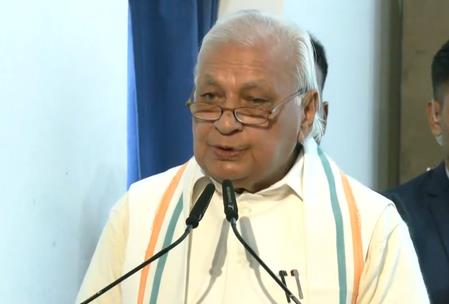
Arif Khan Links Sardar Patel To Shankaracharya's Mission, Urges Reclaiming India's Civilisational Identity


The book has been published by Suruchi Prakashan, and the event was organised by the Kala Nidhi division of the Indira Gandhi National Centre for the Arts (IGNCA). Bihar Governor Arif Mohammed Khan attended as the chief guest, while Ram Madhav joined as the special guest.
Speaking at the event, Bihar Governor Khan said: "We do not need to fit ourselves into frameworks defined by Western nations. Why should we? India is not just a nation-state; we are a cultural nation, a spiritual nation."
He said that the knowledge contained in the book dates back 1,100-1,200 years and noted that UNESCO has officially recognised the Rig Veda as the world's oldest text.
"Had this knowledge not been deeply rooted in the minds of people, Shankaracharya would not have been able to accomplish his work so effortlessly," he added.
Khan said Indian civilisation's unique contribution to the world lies in the divinisation of humanity and the humanisation of the divine.
He questioned whether a nation could be built solely on cultural and spiritual unity, adding that while India has never lagged in the spiritual realm, its political history has been marked by internal conflict.
He recalled how Shankaracharya travelled across the length and breadth of India to build cultural and spiritual unity at a time when the country was politically fragmented.
"It seems to me that his soul did not rest until his unfinished mission was completed. And to complete that task, his soul took birth again as Sardar Patel," Khan said.
Discussing concepts from the book, Khan noted how the meanings of words evolve with time. He stressed that equating 'dharma' with 'religion' was incorrect.
"The Amritkosh lists 18 definitions of dharma, and the one relating to religion is the least significant. At its core, dharma is about fulfilling one's duties and responsibilities."
He cited the line -- 'Swakarma dharma vimukhah Krishnam Krishneti vadinam, te Hare Krishna murkhe' -- explaining that those who abandon their duties and oppose Krishna are both foolish and adversaries of Hari, because Hari incarnates to uphold dharma.
“Dharma is inherently prescriptive. A person must constantly examine what their duty is -- whether it is Sanatan Dharma, Yoga Dharma, Rashtra Dharma, or most importantly, one's own Swadharma,” he said.
Khan also reflected on how the concept of the 'nation-state' is relatively new, noting that earlier the world recognised only empires and tribes. Using the example of pre-Islamic Arabia, he explained that tribes were frequently at war, and when an empire conquered them, collective responsibility overshadowed individual accountability.
India Foundation President Ram Madhav said that 34 years have passed since the demolition of the Babri structure, an event that triggered widespread upheaval but also marked "a turning point".
He said the developments that followed have brought India to a stage where it appears to be moving towards its true potential.
Speaking to IANS, author Abhijit Jogi said the central question that led him to write the book was: "What is India's real identity?"
He said a nation's identity is its most valuable asset, but India's true identity was distorted and replaced with an imposed narrative.
"I wanted to understand the real identity of India, and in the process, I discovered many aspects unknown to the common people. I felt it was necessary to bring these truths to the public, and that is why I wrote this book," he said.

Legal Disclaimer:
MENAFN provides the
information “as is” without warranty of any kind. We do not accept
any responsibility or liability for the accuracy, content, images,
videos, licenses, completeness, legality, or reliability of the information
contained in this article. If you have any complaints or copyright
issues related to this article, kindly contact the provider above.


Comments
No comment