




403
Sorry!!
Error! We're sorry, but the page you were looking for doesn't exist.
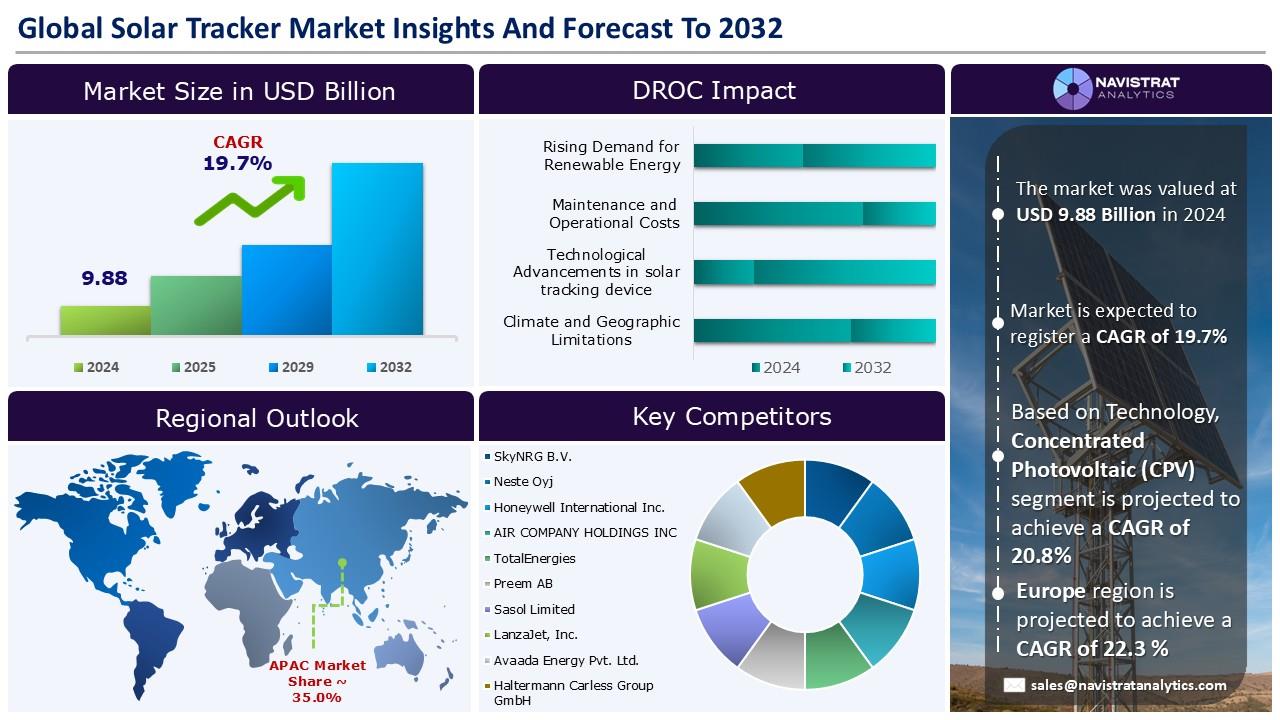
Solar Tracker Market Size to Reach USD 41.82 billion in 2032
(MENAFN- Navistrat Analytics) November 25, 2025- Growing demand for renewable energy continues to be a major catalyst for revenue expansion in the solar tracker market. The International Energy Agency (IEA) reports that solar PV generation surged by a record 320 TWh in 2023—an increase of 25%—bringing total output to more than 1,600 TWh. This marks the largest absolute increase in generation among all renewable technologies that year. The pace of growth is also in line with the trajectory required from 2023 to 2030 under the Net Zero Emissions by 2050 (NZE) Scenario.
Manufacturing capacity across the solar PV supply chain expanded rapidly in 2023. Global cell production capability nearly doubled, polysilicon output rose by almost 90%, module manufacturing increased by roughly 75%, and wafer production grew by 60%. By year-end, the segment with the lowest capacity—polysilicon—had still reached 850 GW. China dominated this expansion, accounting for more than 95% of newly added facilities.
In August 2024, Arctech—a leading provider of solar tracking, racking, and BIPV solutions—introduced its newest innovation, SkyLight. This 1P linked dual-row tracking system features a single-point drive design optimized for regions with low wind speeds, with a particular focus on the Latin American market.
Despite their performance benefits, solar tracking systems also come with challenges. They are mechanically more complex than fixed-tilt systems, requiring additional components and ongoing maintenance. This complexity can affect long-term reliability and increase the likelihood of mechanical or operational issues. Dual-axis trackers also tend to occupy more space due to their broader movement range, which must be considered during site planning. Furthermore, harsh environmental conditions—such as high winds, hail, and extreme temperatures—can damage tracking components and degrade system performance.
Segments market overview and growth Insights
Based on type, the solar tracker market is segmented into single-axis trackers and dual-axis trackers. Dual-axis trackers segment contributed the highest growth rate in 2024. A dual-axis solar tracking system is an advanced mechanical structure designed to continuously adjust the position of solar panels so they follow the sun’s path throughout the day and across seasons. These systems can rotate on both horizontal and vertical axes, enabling panels to maintain an optimal angle to the sun at all times. Dual-axis trackers are well-suited for commercial rooftop installations and large utility-scale solar projects. However, because they contain numerous moving components, they can substantially increase maintenance requirements and operational costs for off-grid, hybrid, and grid-connected solar setups.
Regional market overview and growth insights
North America held the largest market share in 2024. Market growth is largely fueled by increasing renewable energy demand and strong government incentives and policy support. According to the Global Energy Monitor (GEM), China continues to strengthen its leadership in global renewable energy development, with 180 GW of utility-scale solar and 159 GW of wind projects currently under construction. Together, the 339 GW of solar and wind capacity now being built accounts for one-third of all proposed projects in the country—far surpassing the global construction rate of just 7%.
Competitive Landscape and Key Competitors
The Solar Tracker market is characterized by a fragmented structure, with many competitors holding a significant share of the market. List of major players included in the Solar Tracker market report are:
o Nextracker Inc.
o RatedPower
o Soltec Power Holdings S.A.
o IDEEMATEC Deutschland GmbH
o Scorpius Trackers Group
o Arctech
o HCT Sun
o FTC Solar
o Solargik Ltd.
o Optimum Tracker
o Nevados Engineering
o GameChange Solar
o Trina Solar Co., Ltd.
o Asun Solar Power Private Limited
o Targray Technology International Inc.
Major strategic developments by leading competitors
Nextracker: In September 2025, Nextracker, one of the leading companies in solar technology entered the solar panel frame segment by acquiring Origami Solar, Inc., a pioneer in roll-formed steel frame innovation. The acquisition, completed as an all-cash transaction worth approximately USD 53 million including potential earnout provisions, positions Nextracker to expand its product portfolio.
CWP Global: In March 2024, CWP Global, a key developer of large renewable energy and green hydrogen mega-projects, signed an agreement with IDEEMATEC to explore incorporating IDEEMATEC’s advanced L:TEC Solar Tracker technology into CWP Global’s AMAN project. This project located in north-west Mauritania is a landmark 30 GW renewable energy and green hydrogen initiative.
Navistrat Analytics has segmented the Solar Tracker market based on type, technology, installation type, application, and region:
• Type Outlook (Revenue, USD Billion; 2022-2032)
o Single-Axis Trackers
o Dual-Axis Trackers
• Technology Outlook (Revenue, USD Billion; 2022-2032)
o Photovoltaic (PV)
o Concentrated Photovoltaic (CPV)
o Concentrated Solar Power (CSP)
• Installation Type Outlook (Revenue, USD Billion; 2022-2032)
o Ground-Mounted
o Roof-Mounted
• Application Outlook (Revenue, USD Billion; 2022-2032)
o Utility-Scale
o Commercial & Industrial
o Residential
• Regional Outlook (Revenue, USD Billion; 2022-2032)
o North America
a. U.S.
b. Canada
c. Mexico
o Europe
a. Germany
b. France
c. U.K.
d. Italy
e. Spain
f. Benelux
g. Nordic Countries
h. Rest of Europe
o Asia Pacific
a. China
b. India
c. Japan
d. South Korea
e. Oceania
f. ASEAN Countries
g. Rest of APAC
o Latin America
a. Brazil
b. Rest of LATAM
o Middle East & Africa
a. GCC Countries
b. South Africa
c. Israel
d. Turkey
e. Rest of MEA
Manufacturing capacity across the solar PV supply chain expanded rapidly in 2023. Global cell production capability nearly doubled, polysilicon output rose by almost 90%, module manufacturing increased by roughly 75%, and wafer production grew by 60%. By year-end, the segment with the lowest capacity—polysilicon—had still reached 850 GW. China dominated this expansion, accounting for more than 95% of newly added facilities.
In August 2024, Arctech—a leading provider of solar tracking, racking, and BIPV solutions—introduced its newest innovation, SkyLight. This 1P linked dual-row tracking system features a single-point drive design optimized for regions with low wind speeds, with a particular focus on the Latin American market.
Despite their performance benefits, solar tracking systems also come with challenges. They are mechanically more complex than fixed-tilt systems, requiring additional components and ongoing maintenance. This complexity can affect long-term reliability and increase the likelihood of mechanical or operational issues. Dual-axis trackers also tend to occupy more space due to their broader movement range, which must be considered during site planning. Furthermore, harsh environmental conditions—such as high winds, hail, and extreme temperatures—can damage tracking components and degrade system performance.
Segments market overview and growth Insights
Based on type, the solar tracker market is segmented into single-axis trackers and dual-axis trackers. Dual-axis trackers segment contributed the highest growth rate in 2024. A dual-axis solar tracking system is an advanced mechanical structure designed to continuously adjust the position of solar panels so they follow the sun’s path throughout the day and across seasons. These systems can rotate on both horizontal and vertical axes, enabling panels to maintain an optimal angle to the sun at all times. Dual-axis trackers are well-suited for commercial rooftop installations and large utility-scale solar projects. However, because they contain numerous moving components, they can substantially increase maintenance requirements and operational costs for off-grid, hybrid, and grid-connected solar setups.
Regional market overview and growth insights
North America held the largest market share in 2024. Market growth is largely fueled by increasing renewable energy demand and strong government incentives and policy support. According to the Global Energy Monitor (GEM), China continues to strengthen its leadership in global renewable energy development, with 180 GW of utility-scale solar and 159 GW of wind projects currently under construction. Together, the 339 GW of solar and wind capacity now being built accounts for one-third of all proposed projects in the country—far surpassing the global construction rate of just 7%.
Competitive Landscape and Key Competitors
The Solar Tracker market is characterized by a fragmented structure, with many competitors holding a significant share of the market. List of major players included in the Solar Tracker market report are:
o Nextracker Inc.
o RatedPower
o Soltec Power Holdings S.A.
o IDEEMATEC Deutschland GmbH
o Scorpius Trackers Group
o Arctech
o HCT Sun
o FTC Solar
o Solargik Ltd.
o Optimum Tracker
o Nevados Engineering
o GameChange Solar
o Trina Solar Co., Ltd.
o Asun Solar Power Private Limited
o Targray Technology International Inc.
Major strategic developments by leading competitors
Nextracker: In September 2025, Nextracker, one of the leading companies in solar technology entered the solar panel frame segment by acquiring Origami Solar, Inc., a pioneer in roll-formed steel frame innovation. The acquisition, completed as an all-cash transaction worth approximately USD 53 million including potential earnout provisions, positions Nextracker to expand its product portfolio.
CWP Global: In March 2024, CWP Global, a key developer of large renewable energy and green hydrogen mega-projects, signed an agreement with IDEEMATEC to explore incorporating IDEEMATEC’s advanced L:TEC Solar Tracker technology into CWP Global’s AMAN project. This project located in north-west Mauritania is a landmark 30 GW renewable energy and green hydrogen initiative.
Navistrat Analytics has segmented the Solar Tracker market based on type, technology, installation type, application, and region:
• Type Outlook (Revenue, USD Billion; 2022-2032)
o Single-Axis Trackers
o Dual-Axis Trackers
• Technology Outlook (Revenue, USD Billion; 2022-2032)
o Photovoltaic (PV)
o Concentrated Photovoltaic (CPV)
o Concentrated Solar Power (CSP)
• Installation Type Outlook (Revenue, USD Billion; 2022-2032)
o Ground-Mounted
o Roof-Mounted
• Application Outlook (Revenue, USD Billion; 2022-2032)
o Utility-Scale
o Commercial & Industrial
o Residential
• Regional Outlook (Revenue, USD Billion; 2022-2032)
o North America
a. U.S.
b. Canada
c. Mexico
o Europe
a. Germany
b. France
c. U.K.
d. Italy
e. Spain
f. Benelux
g. Nordic Countries
h. Rest of Europe
o Asia Pacific
a. China
b. India
c. Japan
d. South Korea
e. Oceania
f. ASEAN Countries
g. Rest of APAC
o Latin America
a. Brazil
b. Rest of LATAM
o Middle East & Africa
a. GCC Countries
b. South Africa
c. Israel
d. Turkey
e. Rest of MEA
Navistrat Analytics
Legal Disclaimer:
MENAFN provides the
information “as is” without warranty of any kind. We do not accept
any responsibility or liability for the accuracy, content, images,
videos, licenses, completeness, legality, or reliability of the information
contained in this article. If you have any complaints or copyright
issues related to this article, kindly contact the provider above.
Most popular stories
Market Research

More Story








Comments
No comment