







403
Sorry!!
Error! We're sorry, but the page you were looking for doesn't exist.
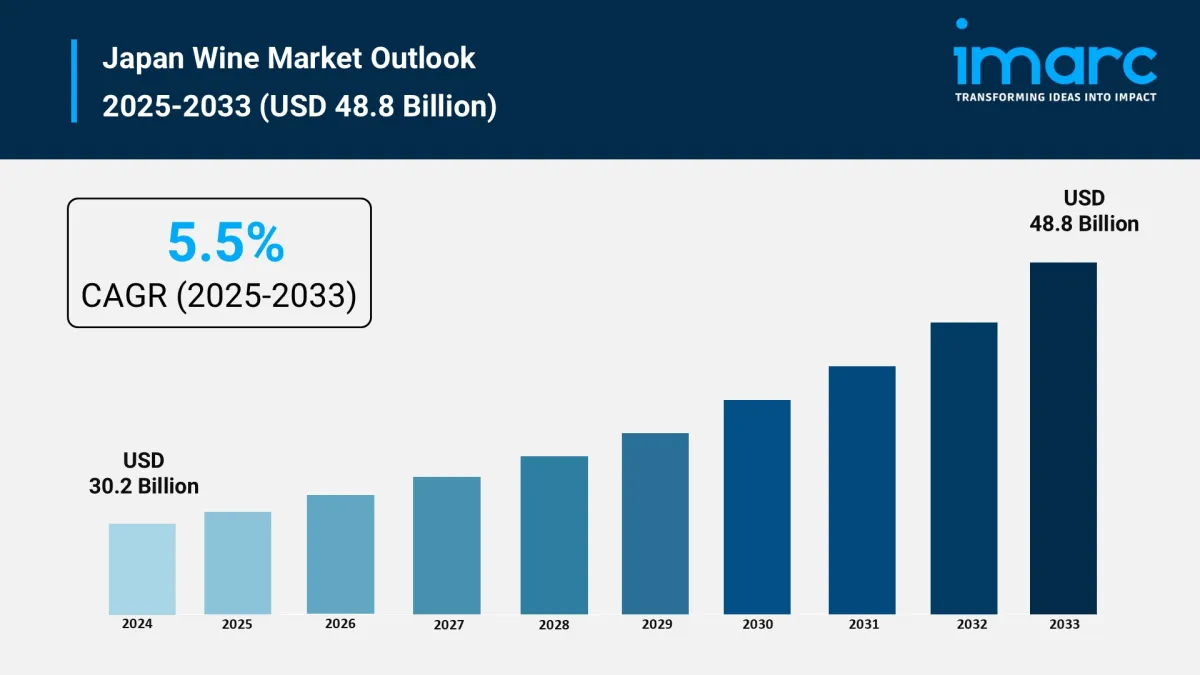
Japan Wine Market Size Is Expected To Reach USD 48.8 Billion By 2033 CAGR: 5.5%
(MENAFN- IMARC Group)
The Japan wine market size reached USD 30.2 billion in 2024. Looking forward, IMARC Group expects the market to reach USD 48.8 billion by 2033, exhibiting a growth rate (CAGR) of 5.5% during 2025-2033. Rising consumer preference for premium and imported wines, driven by evolving lifestyles and increasing wine culture adoption across Japan.
Key Highlights
-
Market size (2024): USD 30.2 Billion
Forecast (2033): USD 48.8 Billion
CAGR (2025–2033): 5.5%
The high-end quality and growing demand for organic, low-alcohol beverages are natural results of clients focusing on quality, health, and environmental friendliness, as well as the desire to feel elite when drinking.
Smaller but developing e-commerce out of Tokyo and zoning attendance upgrades in smaller, affluent-located(neighborhood) supermarkets, inviting respect to adhere to strong assistance, taking up a vast portion of metropolitan Japan.
Red wine is the leader in the market; this is attributed to the health benefits perception, cultural adoption, and coupling with Japanese food.
How Is AI Transforming the Wine Market in Japan?
-
Optimization of Vineyard Management: AI-powered sensors in Yamanashi vineyards assess risks of diseases in advanced stages and develop control measures to minimize the application of pesticides and have higher grape quality due to accurate environmental monitoring.
Empowering Smart Agriculture: MAFF's 8.4 billion smart-farming fund is helping AI initiatives that improve soil evaluation in vineyards, irrigation management, and sustainable organic wine production across the country.
Transformation of Field Operations: AI-enhanced drones can survey and spray vineyards with over 15,000 agricultural drones, reducing workforce requirements by over 50 percent and increasing incidences of uniform grape quality.
Improving Crop Intelligence: e-Kakashi and similar AI-based platforms offer actual, real-time data on weather, moisture, and soil conditions to maximize the harvest during times of optimal wine production.
Transforming the soil health analysis: Less expensive and less wasteful approaches, using satellite imagery and AI, assess vineyard soil carbon and nitrogen at startups like Sagri.
Grab a sample PDF of this report: https://www.imarcgroup.com/japan-wine-market/requestsample
Japan Wine Market Trends and Drivers
-
Premiumization of Wine: Raising preference for high-quality, artisanal, and imported wines, especially among consumers who do not value unique and sophisticated drinking experiences.
Sparkling and RosPlan's Neck: The younger demographics are increasing consumption of sparkling and RosPlan's products via social media and new fashionable lifestyles.
E-commerce: Online stores and subscription models that can bring implications of convenience, better choices, and home delivery to the urban consumer.
Sustainable Wine Choices: There was an increasing trend of organic, environmentally friendly/ environmentally sustainable, and ethically made wines, which are becoming aligned with the environmentally friendly and health-conscious trends.
Western Dining Influence: Western-style restaurant/pairing culture is expanding, which is also leading to increased consumption of wine in restaurants and high-end establishments.
Japan Wine Industry Segmentation:
The report has segmented the market into the following categories:
Breakup by Product Type:
-
Still Wine
Sparkling Wine
Fortified wine and Vermouth
Breakup by Color:
-
Red Wine
Rose Wine
White Wine
Breakup by Distribution Channel:
-
Off-Trade
On-Trade
Breakup by Region:
-
Kanto Region
Kinki Region
Central/ Chubu Region
Kyushu-Okinawa Region
Tohoku Region
Chugoku Region
Hokkaido Region
Shikoku Region
Competitive Landscape:
The competitive landscape of the industry has also been examined along with the profiles of the key players.
Recent News and Developments in Japan Wine Market
-
May 2025: Japan has an almost 500-strong winemaking fraternity, as illness-unaffected hybrid grapes and enhanced growing methods spread to areas such as Yamanashi, Nagano, and Hokkaido, despite climatic and land limitations.
June 2025: Vineyards move to precision viticulture, in which vineyards incorporate AI, drones, predictive analytics, and weather-based disease forecasting, to increase grape quality, minimise waste, and better time harvest to maximise high-quality grapes.
July 2025: The natural wine movement is in full swing as more than 350 wines include local grapes, including Koshu and Muscat Bailey A, produced using minimal intervention, and offering light and umami-filled palates to excite international connoisseurs.
Ask analyst of customized report: https://www.imarcgroup.com/request?type=report&id=8908&flag=E
Note: If you require specific details, data, or insights that are not currently included in the scope of this report, we are happy to accommodate your request. As part of our customization service, we will gather and provide the additional information you need, tailored to your specific requirements. Please let us know your exact needs, and we will ensure the report is updated accordingly to meet your expectations.
About Us:
IMARC Group is a global management consulting firm that helps the world's most ambitious changemakers to create a lasting impact. The company provides a comprehensive suite of market entry and expansion services. IMARC offerings include thorough market assessment, feasibility studies, company incorporation assistance, factory setup support, regulatory approvals and licensing navigation, branding, marketing and sales strategies, competitive landscape and benchmarking analyses, pricing and cost research, and procurement research.
Contact Us:
Street: 563-13 Kamien
Area: Iwata
Country: Tokyo, Japan
Postal Code: 4380111
Email: sales[@]imarcgroup.com

Legal Disclaimer:
MENAFN provides the
information “as is” without warranty of any kind. We do not accept
any responsibility or liability for the accuracy, content, images,
videos, licenses, completeness, legality, or reliability of the information
contained in this article. If you have any complaints or copyright
issues related to this article, kindly contact the provider above.
Most popular stories
Market Research









Comments
No comment