



403
Sorry!!
Error! We're sorry, but the page you were looking for doesn't exist.
India Automotive Components Market 2025: Size, Share, Growth Analysis, Top Manufacturers And Forecast Report 2033
(MENAFN- IMARC Group)
Market Overview
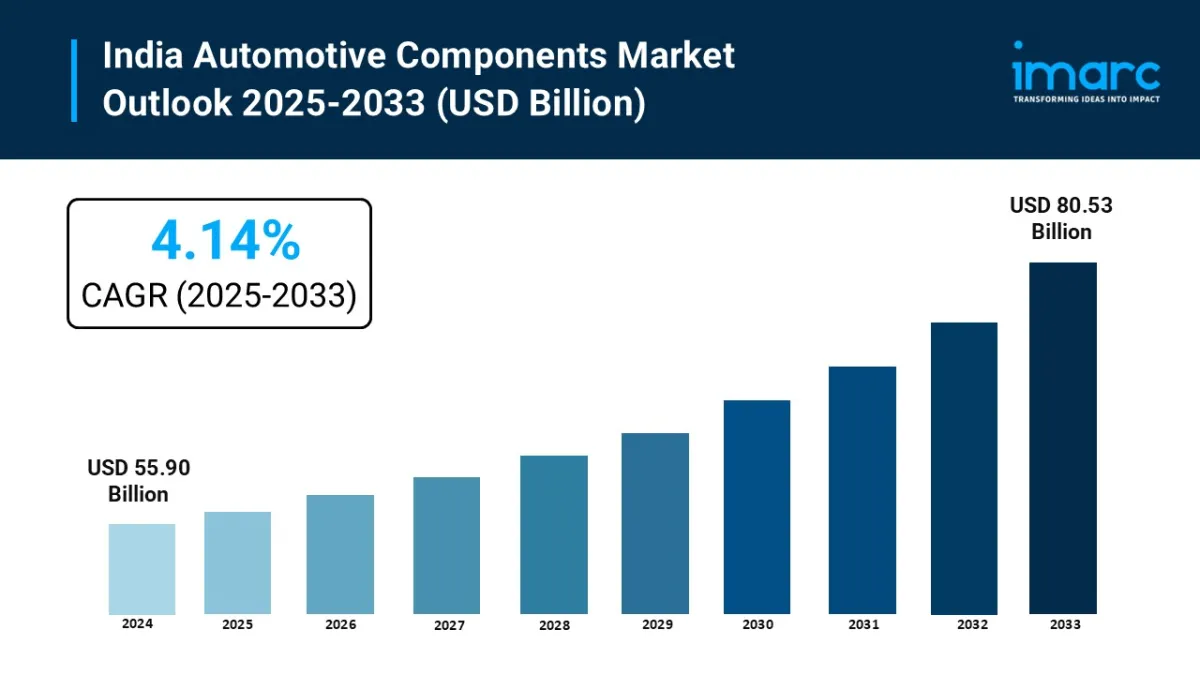
In 2024, the India automotive components market was valued at approximately USD 55.90 billion , and it is forecasted to reach USD 80.53 billion by 2033 , with a CAGR of 4.14% during 2025–2033. Key growth drivers include rapid electrification boosting demand for EV-specific components, government initiatives like the PLI schemes supporting local manufacturing, a shift toward lightweight and high-performance components, and increasing vehicle production and exports.
Key Highlights-
Market Size (2024): USD 55.90 billion
Forecast (2033): USD 80.53 billion
CAGR (2025–2033): 4.14%
Major Growth Contributors:
-
Surge in EV components-battery packs, power electronics, lightweight materials
Government support via schemes like PLI, FAME-II, Automotive Mission Plan
Export expansion benefiting from India's competitive supply base
Get instant access to a free sample copy and explore in-depth analysis: https://www.imarcgroup.com/india-automotive-components-market/requestsample
How Is AI Transforming the Automotive Components Market in India?-
Predictive Production Analytics: AI models optimize component production planning based on demand forecasts and supply chain visibility.
Automated Quality Inspection: Computer vision systems detect micro-defects in parts-such as surface flaws or dimensional inconsistencies-improving quality control.
Smart Manufacturing Integration: AI-powered robotics and IoT-enabled machinery enhance precision in machining, assembly, and testing.
Design Personalization & Simulation: AI-driven simulation tools aid in lightweight part design, performance testing, and customized component configurations.
-
National Initiatives: Production Linked Incentive schemes targeting EV and component manufacturing, along with Automotive Mission Plan goals.
Technology-Led Projects: Focus on lightweight materials, battery systems, ADAS components, and connected vehicle technologies.
Sector-Specific Demand: Rising demand from EVs, commercial vehicles, logistics, and aftermarket segments.
Sustainability & Cost Efficiency: Adoption of lightweight materials and eco-friendly processes supporting emission goals and fuel efficiency.
Retrofit / Modernization: Modernization through local magnet production, infrastructure scaling, and capacity expansion initiatives.
Regional Incentives: Increased manufacturing activity driven by state-level EV policies and infrastructure (e.g., Uttar Pradesh).
Vehicle Type Insights:
-
Passenger Cars
Two-Wheelers
Three-Wheelers
Light Commercial Vehicles
Medium and Heavy Commercial Vehicles
Off the Road Vehicles
Component Insights:
-
Engine Parts
Body and Chassis
Suspension and Brakes
Drive Transmission and Steering Parts
Electrical Parts and Equipments
Demand Category Insights:
-
OEM
Replacement
-
Chennai Automotive Corridor (Tamil Nadu): Anchors 35% of India's auto component production, covering commercial vehicles, passenger cars, and parts.
Uttar Pradesh: Benefiting from EV Manufacturing & Mobility Policy 2022, attracting component makers and EV part investments.
Other Hubs: Maharashtra, Gujarat, Karnataka-each supported by strong industrial clusters, infrastructure, and policy incentives.
Discuss Your Needs with Our Analyst – Inquire or Customize Now: https://www.imarcgroup.com/request?type=report&id=32577&flag=C
Latest Developments in the Industry-
Incentivizing Local Magnet Manufacturing: Mahindra & Mahindra, Uno Minda, and Sona Comstar are exploring domestic production of rare earth magnets to reduce import reliance and strengthen EV supply chains.
Denso's ₹250 Cr EV Component Facility in UP: Japanese firm Denso is investing in a motor generator plant in Gautam Budh Nagar, enhancing regional capabilities in hybrid/EV components.
India–UK FTA Boost for Auto Components: The Free Trade Agreement reduces tariffs on auto part exports (from over 100% down to 10%)-a significant advantage for Tamil Nadu and Indian component exporters.

Legal Disclaimer:
MENAFN provides the
information “as is” without warranty of any kind. We do not accept
any responsibility or liability for the accuracy, content, images,
videos, licenses, completeness, legality, or reliability of the information
contained in this article. If you have any complaints or copyright
issues related to this article, kindly contact the provider above.
Most popular stories
Market Research

More Story







Comments
No comment