


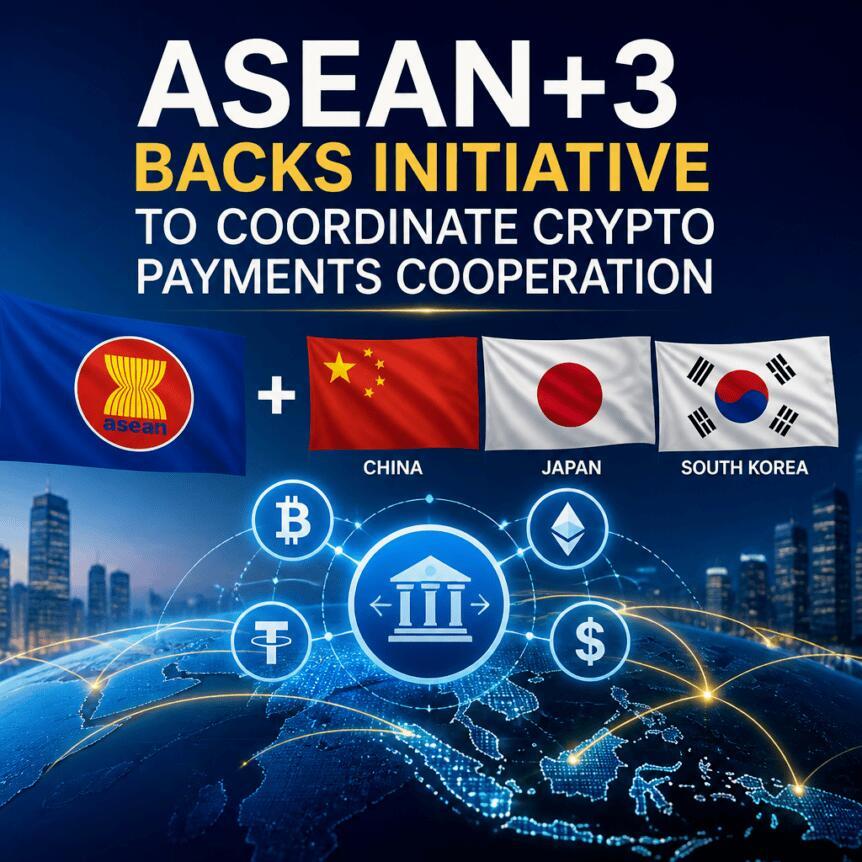
ASEAN+3 Backs Initiative To Coordinate Crypto Payments Cooperation


Japan's Ministry of Finance said the ASEAN+3 Macroeconomic Research Office (AMRO) will oversee the program. The decision was reached at the ASEAN+3 Finance and Central Bank Deputies' Meeting in Kyoto, which wrapped up on Thursday.
Key takeaways- A new ASEAN+3 working group will target interoperability between domestic digital payment networks and greater regulatory alignment. AMRO will supervise the initiative, giving the program a formal coordinating role. Fragmented rules remain a barrier, with member states still regulating digital assets through separate approval pathways. Binance co-founder CZ Zhao supports“license passporting” -a concept aimed at reducing the need for repeated licensing applications across jurisdictions.
The newly agreed working group reflects a broader trend in Asia: authorities increasingly view cross-border digital payments as a foundation for economic connectivity. According to Japan's Ministry of Finance, the group will prioritize enhancing connectivity between domestic digital payment networks and bringing regulatory approaches into closer alignment.
This matters for users and operators because payments infrastructure is often the first layer that determines how quickly new services can scale. When networks and regulatory standards differ across borders, firms typically have to build separate compliance and operational arrangements for each market-slowing adoption and raising costs.
AMRO's role and what changes for market participantsThe Ministry of Finance also named AMRO as the program overseer. While the announcement does not spell out implementation details, assigning a dedicated regional research and coordination body suggests an effort to translate high-level cooperation into working deliverables-such as mapping regulatory differences, assessing technical connectivity barriers, and proposing practical steps toward convergence.
For investors and businesses, the key question is how quickly“alignment” becomes operational. Greater interoperability in payment rails can reduce friction for downstream services, but regulatory harmonization tends to progress unevenly. Companies will likely watch for whether the working group produces guidance that moves beyond analysis toward standardized procedures.
Why crypto licensing remains fragmented across ASEANEven as cooperation expands, the region's regulatory landscape for digital assets remains separate by country. As the article notes, member states still manage digital assets through distinct rules and approval processes. That structure creates multiple licensing tracks for firms seeking a regional presence, which in turn can discourage competition or delay market entry.
The practical implication is that“connectivity” initiatives-while important-may not automatically resolve licensing friction for crypto and stablecoin services. Payments interoperability can help liquidity and settlement, but compliance frameworks determine which services can legally operate and under what conditions.
CZ Zhao backs license portability at ASEAN Tech Summit ManilaAlongside the official regional cooperation, Binance co-founder Changpeng“CZ” Zhao has publicly endorsed a model intended to reduce jurisdiction-by-jurisdiction licensing. Cointelegraph reported on Friday that Zhao supports crypto license“passporting” across ASEAN, arguing that firms regulated in one market should be able to enter others through a simplified approval process rather than starting from scratch.
Cointelegraph further reported that Zhao spoke at a fireside chat during the ASEAN Tech Summit Manila 2026. There, he backed an idea raised by FinTech Alliance PH founding chair Lito Villanueva-regulatory passporting or license portability-positioning it as a way to address the compliance burden created by fragmented frameworks.
A regional licensing framework could, in theory, reduce compliance costs and make it easier for crypto and stablecoin providers to operate across ASEAN's different regulatory environments. It could also affect competitive dynamics: smaller firms may find it easier to expand, while established players might benefit from clearer multi-country pathways.
Still, it's important to recognize the asymmetry between aspiration and execution. Passporting or portability typically requires regulators to trust one another's oversight quality and to define what exactly can be“ported” (and what still requires local authorization). The working group on payments and regulatory alignment may contribute momentum, but it won't automatically eliminate licensing hurdles without concrete regulatory commitments.
What to watch next for policy and market impactThe next signal readers should look for is whether the ASEAN+3 working group moves toward specific, measurable outcomes-especially proposals that connect payment-network cooperation with regulatory procedures affecting digital-asset services. For crypto participants, the most consequential development would be any framework that clarifies how (or whether) licensing portability could work in practice across ASEAN and partner jurisdictions.
Risk & affiliate notice: Crypto assets are volatile and capital is at risk. This article may contain affiliate links.
Legal Disclaimer:
MENAFN provides the
information “as is” without warranty of any kind. We do not accept any
responsibility or liability for the accuracy, content, images, videos,
licenses, completeness, legality, or reliability of the information
contained in this article. If you have any complaints or copyright issues
related to this article, kindly contact the provider above.


Comments
No comment