


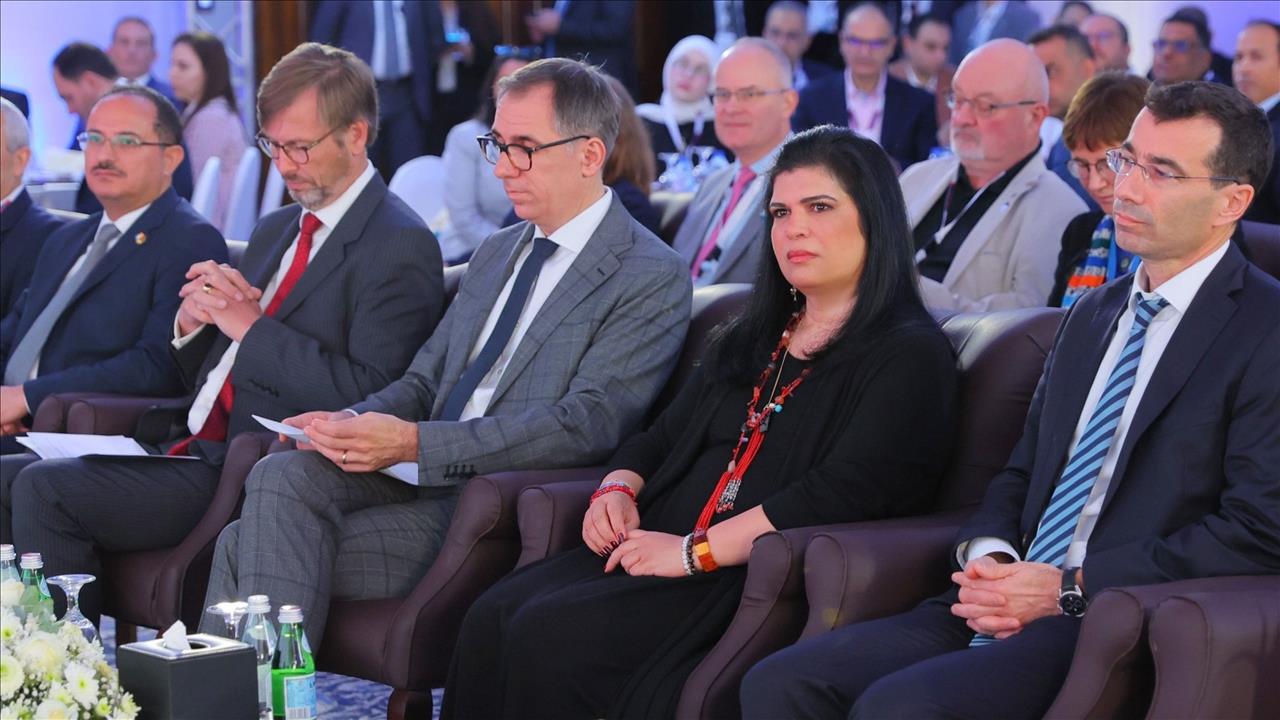
Her Royal Highness Princess Sumaya Inaugurates Regional Conference For DAAD Alumni In The Arab Countries.


Dead Sea, November 28 (Petra) – Her Royal Highness Princess Sumaya bint El Hassan, President of the Royal Scientific Society (RSS), inaugurated the Regional Conference of the German Academic Exchange Service (DAAD) Alumni in Arab Countries.
Held at the Dead Sea from 23 to 25 November, the event promoted the important theme of 'Towards a Shared Water Future in the Arab World: Multidisciplinary Perspectives from Science, Policy and Society'.
At the event, more than 100 DAAD alumni from Jordan, Palestine, Iraq, Egypt, Tunisia, Algeria, Morocco and Germany met to examine the key water challenges facing the Arab region.
Over the course of three days, their discussions explored sustainable solutions through scientific research, multidisciplinary cooperation and stronger regional and international partnerships.
In her opening address, Princess Sumaya stressed that addressing water scarcity requires a shared regional vision that transcends geographical, institutional and disciplinary boundaries.
She emphasised the need to bring together the natural, social and human sciences, and to ensure that research is closely linked to public policy and the future needs of frontline communities.
A persistent theme in the opening remarks of Her Royal Highness was the importance of science diplomacy in strengthening international partnerships and moving beyond technology transfer towards the joint production of knowledge, innovation and new industries.
She stressed that investment in future industries must be matched by investment in science, research and innovation.
Princess Sumaya highlighted the Royal Scientific Society's role in building scientific capacity, developing research and testing facilities, establishing standards, and supporting innovation across the water, energy, environment and industrial sectors.
She recalled the important role that the Society played in hosting the World Science Forum in 2017, also at the Dead Sea, under the theme 'Science for Peace', as well as the recent inaugural Middle East, North Africa and Germany Forum for Science and Technology Horizons (MENAGFOST), organised with the Alexander von Humboldt Foundation to promote international scientific cooperation.
Confronting directly Jordan's national water security, she described the National Water Carrier project as a major investment in the Kingdom's resilience.
The project, which once operational will involve desalinating seawater in Aqaba and transporting it over 400 kilometres to Amman and other parts of the country, is expected to meet around 40 per cent of Jordan's drinking water needs.
More broadly, Her Royal Highness commended the Jordanian-German partnership in education and scientific research, noting that 1,456 Jordanians received DAAD funding in 2025, placing Jordan sixth globally in terms of the number of scholarship recipients.
She drew particular attention to the newly established Jordanian-German Research Chair for Future Water Systems, hosted by the Royal Scientific Society with DAAD support and led by Professor Ahmad Telfah.
This exciting bilateral initiative connects international expertise with national priorities, supporting research into water quality, treatment and reuse, strengthening national research capabilities, and preparing a new generation of scientists.
On the challenges of water diplomacy, Princess Sumaya described it as an important means of addressing tensions over shared water resources, preventing conflict and promoting stability and peace.
She noted that diplomacy creates the space for dialogue, while cooperation gives it practical meaning, with both founded on trust, openness and mutual understanding.
Hebatallah Fathy, director of the DAAD Regional Office in Amman, welcomed Her Royal Highness Princess Sumaya bint El Hassan and praised her role in advancing scientific cooperation and science diplomacy.
Fathy underscored the significance of Her Royal Highness's patronage and participation, saying the turnout reflected the importance of the topic and the strength of scientific and academic partnerships.
DAAD Secretary General Kai Sicks said water scarcity was a shared regional challenge that called for scientific research and cooperation across borders and disciplines.
He highlighted the role of DAAD alumni in building partnerships and said he hoped the conference would strengthen those ties, lead to joint projects and produce recommendations for tackling water challenges.
The German Ambassador to Jordan Bertram von Moltke emphasized how climate change, drought, shifting rainfall patterns, and rising demand for water were interconnected challenges affecting water security, food security and development, reiterating the important underpinning role of scientific research and international cooperation in developing practical solutions and informing decisions.
European Union Ambassador to Jordan Pierre-Christophe Chatzisavas reinforced the view that scientific research should guide the design and implementation of water projects.
He cited the Aqaba–Amman Water Desalination and Conveyance Project, also known as the National Water Carrier Project, as a strategic investment for Jordan that receives co-financing from the EU and institutions in its member states.
Participants shared research findings and practical experience over four headline themes: water-sharing agreements and adaptive cooperation; sustainable water technologies and the circular economy; integrated water and food systems and rural development; and environmental resilience and public health.
Sessions also featured experts from the Ministry of Water and Irrigation, the Water Authority of Jordan, the Jordan Valley Authority and the Royal Scientific Society, strengthening links between scientific research, policymaking and practical implementation and providing an opportunity to exchange perspectives on national and regional water-sector priorities.
At the conclusion of the conference, participants discussed proposals to sustain cooperation among alumni, including the establishment of specialised DAAD alumni networks focusing on water to support knowledge exchange and joint research projects.
The three-day conference was organised in coordination with DAAD's regional offices in Amman, Cairo and Tunis, in cooperation with the organisation's headquarters, as part of broader efforts to strengthen regional academic networks and international cooperation and harness scientific research to address shared challenges across the Arab region.
//Petra// AK
Legal Disclaimer:
MENAFN provides the
information “as is” without warranty of any kind. We do not accept any
responsibility or liability for the accuracy, content, images, videos,
licenses, completeness, legality, or reliability of the information
contained in this article. If you have any complaints or copyright issues
related to this article, kindly contact the provider above.


Comments
No comment