


INDIA Bloc Leaders Oppose Centre's New Delimitation Legislation Plan


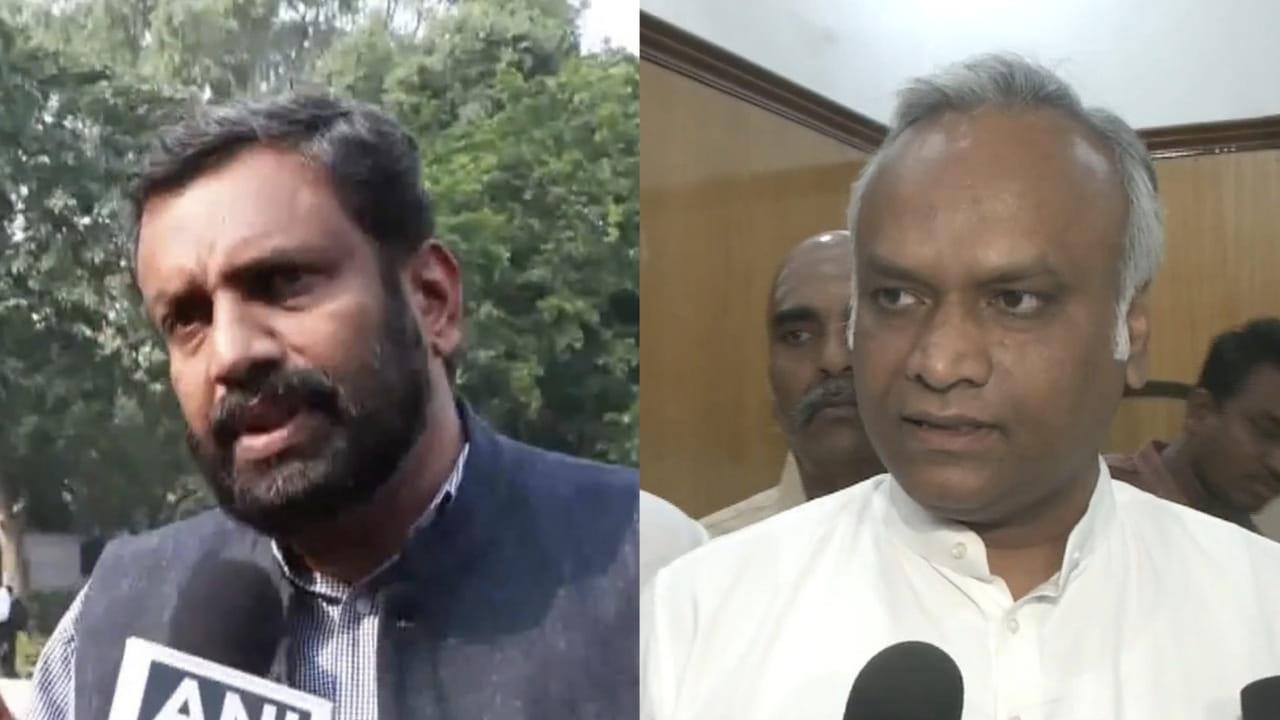
Kalaburagi (Karnataka) [India], November 28 (ANI): Mounting a coordinated counter-offensive ahead of Parliament's session beginning Monday, November 30, Opposition leaders across the INDIA bloc, including Congress president Mallikarjun Kharge, Karnataka Minister Priyank Kharge, and CPI MP P Sandosh Kumar, on Saturday tore into the Centre's proposed Delimitation and Women's Reservation legislative package, branding it a“grave threat to democracy” designed to consolidate permanent political power while shortchanging Scheduled Castes (SC) and Scheduled Tribes (ST).
In Kalaburagi, Karnataka Minister Priyank Kharge accused the Centre of seeking unchecked control over constituency boundary redrawing and questioned why the government was refusing to wait for the ongoing Census scheduled to conclude in 2027. "The Delimitation Commission Bill has been brought in to ensure that the government has complete control over the Delimitation Commission itself. They want to redraw boundaries; they want to ensure demographies are divided so that they stay in power for the rest of their lives. More importantly, it is based on a 2011 census, which will be frozen until 2051, the reservation. If the government is really keen on social justice, if they're interested in ensuring everybody gets equitable power in society, they're doing a census now. They can finish in 2027, which the Central government is bound to do. They can fix the reservations on that. Why are they fixing it on 2011 and freezing it till 2051? So what is the hurry?" Kharge asked.
According to gazette notifications issued by the Office of the Registrar General & Census Commissioner, India (ORGI), the First Phase (Houselisting Operations) of the delayed decennial Census ran from April 1 to September 30, 2026, while the Second Phase (Population Enumeration) is officially notified for Census of India 2027. Challenging the linking of women's reservation with constituency redrawing, he pointed out that the quota law was already on the statute books. "The Women's Reservation Bill has nothing to do with the Delimitation Commission Bill. The Women's Reservation Bill has already been unanimously passed in September 2023. They just have to implement it. Why are they linking it to the Delimitation Bill? I don't understand," he said.
While the Nari Shakti Vandan Adhiniyam (Constitution 128th Amendment Act, 2023) was indeed passed nearly unanimously (with only two MPs voting against it in the Lok Sabha), Article 334A inserted by that very Act explicitly mandates that women's reservation shall come into effect only after a delimitation exercise is undertaken following the publication of relevant Census figures. That constitutional precondition is why the Centre is introducing a fresh constitutional amendment to bypass waiting for the 2027 Census.
In New Delhi, CPI MP P Sandosh Kumar went a step further, alleging that the Centre had already drawn up the new parliamentary map in advance and predicting cracks within parties publicly backing the Bill. "We sincerely doubt that the government has already prepared the delimitation and the boundaries of the Lok Sabha constituencies. So the government can implement this delimitation within a very short time. So how come the government is confident of implementing the same? In the name of women's reservation, these people want to hammer the entire process, which we cannot conceive. We are still confident of defeating the sinister dissent. I think we will get some more support from different forces. Even though some political parties are in favour of this bill openly, their members are highly dissatisfied," Kumar said.
Following a two-hour strategy meeting of INDIA bloc floor leaders in the national capital, Opposition parties resolved to jointly oppose the present form of the legislation. While reiterating full support for the 33 per cent women's reservation passed in September 2023, the alliance has laid down three core demands: delinking the implementation of the women's quota from delimitation, awaiting the completion of the ongoing Census rather than relying on 2011 population figures, and ensuring proportional seat increases for SC/ST communities based on updated demographic data.
Addressing reporters after the INDIA bloc meeting, Congress president Mallikarjun Kharge accused the Narendra Modi government of attempting to engineer an 850-seat Lok Sabha to cling to power indefinitely. "All the leaders of our INDIA alliance have collectively determined that the constitutional amendment bill being introduced by the Modi government poses a grave threat to democracy. It is a threat because, in an attempt to dismantle democracy and consolidate absolute power, they are now aiming for '800 paar'. Previously, they had set a target of '400 paar' in the elections--a goal that has since fallen by the wayside. Now, by increasing the number of seats to 850, they seek to seize and retain power indefinitely," Kharge said.
The 850 figure represents the proposed constitutional maximum ceiling in the Lok Sabha (up from 550), whereas actual elected seats under the uniform 50% formula rise from 543 to ~815–816. Furthermore, the 2051 freeze applies to inter-state seat proportions (preventing populous northern states from gaining a larger share at the expense of southern states), while the Nari Shakti Vandan Adhiniyam sets an initial 15-year sunset clause for women's reservation from its date of commencement. Questioning the Bill's impact on reserved categories and the delay in population enumeration, he added,“They don't know. They aren't even aware that this affects the SC and ST communities in proportion to their populations. According to the census schedule, the next census is due in 2026. Where is it? Let them study the facts first, and then speak.”
The confrontation comes a day after the Union Cabinet cleared three revised draft legislations: The Constitution (132nd Amendment) Bill, 2026, The Delimitation (Second) Bill, 2026, and an amendment to Union Territories laws, for introduction during the special sitting starting November 30. The package raises the maximum strength of the Lok Sabha from 550 to 850 (up to 815 from states and 35 from UTs) via a uniform 50 per cent seat expansion across every state and UT, paired with a corresponding rise in State Assembly seats. To roll out the Nari Shakti Vandan Adhiniyam (33 per cent women's quota) ahead of the 2029 general elections, the Centre proposes using the 2011 Census for internal boundary redrawing and SC/ST seat determination while freezing inter-state seat ratios (based on the 1971 baseline) until 2051. (ANI)

Legal Disclaimer:
MENAFN provides the
information “as is” without warranty of any kind. We do not accept any
responsibility or liability for the accuracy, content, images, videos,
licenses, completeness, legality, or reliability of the information
contained in this article. If you have any complaints or copyright issues
related to this article, kindly contact the provider above.


Comments
No comment