


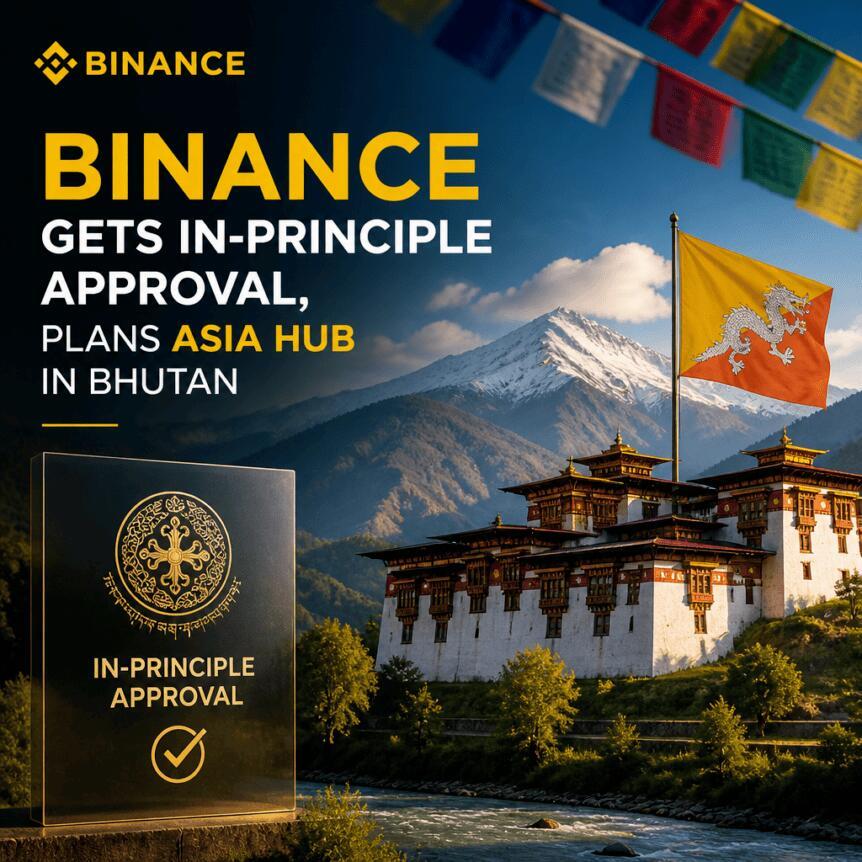
Binance Gets In-Principle Approval, Plans Asia Hub In Bhutan


Under the agreement, Binance plans to work with GMC to build an operational presence in the city after meeting the remaining regulatory requirements. The initial green light is not the end of the licensing process, but it signals that Bhutan's authorities are moving toward a more structured framework for regulated crypto activity.
Key takeaways- In-principle approval from the Gelephu Central Bank clears an early regulatory hurdle for Binance's planned operations in Gelephu Mindfulness City. Licensing is not final: Binance must still satisfy the specific conditions set by GCB to obtain a full authorization. GMC is positioning itself regionally as an“Asia hub” aimed at serving Binance users and attracting firms to set up real operating teams-not just entities. Bhutan's approach links crypto with economic development, building on Binance's existing national crypto-powered tourism payment system launched in 2025. The move fits a wider regional trend of emerging jurisdictions competing to attract crypto businesses while regulators tighten overall oversight.
According to a Binance news release shared on Saturday, the exchange giant has signed an agreement tied to a broader partnership with the GMC framework and received in-principle approval from the GCB. The company's stated goal is for Gelephu Mindfulness City to function as an Asia hub for Binance users.
GMC board director Jigdrel Singay described the approval as an early milestone for the city's longer-term plans. He emphasized that the ambition is not only to attract global companies to establish a presence, but to support sustained operations, job creation, talent development, and capability transfer that can remain in Bhutan over time.
Binance's next steps, as outlined in the release, involve working with Bhutan's central banking authority to complete regulatory requirements. The approval is therefore best understood as a gateway into a licensing process rather than an immediate operational authorization.
Why the“in-principle” step matters for compliance and market entryThe press release also clarifies that the approval does not represent a full license. Binance still needs to meet the conditions specified by GCB and complete remaining regulatory requirements before it can finalize its regulated digital-asset presence in GMC.
For investors, partners, and potential users, the distinction is important: in-principle approval can reduce uncertainty about whether regulators are willing to consider a full authorization, but it does not eliminate risk around timing, scope, or additional compliance requirements that may surface later in the process.
In practice, jurisdictions that offer accelerated pathways can accelerate business planning-but the final approval step often determines what activities are permitted, how customer protections will be handled, and what reporting or operational controls will apply. Readers should watch for details on what GCB requires for a full license and which parts of Binance's intended operations will be contingent on those conditions.
Geopolitical competition in crypto regulation: streamlined vs. tightly supervisedThis announcement lands in the context of a broader effort by emerging jurisdictions to compete for crypto and fintech business. Earlier coverage by Cointelegraph in May reported that Gelephu Mindfulness City was offering an accelerated licensing pathway for crypto and fintech companies already regulated in major hubs such as Singapore, Hong Kong, and Abu Dhabi.
Cointelegraph also highlighted that Singay, speaking in May, stressed the system was not a“passport” for offshore licenses. Firms still had to be authorized under GMC's rules, and the process was described as an additional step toward onboarding established players into a GMC regulatory environment.
The strategic shift reflects market dynamics: global regulators have increasingly emphasized compliance and oversight rather than regulatory shopping. European regulators, for example, have warned against regulatory arbitrage in relation to markets-crypto-asset frameworks under MiCA. The resulting tension is clear-jurisdictions may streamline entry for qualified firms, but regulators worldwide have signaled they do not want simplified frameworks to undermine protections.
In this sense, Binance's in-principle approval functions as a test case for how quickly a new entrant jurisdiction can move from a licensing pathway concept to fully supervised operations.
Bhutan's existing crypto use case and the push for an“ecosystem”Binance's planned expansion in Gelephu also builds on what the release describes as a growing Bhutan footprint. The company says it has been expanding in the country since launching a national crypto-powered tourism payment system in 2025, and it intends to continue building out a local digital-asset ecosystem.
That matters because it suggests the company's positioning is not limited to paper compliance. A tourism-related payment system points to real-world utility, and the GMC licensing effort appears designed to extend that foundation toward broader institutional and business activity within Bhutan.
The Bhutan storyline also connects to Cointelegraph's earlier report about Gelephu's accelerated licensing pathway. Together, the pieces outline an approach that aims to marry regulatory onboarding with tangible domestic economic goals-job creation, skills development, and lasting operational capacity-rather than focusing solely on attracting external entities.
As Binance works with GCB to satisfy remaining conditions for full licensing, the key question for market participants will be what the authorization ultimately allows and how quickly it can be completed. The in-principle approval is a meaningful signal of regulatory engagement, but the next milestones-full approval criteria, scope of permitted activities, and implementation timelines-will determine how consequential this becomes for Binance users and for Bhutan's emerging role in South Asian crypto infrastructure.
Risk & affiliate notice: Crypto assets are volatile and capital is at risk. This article may contain affiliate links.
Legal Disclaimer:
MENAFN provides the
information “as is” without warranty of any kind. We do not accept any
responsibility or liability for the accuracy, content, images, videos,
licenses, completeness, legality, or reliability of the information
contained in this article. If you have any complaints or copyright issues
related to this article, kindly contact the provider above.


Comments
No comment