


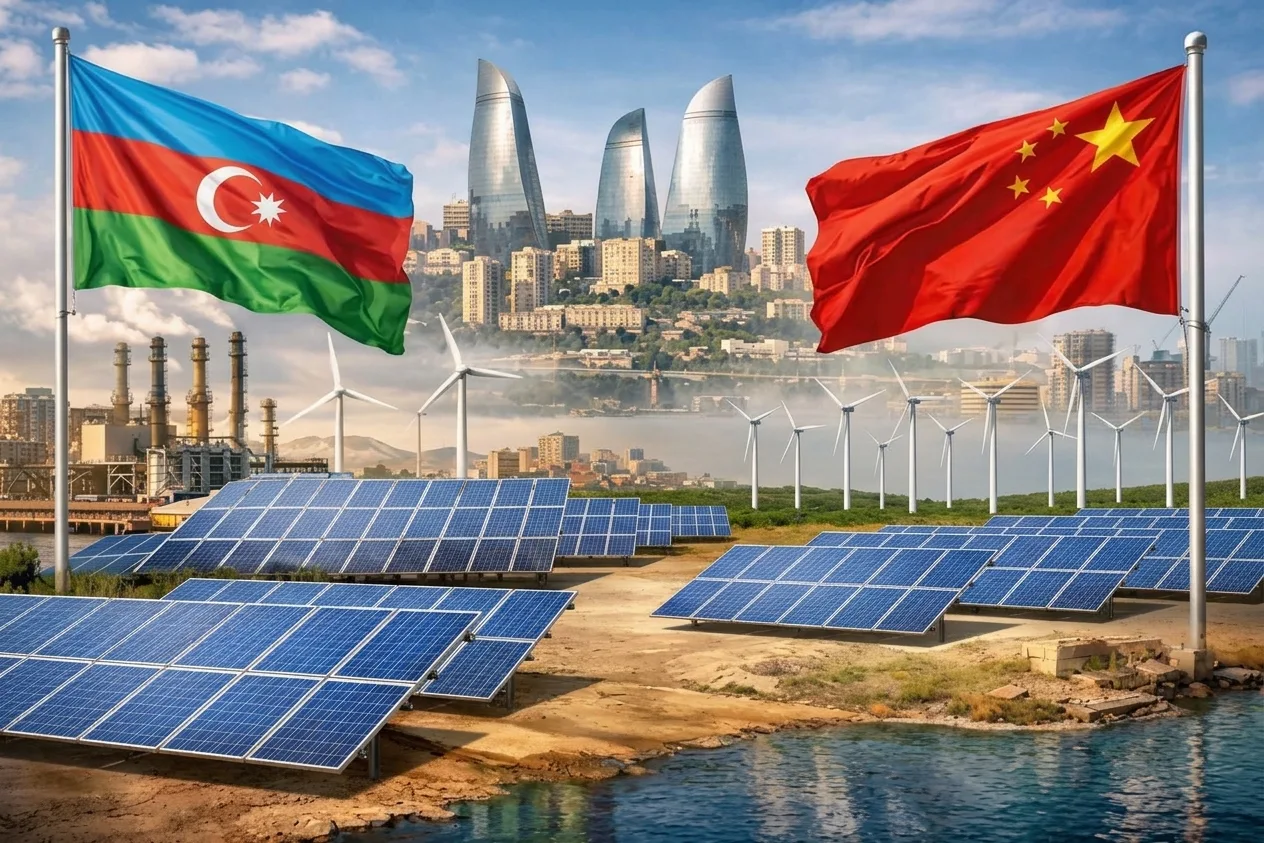
China, Azerbaijan Plot A New Route For Green Electricity To Europe


Azerbaijan's energy transition is increasingly taking shape as an export strategy. Baku aims to turn the Caspian's wind resources and the country's solar potential into a second energy business: electricity for European markets. The emerging partnership with China gives that ambition industrial weight, while a proposed route across the Black Sea gives it a geopolitical destination.
Azerbaijan has spent decades building its position as a supplier of oil and natural gas to international markets. Renewable electricity offers a way to extend that role as European buyers reshape their energy systems around decarbonisation, supply diversity and long-term price security.
The latest talks in Qingdao between Energy Minister Parviz Shahbazov and executives from PowerChina and China Datang focused on an onshore solar project and offshore wind developments in Azerbaijan's sector of the Caspian Sea, involving SOCAR Green, China Datang and PowerChina Resources. Surveys for the solar project have been completed and a feasibility study prepared.
The opportunity is substantial. In April 2025, Azerbaijan's Energy Ministry, SOCAR Green, China Datang Overseas Investment and PowerChina Resources signed a memorandum covering cooperation on a 2-gigawatt offshore wind project. China Datang has outlined a plan to develop a Caspian wind farm by 2030, while a separate 100-megawatt solar project has moved into an implementation framework.
For Azerbaijan, the commercial prize lies in matching generation capacity with access to customers. A wind farm can produce large volumes of clean electricity, while its economic value depends on transmission capacity, market access and purchase contracts. This is why the Caspian-Black Sea-Europe Green Energy Corridor matters as much as the turbines. The 3,000-kilometre project is expected to enter service in phases from 2032, with transmission capacity reaching 4 GW. Its feasibility study envisages at least 8 GW of renewable capacity across the region and annual electricity flows to Europe of around 20 billion kilowatt-hours by 2040.
Azerbaijan could become both a producer and a platform for regional power trade, drawing on domestic wind and solar resources while strengthening connections with neighbouring systems. For Europe, the corridor offers another source of clean electricity and a more diverse network of suppliers and routes.
China's role could prove decisive because the transition is fundamentally an industrial undertaking. PowerChina brings engineering and construction capacity; China Datang brings experience in large-scale power generation and project development. Chinese participation can mobilise equipment, technical expertise, supply chains and financing relationships. Datang has discussed local equipment production and an industrial park linked to the corridor, potentially adding manufacturing, skilled employment and technology transfer.
Chinese partners could help establish component production, maintenance capabilities, engineering services and workforce training inside Azerbaijan, deepening the domestic industrial base. The strategic objective should be to capture value across the supply chain, from project design and construction to operations, grid management and equipment servicing.
Europe's role will be equally important. The corridor's commercial viability will depend on long-term power purchase agreements, predictable electricity-market rules, coordinated grid investment and financing that allocates construction and demand risks. The feasibility study presented in Baku brought international banks, investors, technology suppliers and potential electricity buyers into the discussion. A final investment decision is targeted for 2029, making the next three years crucial for turning political momentum into contracts and capital commitments.
Azerbaijan's advantage is its experience in energy diplomacy and large infrastructure projects. Its next task is to apply that experience to a market where returns depend on technology costs, electricity prices, grid reliability and regulatory coordination. Offshore wind in the Caspian will require specialised vessels, subsea foundations, cables and maintenance systems. The Black Sea connection will demand advanced high-voltage direct-current technology and cooperation among national transmission operators.
Azerbaijan is seeking to convert its geography into a clean-energy export corridor and its partnership with China into an engine of industrial development. Oil and gas built the country's place in global energy markets; renewable electricity could broaden that position for the next generation. The decisive measure of success will be the value retained at home, the reliability of electricity delivered abroad and the industrial capabilities created along the way.

Legal Disclaimer:
MENAFN provides the
information “as is” without warranty of any kind. We do not accept any
responsibility or liability for the accuracy, content, images, videos,
licenses, completeness, legality, or reliability of the information
contained in this article. If you have any complaints or copyright issues
related to this article, kindly contact the provider above.


Comments
No comment