


Polish Prosecutors Reveal Expert Findings On Causes Of Smolensk Air Disaster


This was announced during a conference in Warsaw by Przemysław Nowak, a spokesperson for the Polish National Prosecutor's Office, when he presented the findings of a comprehensive investigation by the international expert group on Friday, 27 November, according to a Ukrinform correspondent.
Nowak stated that the findings were prepared by an international interdisciplinary group comprising more than 20 experts. The group was established in 2019, and work on the expert report took five years. The experts finalised the initial document in August 2024. Following its translation, Polish prosecutors deemed the report incomplete and unclear and posed 66 additional questions to the experts. The supplementary material was prepared in May 2026. After analysing it, the prosecutor's office deemed the expert report to be complete and clear.
“These are the experts' conclusions and assessments, not those of the prosecutor's office or the prosecutors,” he emphasised.
During the presentation, the spokesperson for the prosecutor's office also stressed that“there is nothing to suggest that the Smolensk crash was the result of an assassination attempt or sabotage”.
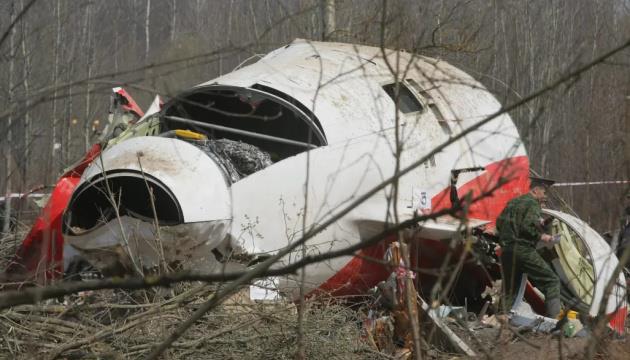
According to the findings of international experts, the Tu-154M government aircraft was descending in thick fog, with visibility of 200–400 metres. The aircraft was descending too rapidly, and the crew misjudged its actual altitude. During the final approach, the aircraft continued to descend below the minimum permissible altitude, even though conditions for a safe landing were not present. At the same time, the TAWS system, which warns of a dangerous approach to the ground, repeatedly issued collision warning signals. The report states that the aircraft's captain decided to abort the landing and go round for a second approach approximately 15 seconds before impact with the ground. However, signs that this manoeuvre was being initiated only became apparent a few seconds later. As highlighted, at around 10.41 (local time), the aircraft's left wing struck a birch tree, after which its outer section broke off. The aircraft veered sharply to the left, struck other obstacles, and then crashed upside down onto the ground in front of the runway.
Experts also cited the following factors as contributing to the crash: the actions of Russian air traffic controllers in Smolensk, who did not prohibit the aircraft's crew from landing despite extremely unfavourable conditions; the operating conditions of the 36th Special Aviation Regiment; the choice of Smolensk-North aerodrome for landing, despite the fact that it had been decommissioned; the presence of unauthorised persons in the cockpit; and inadequate coordination amongst crew members, who were flying together in this configuration for only the second time.
It is noted that an analysis of the flight recorder data revealed that people who were not part of the crew had entered the cockpit. In particular, experts identified one passenger who entered the cockpit on three occasions; his voice was last recorded approximately 11 minutes before the crash. It is emphasised that conversations unrelated to flying the aircraft may have distracted the crew. At the same time, experts found no evidence that Polish President Lech Kaczyński or the then Commander of the Air Force, General Andrzej Blasik, were present in the cockpit.
The crash of the Tu-154M aircraft on 10 April 2010 claimed the lives of 96 people, including Polish President Lech Kaczyński and his wife Maria, members of the Polish delegation and the crew.
As previously reported, on 10 April 2010, a Polish government aircraft carrying 96 people crashed near the 'Smolensk-North' military airfield. The crash claimed the lives of the presidential couple, Lech and Maria Kaczyński, the entire military command of the Polish army, and a significant portion of the country's political, religious and civic elite. They were travelling to pay tribute to the victims of the Katyn massacre on the 70th anniversary of that tragedy.
In 2011, the Polish government commission investigating the causes of the crash (the commission headed by Interior Minister Jerzy Miller – ed.) and the Intergovernmental Aviation Committee in Moscow identified errors made by the crew of the Polish aircraft as the main causes of the crash. Furthermore, the Polish commission placed significant blame on the Russian air traffic controllers at Smolensk-North Airport, who provided the crew with partially incorrect information and failed to prevent the Tu-154M from landing at the airport.
After Jarosław Kaczyński's right-wing conservative Law and Justice (PiS) party came to power in Poland in 2015, the new government annulled its predecessors' report, declaring it illegitimate, and in February 2016 reopened the investigation into the Smolensk crash. At that time, the bodies of all the crash victims were exhumed, and all the 'black box' recordings and parts of the wrecked aircraft were re-examined for traces of explosives. Samples of the collected material were sent to several international laboratories to confirm or rule out the presence of explosive residues.
The ruling PiS party repeatedly blamed the Russians for the crash, hinting at the possible involvement of the Russian authoritie. Furthermore, they accused members of former Prime Minister Donald Tusk's government of negligence, suggesting that their actions may also have contributed to the crash.
Read also: President Zelensky honors memory of Smolensk air disaster victimsFollowing the return to power in Poland of Donald Tusk's Civic Coalition, the work of the previous government's commission was halted and an investigation was launched into its misuse of funds and the falsification of evidence in the crash case. Based on the findings, 41 submissions were made to the public prosecutor's office, including against former Polish Ministers of National Defence in the PiS governments, Antoni Macierewicz and Mariusz Błaszczak. The current government has also restored the legitimacy of the Miller Report on the 2011 crash.
Photo: Wikipedia

Legal Disclaimer:
MENAFN provides the
information “as is” without warranty of any kind. We do not accept any
responsibility or liability for the accuracy, content, images, videos,
licenses, completeness, legality, or reliability of the information
contained in this article. If you have any complaints or copyright issues
related to this article, kindly contact the provider above.


Comments
No comment