


Civilian Killings In Pojk: The World Wants Answers


United Nations human rights experts have written to Islamabad. The UN human rights chief has called for investigations. Amnesty International has written to the region's prime minister. British lawmakers have raised the killings in Parliament. Even inside Pakistan, an opposition alliance has said that firing on unarmed civilians is never acceptable.
They are all asking for the same two things. They want an independent count of the dead. They also want a clear explanation of why security forces used deadly force against protesters. Pakistan has given neither. Since then, more people have died.
The strongest demand came on 4 September. Six UN human rights experts sent Pakistan a formal letter, reference AL PAK 4/2026. Their work covers counter-terrorism, unlawful killings, arbitrary detention, free speech, peaceful protest, and the protection of human rights defenders. The letter says at least 96 protesters were reportedly killed after June 2026. Six police and paramilitary personnel were also killed. Many of the dead were between 15 and 35 years old.
The experts made two key points. First, they said peaceful speech and protest“cannot, without sufficient justification, be equated with terrorism.” Second, they said“firearms should never be used simply to disperse an assembly.”
They asked Pakistan to explain why it banned the protest group, the Jammu Kashmir Joint Awami Action Committee (JKJAAC), as a terrorist organisation. They asked what Pakistan had done to investigate the killings. They also asked it to take“all necessary interim measures” to stop the abuses.
The letter is now public. No reply from Pakistan has been made public. On the ground, the force did not stop. It increased.
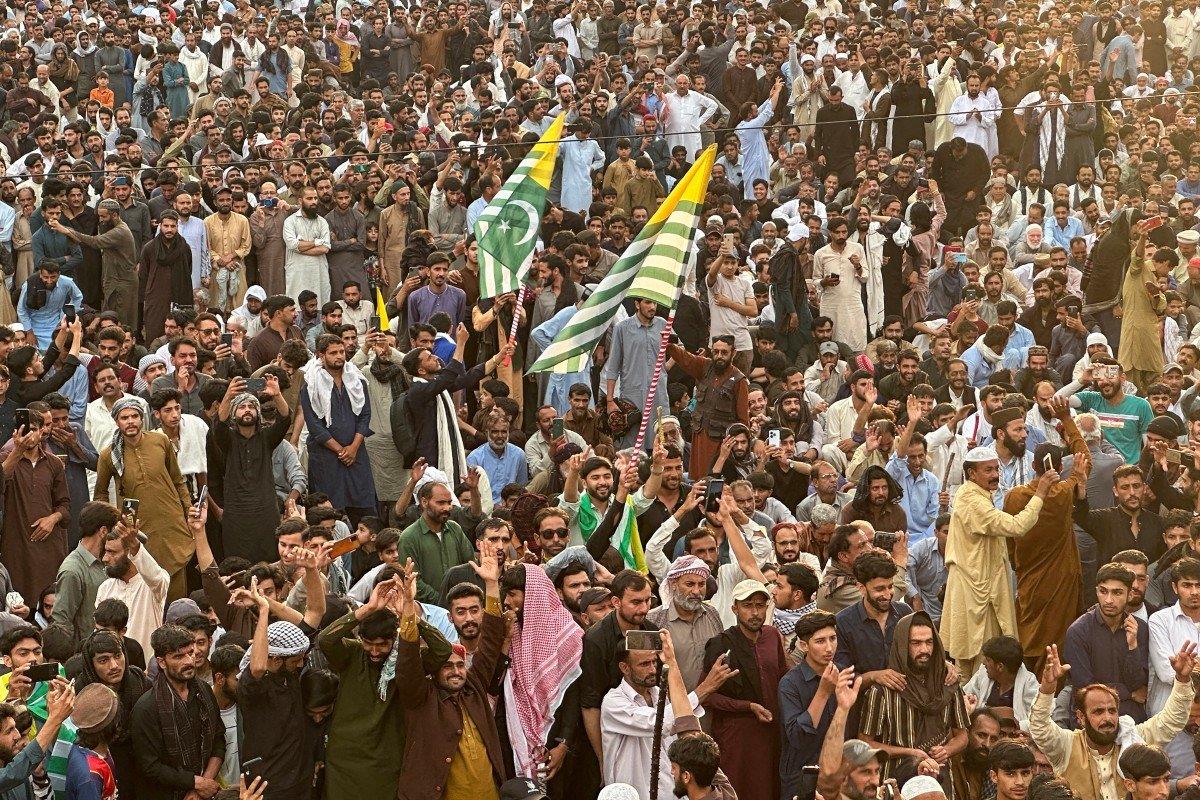
On 5 November, Pakistani paramilitary forces and local police moved against protest camps in the town of Rawalakot. The camps were near the Matialmira bus terminal. Protesters had been holding a sit-in there since early June.
The action committee confirmed three deaths and 18 injuries. It named the dead as Ehtisham and Atif Noor of Chamba Nar and Adil Rashid of Mang Mor. A local journalist said at least five people died. Some local media reported seven. Sardar Umar Nazir, a leader of the group, said drones attacked the camps from several directions. Videos from the town showed buildings on fire.
The police give a different account. They say officers were removing road barriers when armed men opened fire. They say people were hurt on both sides. A Rangers soldier who was wounded at a police post that day later died. The regional government denies that its forces shot at protesters or killed civilians.
Both accounts cannot be true. This is exactly why an independent investigation is needed. Without one, the side that controls the guns and the information wins the argument.
A week earlier, on 29 October, an explosion hit a house in Pandi village in Bagh district. Another sit-in was taking place nearby. Four members of one family were killed: a mother, her 11-year-old son, her 8-year-old daughter and their grandmother. A 15-year-old girl was injured.
The action committee said a drone dropped a bomb on the house. It called for an independent inquiry.
Within two days, the police had already decided what happened. Bagh's police chief, Ameer-ud-Deen, said the blast came from inside the house. He pointed to marks on the walls and the lack of a crater on the floor. He then said the incident showed that the group“uses the homes of poor people as its hideouts.” The region's prime minister, Syed Iftikhar Ali Gilani, said the banned group must be held accountable.
The police have the right to give their version. The problem is something else. The state investigated itself, reached a conclusion in two days and blamed the protesters. It announced no independent inquiry. When four members of one family are killed, a police statement is not an investigation.
On 12 November, local reports said a ninth-grade student, Ayesha Saqib, was shot dead while playing outside her home in Rawalakot. Her sister, Jawairiya, was badly injured. A Kashmiri political party, the United Kashmir People's National Party, shared these reports.
No one has been able to confirm them independently. That is the main problem in this crisis. Pakistan has cut phone and internet services again and again. Security forces have closed roads into the Poonch area. Then officials reject death tolls that their own restrictions make impossible to check. In July, Amnesty International's head, Agnès Callamard, warned that the blackout made independent checking very difficult. That warning still applies.
The violence continues. Police say a Rangers officer, Barkat Ali, was shot dead near the Rawalakot bus terminal in mid-November. They say four armed men linked to the action committee were also killed. Every new death, on either side, makes the case for a neutral inquiry stronger.
People who have not been shot face other punishments. Under Pakistan's anti-terrorism law, authorities can put people on a watchlist called the Fourth Schedule. People on this list can lose their passports, identity cards, bank accounts and phone connections. They must also report to the police.
A UK-based monitoring group, the Jammu Kashmir Human Rights Observatory, counted at least 445 entries on the list by 11 November. The group says some names may appear more than once. Even so, the number is more than double the 205 people the UN experts were told about in September. The Poonch district alone has 179 entries.
One order, dated 29 September, reportedly lists six members of one family. One of them is a child about four years old. At least 15 lawyers are on the list. So are four journalists: Danish Irshad, Azra Alam, Muhammad Riaz Khan and Ajmal Shaheen. It is fair to ask what act of terrorism a four-year-old child could have committed.
On 13 November, Amnesty International wrote an open letter to Prime Minister Gilani. It asked his government to free activists held under anti-terrorism laws. It also asked the government to lift the ban on the action committee. Amnesty says the ban violates people's right to form groups, speak freely and protest peacefully. In June, Isabelle Lassee of Amnesty's South Asia office called the ban“disproportionate, unlawful and a violation of the right to freedom of association.”
In Britain, lawmakers debated human rights in Kashmir on 7 July. More than 50 of them wrote to the foreign secretary. The British government said it was concerned about the deaths of both civilians and security personnel. It said any claims of abuse“should be investigated thoroughly, promptly and transparently.” British Kashmiris have also protested outside Pakistani diplomatic offices in London, Manchester, Bradford and Birmingham, including in the days after the Rawalakot operation.
More than five months have passed. There is still no sign of a serious investigation. Public records show no officer charged for any civilian death since June. No independent body has been allowed into hospitals, to meet the families, or to examine security force records. The ban remains in place.
On 23 November, a meeting in Islamabad formed a six-member committee to help start talks. Former regional president Sardar Masood Khan leads it. This could open a door to dialogue. But the action committee in Poonch rejected the meeting's statement because it did not condemn the civilian deaths. Talks without accountability will not last.
Pakistan does not have to accept every number the protesters give. But it must allow a neutral body to count the dead. Until it does, every disputed death will deepen distrust. And the world's questions will only grow louder.
Background: The protests began in early June. One key demand is ending the 12 seats in the region's assembly that are reserved for refugees from Indian-administered Kashmir. Protesters also say the government never carried out an agreement it signed with the action committee in October 2025. On 5 June, the regional government banned the group under its 2014 anti-terrorism law. Regional elections took place on 27 July amid deadly clashes. Pakistani officials accuse the group of violence and of foreign backing. The group says it is a peaceful civil rights movement of traders, lawyers, students and community members.
The views expressed in this article are the author's own and do not necessarily reflect the editorial position of Khaama Press.

Legal Disclaimer:
MENAFN provides the
information “as is” without warranty of any kind. We do not accept any
responsibility or liability for the accuracy, content, images, videos,
licenses, completeness, legality, or reliability of the information
contained in this article. If you have any complaints or copyright issues
related to this article, kindly contact the provider above.


Comments
No comment