


Witness To The Looting Of Afghanistan's National Museum In 1990S


The entire collection was briefly re-located to central Kabul between April 1979 and October 1980, when the museum building became an annex to the Ministry of Defence, then based in the adjacent Darulaman Palace. This led to rumours that the Soviets had taken the entire collection to Leningrad, but it remained intact and no objects were reported lost or damaged during these transfers. In the autumn of 1989, concerns about the security in Darulaman led to 16 trunks containing key items being re-located to the city centre. Most gold and silver coins and artefacts were sent to the Central Bank Treasury, with other items stored in the Ministry of Information and Culture. Given the sheer size of the collection, however, many significant artefacts remained packed in the depots at the National Museum.
During the fighting that followed the fall of the PDPA regime in April 1992, Darulaman was among the areas that were fiercely contested between factions. Despite reports of looting, it was not safe for museum staff to get to the site to check. This was at a time when the historic centre of Kabul was also the focus of fighting that displaced the inhabitants and resulted in damage to important monuments and property. As part of the UN's humanitarian response to the massive extent of damage and displacement, I took it upon myself to visit and document conflict-affected neighbourhoods where conditions allowed.
In May 1993 the museum was struck by rockets, resulting in a fire that not only destroyed the roof and upper level but exposed the ground-floor depots to the elements. Front lines between the armed groups tended to shift, with the museum site at that time held by fighters of Hizbe Wahdat. Following contact between senior UN officials and their leader, Ustad Mazari, I drove in December with Afghan colleagues to the museum in order to assess the situation and see what could be done to secure and weatherproof the badly damaged structure. Security 'guarantees' that we had obtained for this and subsequent trips from an ever-changing cast of local commanders – Shura-e Nizar snipers occupied the Koh-e Asmai ridge overlooking the road south from the city centre – often proved to be of limited value and we were regularly challenged by nervous fighters at the many check-posts along our route.
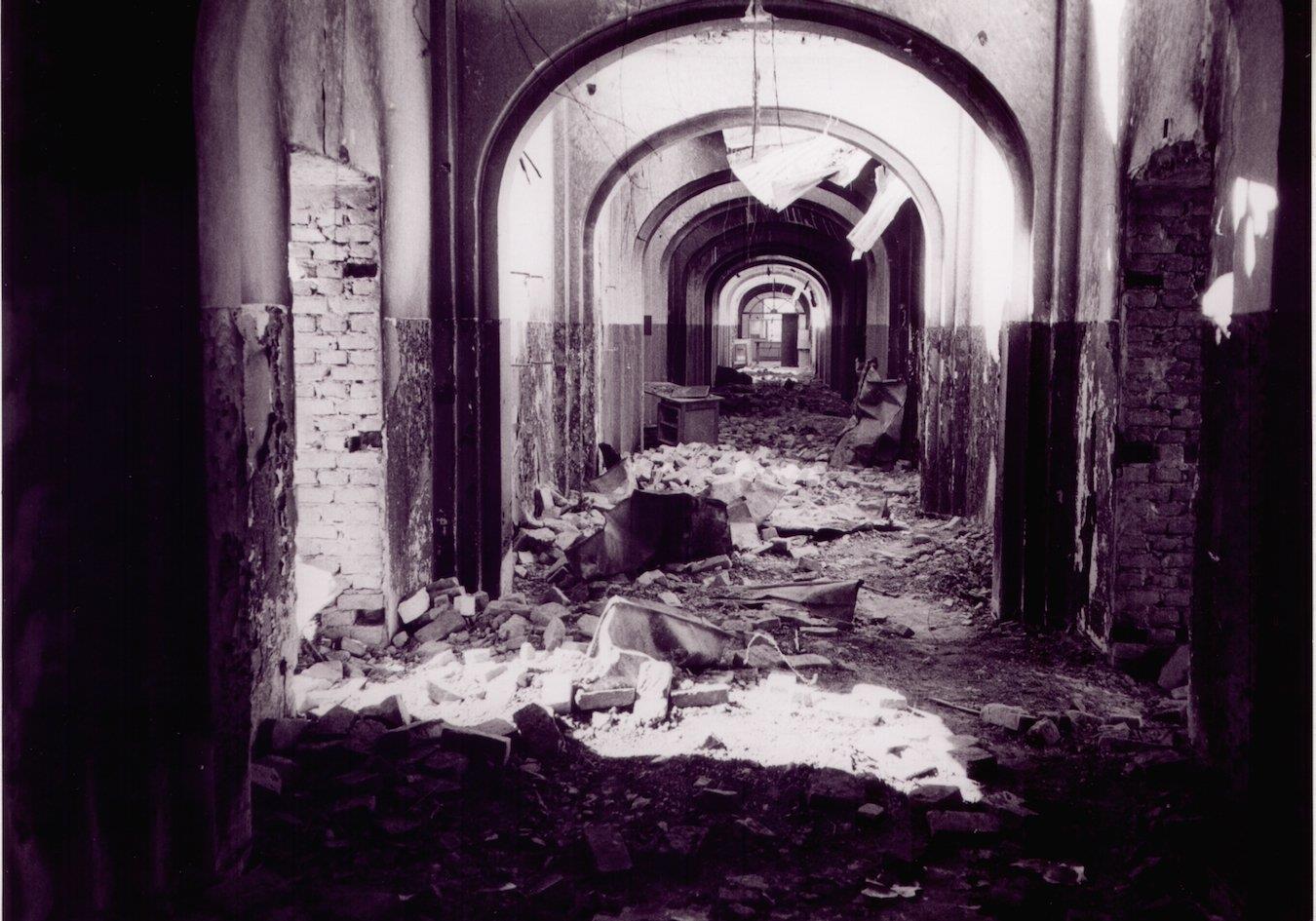
What we encountered on that initial visit was a scene of utter devastation. Under the burned remains of the timber roof and crumbling masonry, the store-rooms on the ground floor had been ransacked. Bundles of charred registration cards lay in the rubble. Our focus was initially on urgent measures to weatherproof the ruined structure, rather than trying to determine the extent of losses from the collection. Through the bitter winter of 1993–4, we arranged for key ground-floor openings to be blocked with sandbags or brick masonry and for damaged bars and doors to be welded. These activities took place under the watchful gaze of Hizbe Wahdat fighters who claimed to be protecting the building and its contents. Despite repeated assurances to myself and UN colleagues by their leaders and local commanders that the looting would cease, we would find some of these protective measures dismantled or damaged while we'd been absent. On successive visits, I photographed the condition of the stores to share with museum staff who were still confined in Kabul, only to find on our return to Darulaman that portable objects had either vanished or been moved close to a position from where they might be easily removed. It felt that we were engaged in a game of cat-and-mouse with the 'guardians' of the ruined museum, who vehemently denied any knowledge of unauthorised access to the stores.
We soon turned our attention to the ransacked stores, where rows of drawers that had contained hundreds of valuable coins were completely empty, as were shelves that had housed precious metal artefacts. It was clear that the looters were discriminating; fragile carved ivory panels from Begram had been removed from their protective display frames to ease their transport. A purpose-made aluminium case containing other ivory objects had vanished. It was hard to know where to start amidst the fragments of smashed pottery, glass and metalwork and the odd coin in the debris. My excitement at spotting a fragment of a partially melted bronze vessel in a corridor prompted thoughts of how the archaeologist who had originally excavated it would have felt.
Without an inventory of the collection, we tried to save whatever could realistically be retrieved from the debris. Objects that seem to have been too heavy for looters to take, such as the 2nd-century AD figure of the Kushan king Kanishka and a stone panel bearing a Bactrian inscription in cursive Greek from Surkh Kotal, were photographed in situ. Some 3,000 of the surviving artefacts, many badly damaged, that we found in the stores were gradually re-located in the ensuing months to the relative safety of temporary stores in the city centre. On driving a pick-up load of stucco fragments back from Darulaman early in 1994, I noticed several small Buddhist figurines lined up for sale among vegetables in a roadside stall. It seemed important to recover these before they disappeared into the hands of dealers and so (controversially) we bought dozens of these during our trips through south-western neighborhoods and delivered them to museum staff.
By mid-1994, the museum staff too were able to visit the ruined museum and embarked on inventorying surviving objects in the stores, along with material that had previously been transported to the city centre. This resulted in the cataloguing of some 16,000 items that had been part of the pre-conflict collection, but it remained at this stage difficult to establish accurately what was missing. This did not prevent wild speculation in the press about the extent of losses and, given that the museum remained vulnerable, we deliberately did not contest exaggerated accounts of what had been spirited away. We also kept quiet about the 16 trunks containing the most precious artefacts that had been re-located to the city centre in 1989.
The process of stock-taking was disrupted in the autumn of 1994, when fighting resumed around Darulaman as rival groups in Hizbe Wahdat jostled for territory, while a force from Hizbe Islami took high ground overlooking the valley, from where they proceeded to rocket the area. As well as preventing visits by museum staff, the conflict resulted in further looting as the site repeatedly changed hands. Ironically, previous work to assess and organise what was left in the museum stores probably facilitated the theft of material that had been identified as significant. The Taliban drove out Hizbe Wahdat and Hizbe Islami, only to be routed by Shura-e Nizar forces in March 1995. It was not until late September 1996, when the Taliban took full control of Kabul, that looting of the museum ceased and the long process of documentation and repairs could begin.
As news of the fate of the National Museum spread internationally, questions were asked about where the looted items might have been taken. Few initial rumours about objects offered for sale in Pakistan could be verified, but there was little doubt that material from the collection would in time appear on the insatiable international art market, where private collectors might be unlikely to question its provenance. This led to the establishment of the Society for the Preservation of Afghanistan's Cultural Heritage (SPACH), tasked with raising awareness about looted objects and co-ordinating rehabilitation and conservation efforts. To this day, images appear online of objects that could be from the museum collection – along with many crude fakes. Over the years, there have been a number of returns of looted objects that were acquired abroad, while a number of significant items from the collection that were intercepted by customs in Europe are held for safekeeping in museums abroad.
My direct involvement in the gradual rehabilitation of the museum after 1996 was limited. As someone who bore witness in the aftermath of its destruction and looting, it is concerning to see how the role of factions at the time is glossed over in press reports and official accounts, which tend to blame the Taliban for events in 1993–4. There was understandable outrage at damage to pre-Islamic objects caused by members of the movement in 2001, but far less scrutiny of earlier crimes by factional fighters or the looters that they protected. Young Afghans deserve a truthful and balanced account of their history and, as a witness to what took place in Darulaman at the time, I feel that we need to acknowledge the facts.
About the authorJolyon Leslie trained as an architect and, after work in Yemen during the 1980s, has since been based in Afghanistan, where he has worked for the UN and NGOs as well as undertaking research. Between 2004 and 2010 he managed an urban conservation programme in Kabul and Herat for the Aga Khan Trust for Culture. He subsequently co-founded the Afghan Cultural Heritage Consulting Organisation (ACHCO) and continues to support its conservation and advocacy work. He co-authored a book on the political transition, Afghanistan: The Mirage of Peace (Zed Books, 2004), with Chris Johnson, and is currently undertaking research on the history of Kabul.
Disclaimer: The views expressed in this article are those of the author and do not necessarily reflect the editorial policy or position of Khaama Press.

Legal Disclaimer:
MENAFN provides the
information “as is” without warranty of any kind. We do not accept any
responsibility or liability for the accuracy, content, images, videos,
licenses, completeness, legality, or reliability of the information
contained in this article. If you have any complaints or copyright issues
related to this article, kindly contact the provider above.


Comments
No comment