


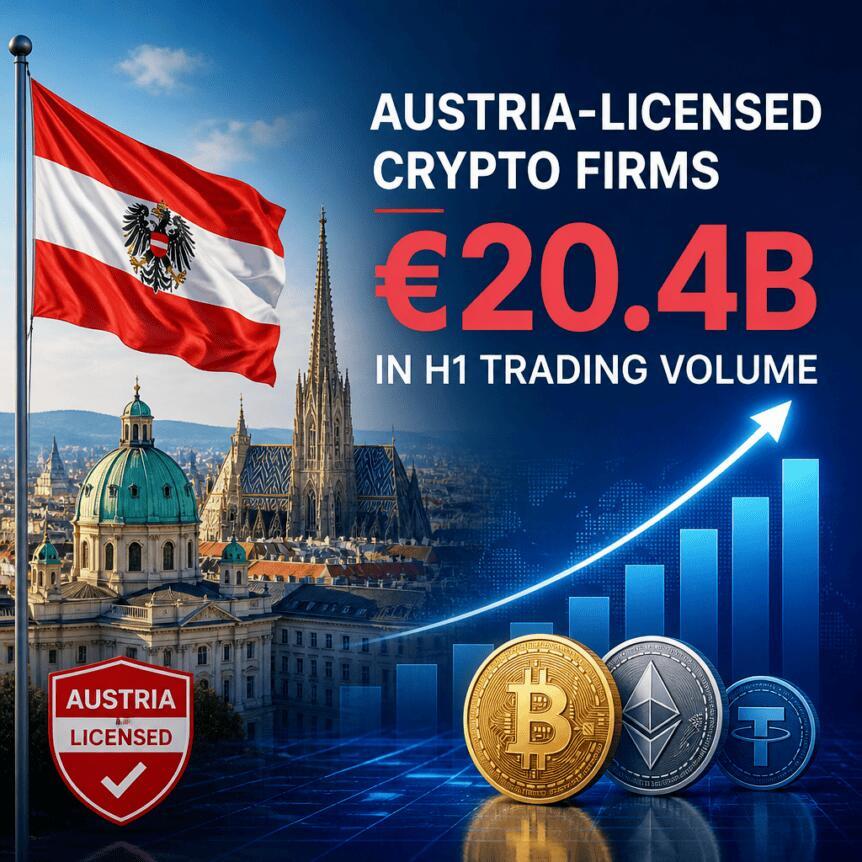
Austria-Licensed Crypto Firms Log €20.4B In H1 Trading Volume


In a press release on Friday, the FMA said around 74% of user accounts on these regulated platforms were based in other European Economic Area (EEA) countries-most notably Germany and France. The figures underline why regulators across the EU are increasingly focused on whether supervision should remain fragmented by country or be coordinated at a higher EU level.
Key takeaways- 20.4 billion euros in trading volume was reported by FMA-supervised CASPs in H1 2026, reflecting strong activity in the regulated segment. 74% of accounts were held by users in other EEA countries, showing crypto services are already operating well beyond national borders. H1 2026 volume of 20.4 billion euros is above the 17 billion euros figure reported for full-year 2025 in the FMA's annual report. The FMA points to growing cross-border business as a driver for renewed debate about giving ESMA enhanced supervisory competences. A December 2025 European Commission proposal and earlier calls from major EU regulators (including France) suggest the conversation is shifting from theory to EU-level implementation.
The FMA's latest reporting period makes one trend hard to ignore: the“regulated crypto” market in Austria is not mainly serving Austrian retail or institutional clients. According to the supervisor, 74% of user accounts on FMA-supervised platforms are linked to other EEA countries, particularly Germany and France.
For market participants, this matters because supervision and consumer-protection expectations typically depend on where a service is authorised and which regulator oversees it. When most users reside elsewhere, questions around regulatory consistency, reporting requirements, and enforcement coordination become more than administrative details-they affect how quickly firms can scale across jurisdictions and how investors assess the strength of protections around the services they use.
Trading volume rises faster than the prior full-year totalThe FMA reported 20.4 billion euros in trading volume for the first half of 2026. The supervisor also drew a clear comparison to past performance, noting that this H1 figure exceeded the 17 billion euros reported for the full year of 2025 in its annual report.
While volume growth alone doesn't indicate how revenue, market depth, or risk profiles are changing, it does suggest that activity within regulated, FMA-supervised CASPs is accelerating. Traders and compliance teams should pay attention to such expansion because higher activity often brings operational pressure-more transaction monitoring, more customer due diligence, and greater demands on systems used for reporting and controls.
Why the FMA is pushing attention toward ESMAThe FMA linked its findings to a broader regulatory question: when business flows across borders, Europe's supervision framework may need to evolve. The authority said increasing cross-border activity is driving sharper focus on Europe's crypto supervisory setup and on ongoing discussions about granting ESMA an enhanced supervisory role for the industry.
In practical terms, the key issue is whether oversight should remain rooted primarily in national authorities or whether a central EU body should play a bigger role-especially for large or systemically relevant market infrastructure providers. The FMA's framing suggests that, as cross-border participation grows, coordination and consistency across jurisdictions become increasingly difficult to achieve through national supervision alone.
EU lawmakers weigh ESMA centralisation amid earlier regulator callsThis debate is not starting from scratch. In December 2025, the European Commission proposed transferring“ direct supervisory competences” for key parts of market infrastructure-explicitly including CASPs -to ESMA. If adopted by EU lawmakers, ESMA's role in supervising EU capital markets would be designed to resemble the framework used by the US Securities and Exchange Commission, according to the report highlighted by earlier coverage from Cointelegraph.
Meanwhile, momentum among regulators has been building. In September 2025, France became the third European country to publicly call for ESMA to take over supervision of major crypto firms, joining Austrian and Italian securities regulators. That stance was reported earlier by Cointelegraph.
Separate from the ESMA discussion, France's position has also been connected to debates around how EU crypto firms could operate across member states. Earlier coverage cited a“passporting” challenge tied to unified rules under the EU's MiCA framework, but the FMA's Friday release focused specifically on supervisory competences and cross-border supervision needs.
What to watch next for investors and firmsFMA's numbers suggest that regulated crypto trading in Austria is already deeply international, with EEA-based users accounting for the majority of platform accounts. The next question is how EU policymakers will respond to that reality: whether ESMA's role expands in practice, and how such a shift would affect compliance expectations, enforcement coherence, and market access for CASPs operating across multiple jurisdictions.
Risk & affiliate notice: Crypto assets are volatile and capital is at risk. This article may contain affiliate links.
Legal Disclaimer:
MENAFN provides the
information “as is” without warranty of any kind. We do not accept any
responsibility or liability for the accuracy, content, images, videos,
licenses, completeness, legality, or reliability of the information
contained in this article. If you have any complaints or copyright issues
related to this article, kindly contact the provider above.


Comments
No comment