


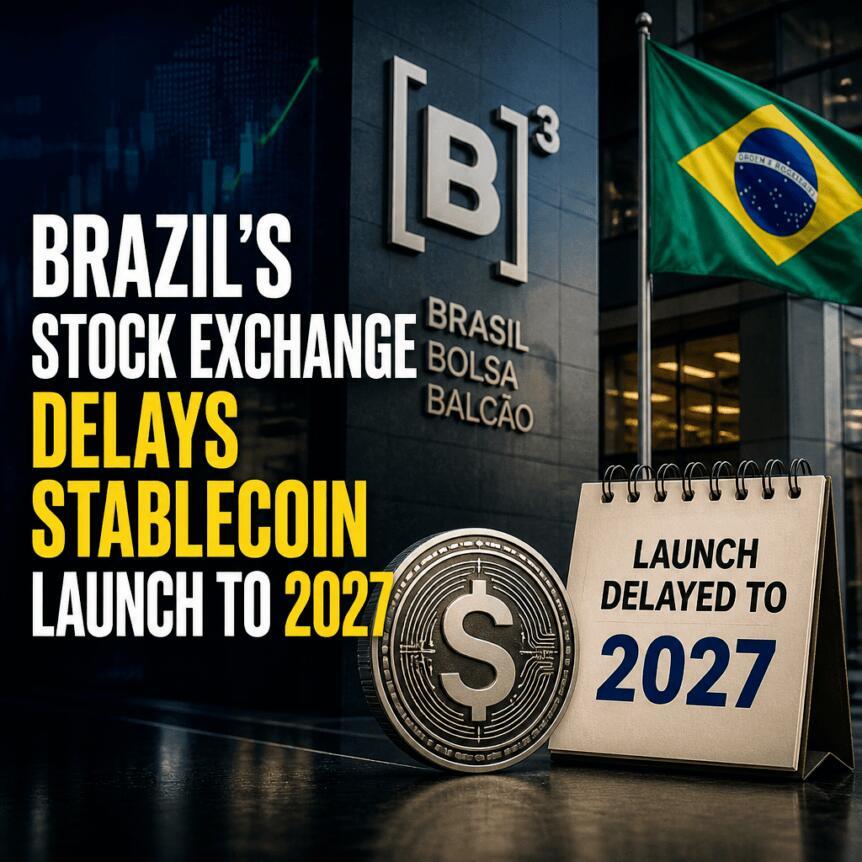
Brazil's Stock Exchange Delays Stablecoin Launch To 2027


According to a Friday report by Valor Econômico, Open BRL is planned for the first quarter of 2027, after B3 previously pointed to earlier timelines for a BRL-stablecoin experiment.
Key takeaways- B3's real-pegged stablecoin, Open BRL, is now targeted for Q1 2027, issued by Banco B3 and backed by one BRL per token. The initiative involves collaboration with six large Brazilian financial institutions: Bradesco, BTG Pactual, Itaú Unibanco, Safra, Santander, and XP. B3 will provide the underlying infrastructure, signaling that tokenization efforts remain tightly tied to exchange rails and compliance. B3 plans to expand into tokenized share trading in early 2027, but settlement mechanics and 24/7 trading depend on Brazil's regulatory framework. It is currently unclear whether Open BRL will replace B3's earlier stablecoin concept (B3RL) or run in parallel.
B3's stablecoin roadmap has moved more than once. The exchange initially disclosed plans in December 2025 to launch a stablecoin around 2026. More recently, local reporting had suggested B3 was still preparing a near-term rollout of a stablecoin called B3RL, with infrastructure testing and integrations scheduled for August and September.
Earlier coverage also described B3RL as a real-pegged token secured by government bonds, intended to support blockchain-based trading of stocks and fixed-income instruments starting in 2027. With Open BRL now slated for Q1 2027, the operational question is whether B3 is keeping the same design and simply pushing timing, or whether it is restructuring the stablecoin program entirely.
Valor Econômico's report states Open BRL will be issued by Banco B3 -the exchange's banking subsidiary-with each token backed by one Brazilian real. B3 would also run the underlying technology. However, the overlap with B3RL remains unresolved. Cointelegraph previously reached out to B3 for clarification but did not receive a response by publication.
What stablecoins mean for tokenized securities in BrazilEven in markets where stablecoins are common, real-pegged tokens used for on-chain finance can be politically and operationally sensitive. For B3, the stablecoin appears less like a speculative asset and more like infrastructure for moving value around tokenized markets.
The broader strategic context matters: B3's initiative is part of a wider effort to bring traditional securities onto blockchain networks as Brazil's financial sector explores tokenization. By anchoring Open BRL to the real and placing issuance with Banco B3, the exchange is effectively building a bridge between regulated banking settlement expectations and on-chain trading workflows.
That bridge is likely one reason B3's timeline has elongated. Tokenization projects often stall not because the technology is impossible, but because the exchange has to coordinate with banks, custody and settlement expectations, and regulators' interpretations of how existing market rules apply to new rails.
Tokenized shares planned for early 2027-still constrained by settlement rulesB3 is also preparing to trade tokenized shares in early 2027. The exchange intends to use the same order book as conventional equities at launch, according to earlier reporting tied to B3's internal timeline.
However, operational details show how closely the project is tied to regulation and market plumbing. In October, Humberto Costa, a B3 executive overseeing digital asset products, reportedly said B3 would initially retain its two-business-day settlement cycle rather than introduce instant settlement. Costa also reportedly said that B3RL would not handle settlement of tokenized shares at launch and that 24/7 trading would require changes to Brazil's regulatory framework.
Those points highlight an asymmetry that investors often overlook: tokenized markets can look instant on-chain, but settlement finality still must fit within legal and regulatory processes. For traders, the practical implication is that adoption may arrive in phases-first enabling trading on tokenized systems while settlement and settlement-driven cash/asset finality remain closer to traditional timelines.
Regulators are actively working on tokenization frameworksBrazil's regulatory environment is a central variable for how quickly B3 can expand from tokenized trading to broader on-chain settlement behaviors. The Brazilian Securities and Exchange Commission (CVM) has been exploring a regulatory framework for tokenization, presenting progress of its dedicated working group at an industry meeting in October, as reported by a CVM news update hosted by the agency.
For market participants, this is significant because the stablecoin and tokenized share components are interdependent. The less the framework permits real-time settlement and continuous trading, the more B3 is likely to focus on tokenization that fits within existing settlement cycles-at least initially.
At the same time, B3's insistence on retaining standard settlement at launch suggests the exchange is aiming to minimize regulatory friction while still moving forward with pilot functionality. If CVM's work tightens or clarifies how tokenized securities should be settled and administered, B3 could later expand features such as faster settlement and potentially continuous market hours.
Investors and builders should watch for two developments next: whether B3 formally clarifies how Open BRL relates to (or replaces) B3RL, and how CVM's tokenization framework progresses toward enabling new settlement and trading behaviors beyond B3's initial early-2027 rollout.
Risk & affiliate notice: Crypto assets are volatile and capital is at risk. This article may contain affiliate links.
Legal Disclaimer:
MENAFN provides the
information “as is” without warranty of any kind. We do not accept any
responsibility or liability for the accuracy, content, images, videos,
licenses, completeness, legality, or reliability of the information
contained in this article. If you have any complaints or copyright issues
related to this article, kindly contact the provider above.


Comments
No comment