


Work And Place In Dialogue: Lara Julian In Conversation With Isabel De Vasconcellos


James's, London, 2026.
Photography: Stephen White & Co. · Images courtesy of Varvara Roza Gallery
An Exclusive Interview for USA Art News
The curator of Anthony Daley: Resonance on staging colour across three rooms in St James's, on painting's long dialogue with the Old Masters, and on finding the right fit between work and place.
Anthony Daley: Resonance, an exhibition of recent paintings by the Jamaican-born British artist, is on view at Varvara Roza Galleries, 8 Duke Street, St James's, until 28 November 2026. It was curated by Isabel de Vasconcellos, a writer and curator of contemporary art and the author of Fourth Plinth: How London Created the Smallest Sculpture Park in the World.
Lara Julian met Isabel at the exhibition and invited her to a written conversation for USA Art News. Together they consider the sequence of Daley's paintings across the gallery's three spaces, his lifelong dialogue with the Old Masters, what a painting's surface offers that a reproduction cannot, and what it means to work with an artist at a pivotal moment, in the public realm and in the quieter setting of a St James's gallery.
Lara Julian: Resonance unfolds across the three spaces at 8 Duke Street. How did you think about sequence and pacing, and what did you want each room to do for the viewer?
Isabel de Vasconcellos: Each space at 8 Duke Street St James's has a very distinct character, which is something I enjoy, so in choosing the works for Resonance, I wanted to work with these qualities.
The gallery sits on the ground floor of a late Victorian/early Edwardian building typical of the area's vernacular, with large timber-framed windows bathing the first space in light. In it, we have three large canvases in shades of pink, yellow and blue, drawn from a series of paintings that take as their starting point Joseph Wright of Derby's Mr and Mrs Thomas Coltman in the National Gallery. The colours of these works respond dynamically depending on the light of day, subtly changing the experience of exhibition moment by moment.
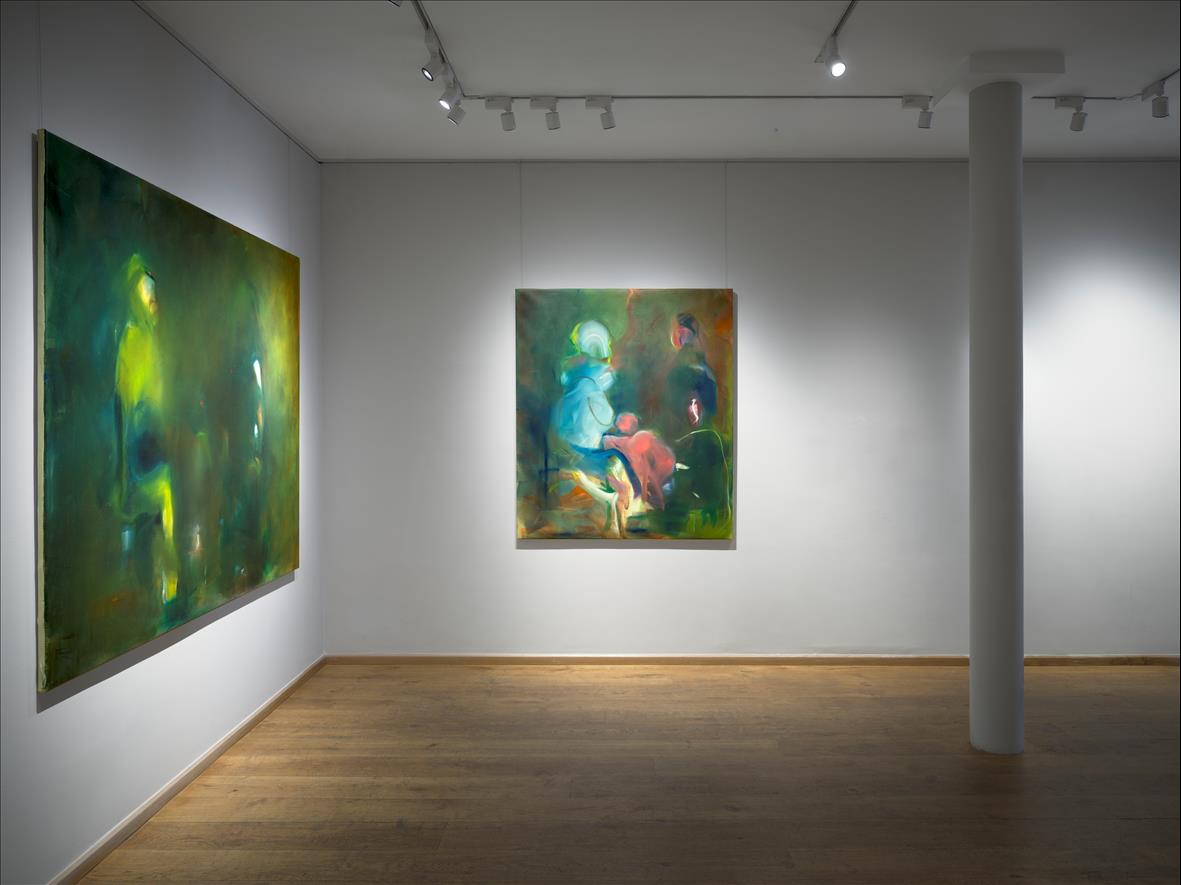
For Gallery Two, deep in the building, I selected four paintings from Daley's Son of Rubens series (inspired by Rubens's Venus, Mars and Cupid at the Dulwich Picture Gallery). Here, Daley dials into a moodier palette of deep greens and blacks, leavened by flashes of acid pink, yellow and pools of bluey-white. Contained in this darker space, the menacing undertones of the theme really come out: the age-old wrestle between love and war, always precariously mediated and under threat.
Downstairs, the mood lifts again with a selection of smaller canvases drawn from Daley's Mr and Mrs Coltman variations.
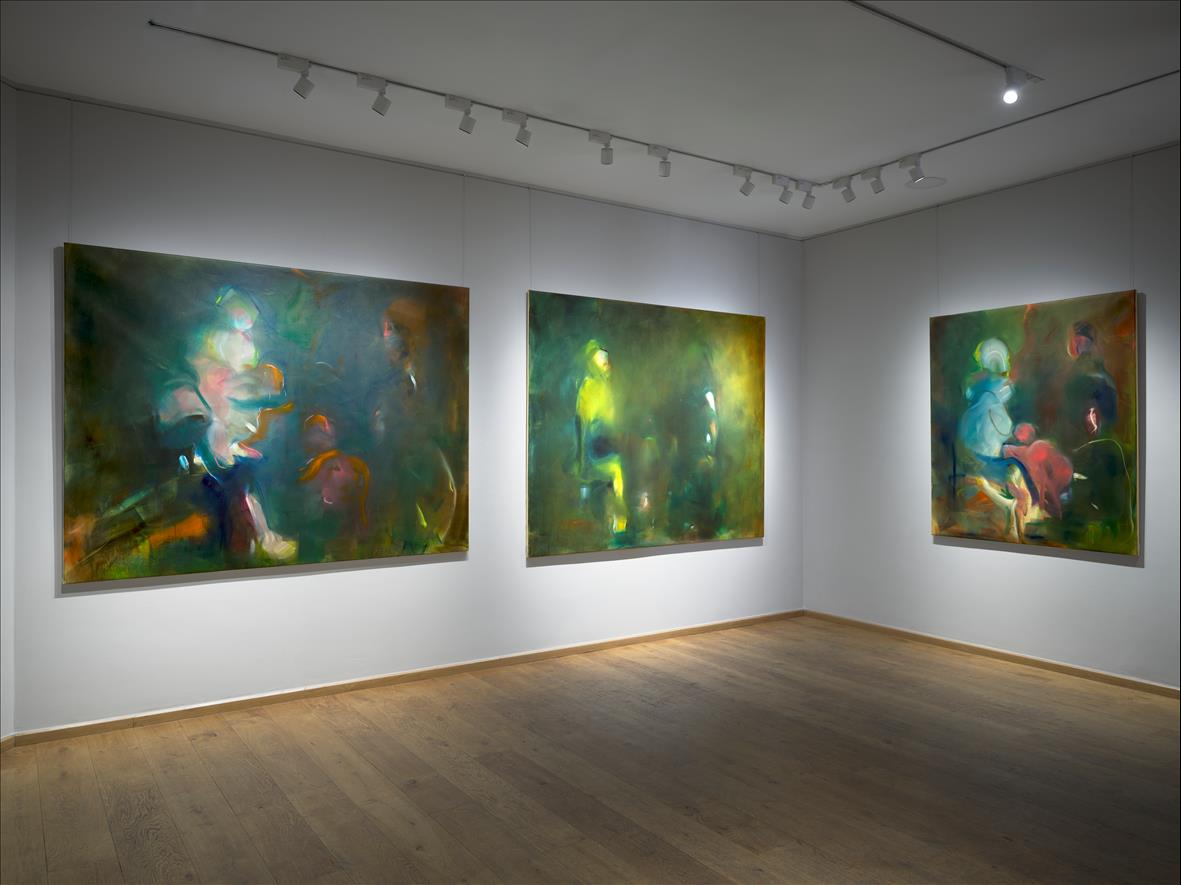
Installation view, Anthony Daley: Resonance. Left: Anthony Daley, Spoils of War, 2026, oil on canvas, 160 × 210 cm. Right: Anthony Daley, Meanwhile, 2025, oil on canvas, 150 × 130 cm.
Photography: Stephen White & Co. · Images courtesy of Varvara Roza Gallery
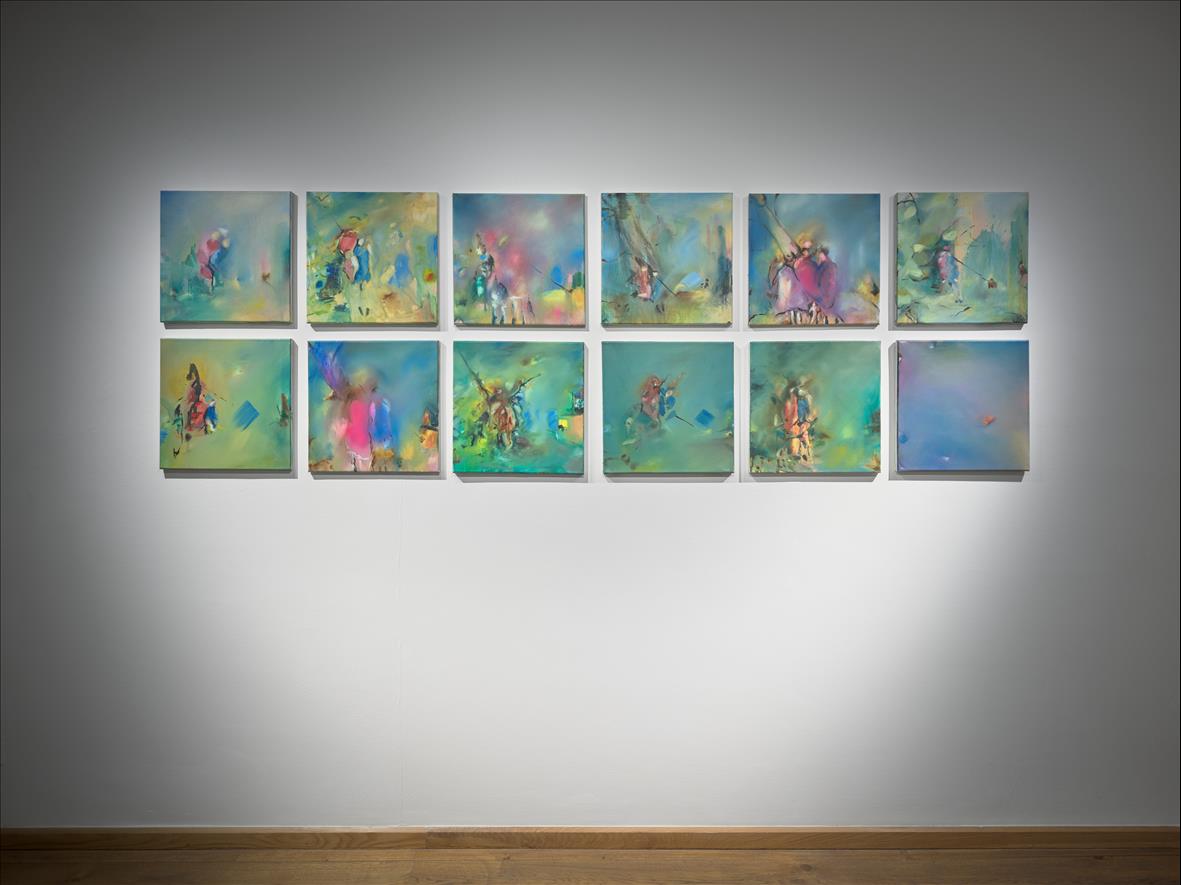
Installation view, Anthony Daley: Resonance. A group of smaller canvases.
Photography: Stephen White & Co. · Images courtesy of Varvara Roza Gallery
Lara Julian: Anthony first met the Dutch and Italian Masters through reproductions as a child in Jamaica, and later made Son of Rubens at Dulwich Picture Gallery. How present are Rubens and Delacroix in these new works: as conversation, as inheritance, or as something he has absorbed and moved beyond?
Isabel de Vasconcellos: Daley's painting is a lifelong dialogue with the Old Masters, first fired by seeing them in reproduction as a child in Jamaica. His heightened experiences of the colours of nature, together with these distant vestiges of human virtuosity, forged a language that has sustained his practice from the start.
The works derive from a passion for the material properties of oil paint and its expressive potential. They engage in a very physical way with historical painting from centuries past and go toe to toe with the greats, refusing to pay lip service to hierarchies and laying claim to the heroic traditions of oil painting as a common heritage.
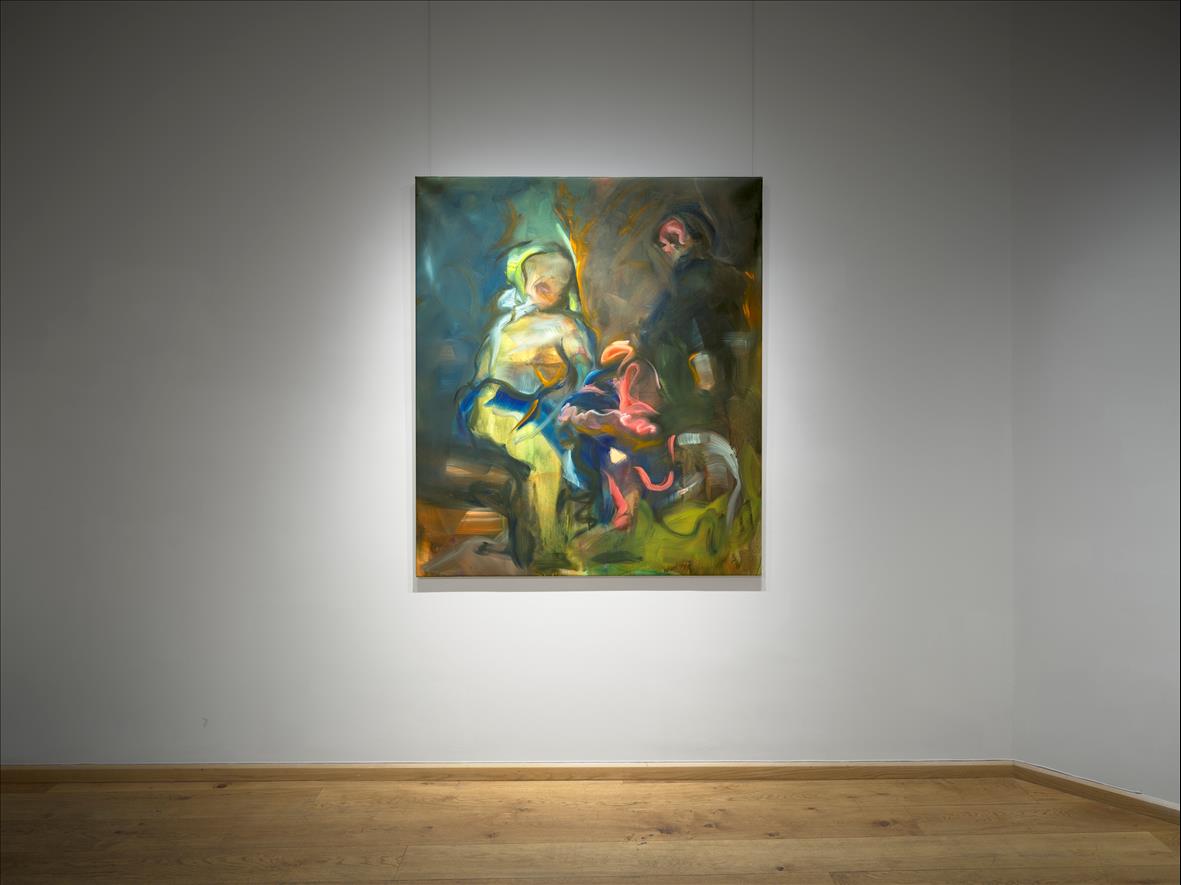
Installation view, Anthony Daley: Resonance, Varvara Roza
Galleries, 8 Duke Street, St James's, London, 2026.
Photography: Stephen White & Co. · Images courtesy of Varvara Roza
Gallery
Daley's reference to the likes of Rubens or Wright of Derby is not a nostalgic homage, but a starting point from which he draws on all that came after them: the trajectory from figuration, through the colourists (and here is where Delacroix is a significant pivot, hence Cézanne's declaration,“We all paint in Delacroix's language”), Impressionism, the twentieth century's dalliance with expressionism and abstraction, in a through line to the present day. Daley explicitly situates himself in this lineage, and claims a place for his work within it.
Lara Julian: The paint records its own making: sinewing strokes, scumbles, layers built up and scraped away. What do you look for in the surface of a painting that a reproduction can never show?
Isabel de Vasconcellos: There is nothing like being confronted with a work of art, made as the result of a series of decisions by the human body and mind working in concert, to bring home the understanding that art is not a purely retinal experience.
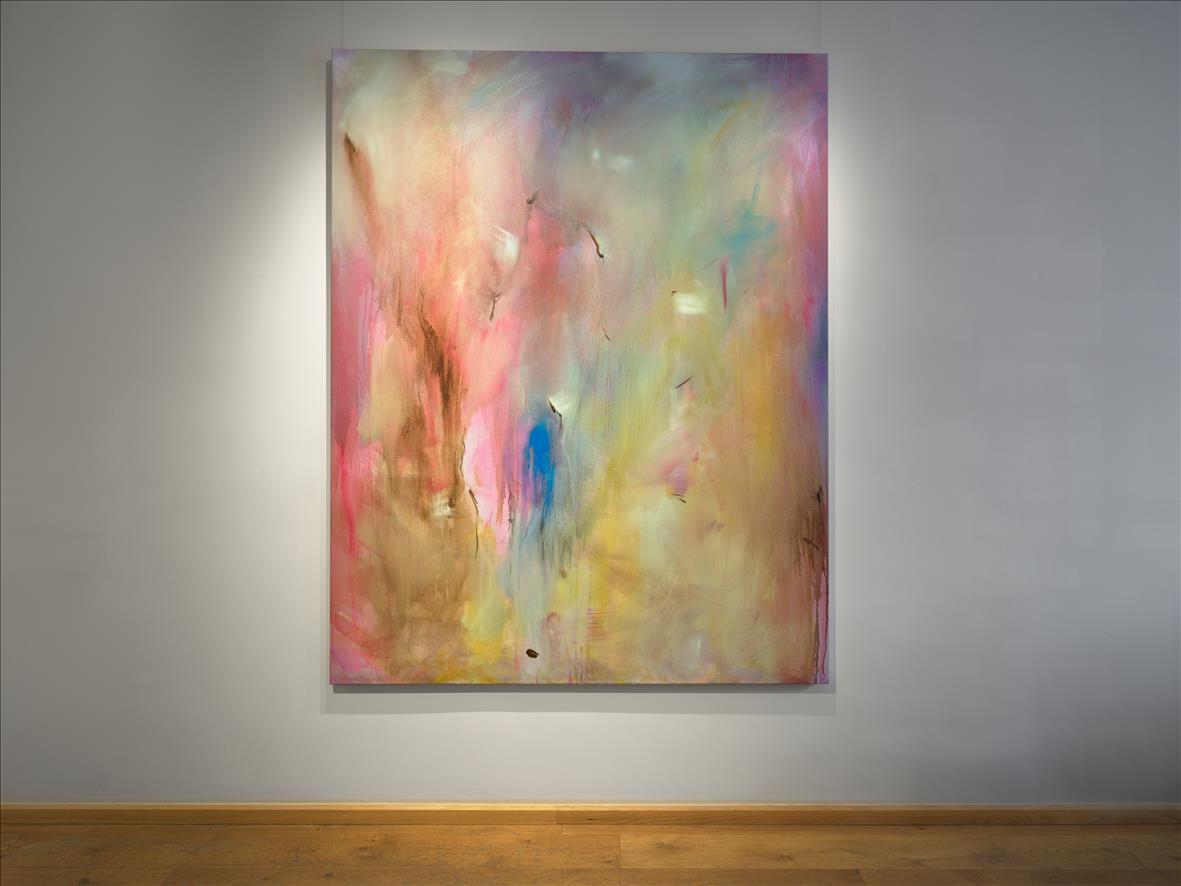
Installation view, Anthony Daley: Resonance. Anthony Daley, Pointer, 2023,
oil on canvas, 213 × 168 cm.
Photography: Stephen White & Co. · Images courtesy of Varvara Roza Gallery
There is much that reproduction and screens can do to share and inspire: one need only imagine Anthony Daley leafing through history of art books in Jamaica as a child to see how vital this dissemination can be.
Standing in the gallery at 8 Duke Street St James's, one is drawn in by sheer scale, the immersive qualities of pigment as it blooms and wanes in dialogue with itself and the light; by the trace of movement left by a brush, held in hand; powered by a conscious body in an accumulation of moments elsewhere: now suspended forever for an unknown audience to experience and make their own.
Lara Julian: You work with a small number of artists at critical moments in their careers. What does that collaboration involve, and what makes this moment in Anthony's career significant?
Isabel de Vasconcellos: Anthony Daley has been active in the London art scene as a painter for more than four decades, and part of a generation of Black British artists whose work featured in important exhibitions examining Black artistic practice in Britain, including Eddie Chambers's The Dub Factor (1992). Yet, in spite of notable exhibitions such as 2022's Son of Rubens, curated by Lisa Anderson at the Dulwich Picture Gallery, his work is yet to be discovered by audiences more. It's something I hope this show and our work around it will begin to put right.
At a moment when we are reconsidering the histories and categories through which British art has been interpreted, Daley's personal and artistic positioning presents an invitation to explore the complexities of cultural identity and artistic inheritance, through works of extraordinary physicality, chromatic intensity and painterly ambition.
Installation view, Anthony Daley: Resonance. Centre: Anthony
Daley, Meanwhile, 2025, oil on canvas, 150 × 130 cm.
Photography: Stephen White & Co. · Images courtesy of Varvara Roza
Gallery
Lara Julian: Your book on the Fourth Plinth explores art in the most public place in London. How does that compare with curating painting in the intimacy of a St James's gallery?
Isabel de Vasconcellos: I find the challenges of working on complex projects in the public realm incredibly fulfilling. I first got a taste for it when I was brought on by Antony Gormley to help deliver his Quantum Cloud commission for the Millennium Dome (now the O2 Arena and part of The Line), and it's been a constant part of my professional life all the way to Saad Qureshi's magnificent Tower of Now commission for Bradford 2025. Realising the visions of brilliant artists requires the pulling together of extraordinary teams of makers, engineers, commissioners and local government. Even though going into contemporary art, I saw my future as being a curator and communicator, it's
enhanced my life in wonderful ways.
My approach is always that work and place are a dialogue, and the beauty of curating is finding the right fit. A painting show in a district with 300 years of art and commerce behind it is a quieter, but no less powerful proposition.
Lara Julian: Varvara Roza has built her gallery on discretion, integrity and work that“elevates collective consciousness”. What has it been like to develop Resonance with her and her team?
Isabel de Vasconcellos: You're right to point out Varvara Roza's integrity and sense of mission. It was the first thing that resonated with me, and decisive in our early conversations.
Varvara has great ambition for her artists, and this is reflected in the professionalism and grounding of the team she has around her, and the trust she extends to them. Working with them all has made this exhibition, as much as anything, a beautiful adventure.
Thank you, Isabel, for such a generous and thoughtful conversation. Anthony Daley: Resonance remains on view at Varvara Roza Galleries, 8 Duke Street, St James's, until 28 November 2026.

Legal Disclaimer:
MENAFN provides the
information “as is” without warranty of any kind. We do not accept any
responsibility or liability for the accuracy, content, images, videos,
licenses, completeness, legality, or reliability of the information
contained in this article. If you have any complaints or copyright issues
related to this article, kindly contact the provider above.


Comments
No comment