


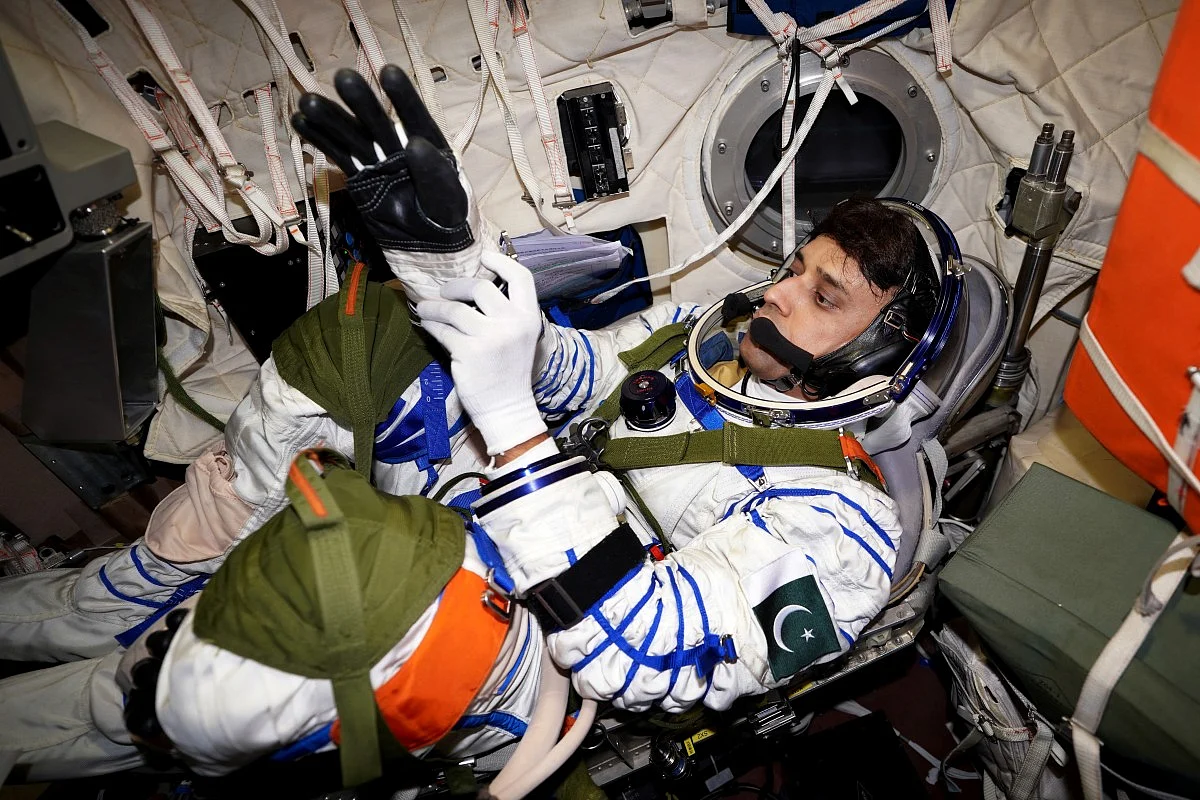
From Islamabad To Space: Pakistanis Celebrate Astronaut's Historic Feat


Ali, a Pakistan Air Force pilot and payload specialist, became the first Pakistani to reach orbit and the first non-Chinese national to board China's Tiangong space station.
Recommended For YouThe recent launch drew an emotional response at the Space and Upper Atmosphere Research Commission (SUPARCO), where attendees had gathered before dawn. That sense of pride was echoed by three Pakistanis who spoke to Khaleej Times, welcoming the milestone while reflecting on the country's ambitions in space.
Stay up to date with the latest news. Follow KT on WhatsApp Channels. For Pakistanis everywhere
M. Nadeem Azam, 60, a retired law professor at the University of Peshawar from Khyber Pakhtunkhwa, said the achievement brought back memories of following the American-Soviet space race as a child.
“To see a son of the soil in space brings me immense joy,” he said, describing the mission as a historic event for Pakistanis everywhere. He added, however, that it was“just a small step” towards space exploration.
Yusuf Kamal, 61, who works in event management and is from Karachi, Sindh, also expressed pride. He recalled watching the first Moon landing as a four-year-old while living in New York, describing Ali's journey as“another first”.
His reaction, however, also raised questions about Pakistan's role in the mission and how far can Pakistan develop its own space capabilities while relying on cooperation with China?
“We need our own," he added, noting Pakistan must develop its own technology to reach space.
Professor Raza Akbar of the Institute of Space Technology described independence as a gradual process, arguing that collaboration, technology transfer and mentorship could help Pakistan develop its capabilities.
Not a one-time successFor Nawabzada Qasim Aslam, 61, from District Mansehra in Khyber Pakhtunkhwa, the achievement should mark the beginning of a continuing effort rather than a one-time success.
“Personally, I feel that this should not be a one-off instance,” he said. Aslam called for Pakistan to prioritise developing the ability to launch rockets into space independently, saying it would open up new opportunities and give the country further reasons for pride. His response points to the expectations that now accompany the celebrations: that the mission should lead to sustained progress.
There are practical foundations on which to build. According to SUPARCO chief Muhammad Yousaf Khan, Pakistan has launched six satellites in the past 30 months. Ali is also due to conduct four experiments selected from more than 300 proposals submitted by Pakistani universities, including research into microalgae, self-healing spacecraft materials and growing quinoa in space.
For the three Pakistanis, the mission is a source of pride, but also a reminder of what remains to be done. Aslam said the achievement showed Pakistanis that they could“achieve and do better in all fields”. The challenge now is to turn the excitement surrounding Ali's flight into continued investment, research and opportunities for the next generation of Pakistani scientists.
'Aim for the Moon and beyond'Meanwhile, Prime Minister Muhammad Shehbaz Sharif congratulated China on the successful launch of the Shenzhou-24 mission from the Jiuquan Satellite Launch Centre on November 25, carrying Pakistan's first astronaut, Muhammad Zeeshan Ali, to the Tiangong Space Station.
He also expressed his gratitude to China "for the opportunity to be part of this historic mission, through which a Pakistani has become the first foreign astronaut to visit China's space station."
Sharif described the mission "as living proof of the ironclad friendship between Pakistan and China, adding that the cooperation between the two countries had now truly reached the stars."
"This was not merely the journey of an individual astronaut, but that of 240 million Pakistanis, embodying, in particular, the dreams and aspirations of the country's youth and scientific community," he added.
Sharif underscored Ali's achievement would inspire Pakistan's youth to aim for the Moon and beyond.
ALSO READ- 'Made history': Pakistan cheers as astronaut flies pioneering mission Meet Zeeshan Ali, first Pakistani to undertake orbital space mission 'Hopes of 250 million' for Pakistani astronaut on China space mission

Legal Disclaimer:
MENAFN provides the
information “as is” without warranty of any kind. We do not accept any
responsibility or liability for the accuracy, content, images, videos,
licenses, completeness, legality, or reliability of the information
contained in this article. If you have any complaints or copyright issues
related to this article, kindly contact the provider above.


Comments
No comment