


Physical AI Model Beats Human Operator In Robot Speed Tests


| Model | Reliability (%) | Successful tasks/min |
|---|---|---|
| Human teleoperation | 94.7 | 1.83 |
| mimic FLUX-mimic-x | 71.2 | 3.08 |
| Nvidia Cosmos3 Nano | 68.7 | 1.24 |
| Runway Praxis-1 | 65.7 | 1.72 |
| OpenAI GPT-6 Astra | 64.1 | 0.45 |
| Black Forest Labs FLUX 3 Action | 63.7 | 1.59 |
| Physical Intelligence π0.5 | 55.6 | 1.58 |
| Nvidia GR00T | 54.8 | 1.64 |
| Ai2 MolmoAct2 | 47.6 | 1.39 |
| Galaxea G0.5 | 42.5 | 1.06 |
Runway's Praxis-1 demonstrated another capability that could prove particularly valuable in commercial robotics applications – recovering from unsuccessful actions without abandoning the task.
When an object slipped from the robot's gripper, Praxis-1 attempted to grasp it again, ultimately completing the task successfully in 66 percent of such episodes.
Of those successful recovery episodes, 79 percent took less than 60 seconds.
Runway released Praxis-1 on November 11 under the Apache 2.0 license, making its model weights available for researchers and developers to use and train further.
The rise of world-action modelsThe results point towards a potentially significant technological shift within the physical AI industry.
While conventional vision-language models learn relationships between images and text, world-action models learn from video how objects move and interact, predicting future video frames alongside robotic actions.
Matov says:“A video model learns how objects move before it sees a single robot action. We think this pretraining is the main reason for its speed and its reliability.”
All four of the highest-scoring dedicated robot models on the PhAIL reliability leaderboard use video-based approaches.
OpenAI's GPT-6 Astra represents a different approach, being a general-purpose AI model controlling the robotic arm rather than a dedicated robot model.
As previously reported by Robotics & Automation News, Positronic Robotics has partnered with AI infrastructure company Nebius to organize a physical AI competition running from October to December 2026.
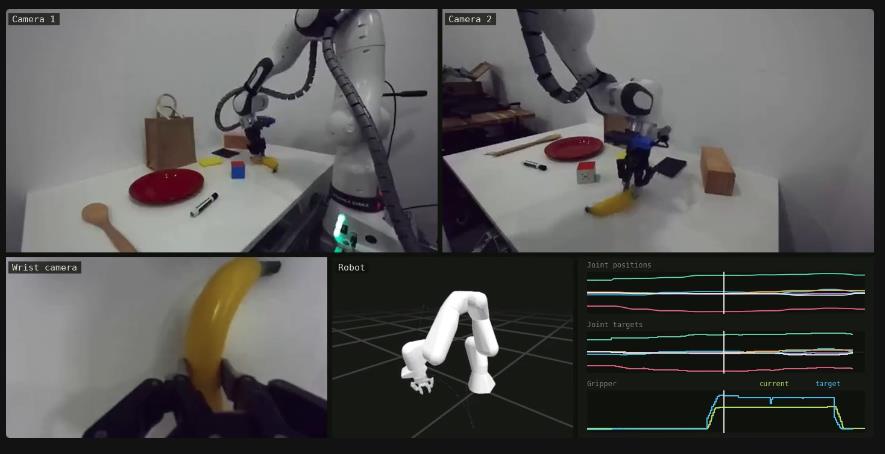
Individual test episodes are publicly available through the PhAIL leaderboard, including video recordings from three camera perspectives.

Legal Disclaimer:
MENAFN provides the
information “as is” without warranty of any kind. We do not accept any
responsibility or liability for the accuracy, content, images, videos,
licenses, completeness, legality, or reliability of the information
contained in this article. If you have any complaints or copyright issues
related to this article, kindly contact the provider above.


Comments
No comment