


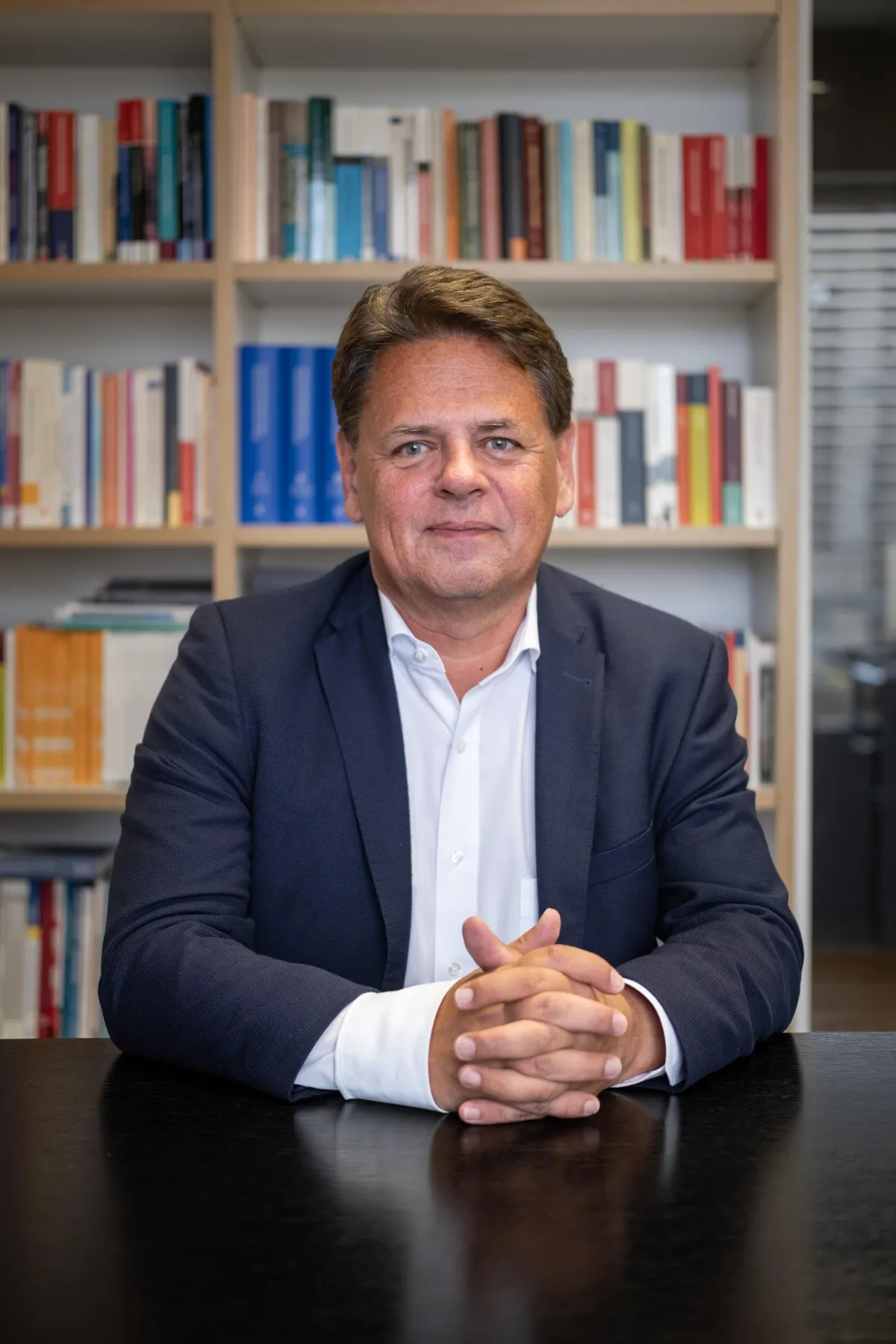
How Polarisation Strains Switzerland's Model Of Compromise


I write about political developments and social issues that are relevant for the Swiss Abroad. As part of the Swiss Broadcasting Corporation's "dialogue" project, I further aim to encourage multilingual debates between the Swiss Abroad and people living in Switzerland. After graduating from the MAZ School of Journalism, I worked as a program director at a local radio station in Basel and reported on political, economic, social and cultural topics. I have been working for SWI swissinfo since 2023.
-
More from this aut
German Departm
-
Deutsch
de
Adrian Vatter, gefährdet die Polarisierung den gutschweizerischen Kompromiss?
Original
Read more: Adrian Vatter, gefährdet die Polarisierung den gutschweizerischen Kompro
Français
fr
Adrian Vatter, la polarisation met-elle en péril le modèle de réussite du compromis suisse?
Read more: Adrian Vatter, la polarisation met-elle en péril le modèle de réussite du compromis su
Italiano
it
Compromesso a rischio:“In Parlamento è sempre più difficile trovare soluzioni condivise”
Read more: Compromesso a rischio:“In Parlamento è sempre più difficile trovare soluzioni condi
日本語
ja
二極化で揺らぐスイスの「妥協政治」
Read more: 二極化で揺らぐスイスの「
العربية
ar
استقطاب حزبي متزايد وتسويات متعثّرة... هل يفقد النموذج السويسري بريقه؟
Read more: استقطاب حزبي متزايد وتسويات متعثّرة... هل يفقد النموذج السويسري ب
Русский
ru
Угрожает ли общественный раскол практике политического компромисса?
Read more: Угрожает ли общественный раскол практике политического компром
Swissinfo: Compromise is the foundation of every democracy. Yet Switzerland is considered a prime example of consensus politics. What sets it apart?
Adrian Vatter: In my view, Switzerland has almost no alternative, given how heterogeneous its society is. Unlike more homogeneous societies, we cannot operate so readily on the principle of“the winner takes it all”. We depend again and again on bringing everyone on board. Under direct democracy, you are sometimes among the winners and sometimes among the losers.
Switzerland has also learnt lessons from its long-running religious conflicts: if economic constraints make a larger state necessary, very different sections of society have to be brought together.
Swissinfo: So the politics of compromise was there from the start?
A.V.: It took a struggle to establish it, and the creation of the federal state in 1848 was preceded by a brief civil war. Over the course of the 20th century, techniques and rules were developed to encourage compromise. These include, for example, the institutionalisation of the consultation procedure and the conciliation conference between the two chambers of parliament.
In addition, almost no other country has as many institutional opportunities for vetoes as Switzerland; we have, among others, the popular initiative, the referendum and the bicameral system. There are numerous mechanisms capable of curbing the power of government.
As a member of the government, you therefore have little choice but to seek compromises and involve the various groups that might, for example, launch a referendum. This is also a key function of the consultation procedure, which developed under the influence of the introduction of the optional referendum: to find solutions at the earliest possible stage that will also stand up to a subsequent popular vote.
Swissinfo: So voters also force politicians to compromise?
A.V.: It is widely accepted in Swiss political science that direct democracy was a decisive precondition for the emergence and development of the system of consensus government. Because the threat of an optional referendum is constantly hanging over members of parliament and the government like a sword of Damocles, they are under pressure to find compromises during the parliamentary process. That is why they try to bring all the key players on board at an early stage. During referendum campaigns, by contrast, the situation can become highly polarised again.
Swissinfo: How has the process of finding compromises in Swiss politics changed in recent years?
A.V.: Until the 1990s, to generalise a bit, compromises were sought mainly behind closed doors, in other words during the pre-parliamentary process. Parliament would then often simply rubber-stamp the compromises reached there.
Over the past 20 years, we have seen a shift. Parliament has become more self-confident and more confrontational. It is no longer willing in every case to wave through compromises negotiated during the pre-parliamentary consultation process. This has also changed lobbying, shifting it away from the pre-parliamentary stage and towards the parliamentary process.
This shift reflects growing competition between political parties, increasing polarisation and a stronger parliament. As a result, the search for compromises has moved further into parliament and, at least in part, become more public.
Swissinfo: Polarisation is increasing and positions are becoming more entrenched. Is this also evident in the way compromises are reached in parliament?
A.V.: Political polarisation certainly has an impact. The parties at the political extremes are particularly keen to make their positions crystal clear. And they are rewarded for doing so.
The problem lies with the centre-right parties: the Centre and the Radical-Liberal Party. They are indispensable to constructive compromise and are willing to work towards it. At the same time, they are under significant pressure, since a compromise-oriented approach to politics makes it harder for them to stand out in an increasingly polarised party landscape.
In recent years, we have observed that certain politicians from these parties have become less willing to compromise. Once that willingness disappears, it becomes enormously difficult to find compromises with genuinely broad support. These centre-right parties are the lubricant that makes consensus politics work at all.
Swissinfo : And these parties are currently losing support.
A.V.: Exactly. Another result of political polarisation is that party discipline in Switzerland's parliamentary groups has increased further in recent years. Strong party discipline means less willingness to reach out to political opponents and make compromises possible. Finding common solutions consequently becomes more difficult.
More More Swiss Politics Our newsletter on Swiss politicsShort political news from Bern: the latest on votes, parliament and new political ideas. Everything you need to keep up to date in a single newsletter.
Read more: Our newsletter on Swiss pol
Legal Disclaimer:
MENAFN provides the
information “as is” without warranty of any kind. We do not accept any
responsibility or liability for the accuracy, content, images, videos,
licenses, completeness, legality, or reliability of the information
contained in this article. If you have any complaints or copyright issues
related to this article, kindly contact the provider above.


Comments
No comment