


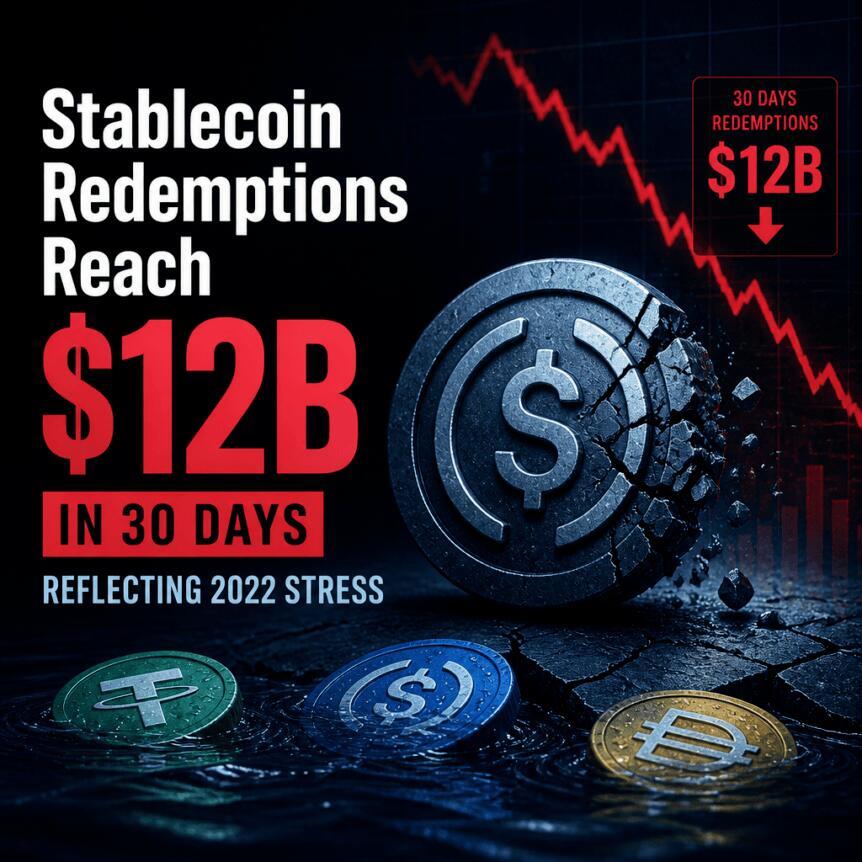
Stablecoin Redemptions Reach $12B In 30 Days, Reflecting 2022 Stress


Kaiko reports that both Tether's USDT and Circle 's USDC-two of the largest stablecoins by market presence-ended the period with about 4% fewer tokens in circulation. Since Nov. 13, total stablecoin supply is down about 0.4%, while USDC supply has edged slightly higher, suggesting the outflow was not evenly distributed across issuers.
Key takeaways- Kaiko estimates about $12B in net redemptions across 11 tracked stablecoins in the 30 days to Nov. 13, a liquidity contraction that resembles 2022 patterns. USDT and USDC both ended the period with roughly 4% fewer tokens in circulation, though USDC supply has risen modestly since Nov. 13. Kaiko data shows USDT trading volume in dollar pairs dropped to around half of its 2025 average over the past month. Nearly 90% of the 30-day stablecoin decline came from Ethereum, while Tron saw a much smaller reduction. Onchain transfer activity for USDT and USDC remains high, averaging about $157B per day this quarter-above 2025's daily average, but below late-2023's pace.
The contraction appears driven by capital leaving crypto rather than funds rotating within it. Kaiko analyst Andrew Yang told Cointelegraph that the overall pattern“looks like capital leaving crypto rather than rotating within it,” pointing to the fact that redemptions reduce the amount of stablecoins available for traders to fund positions.
Yang added that the cash-out leaves market participants with fewer stablecoins on hand to buy other cryptocurrencies, tightening near-term liquidity where stablecoins are used as a bridge between fiat and crypto.
This pullback coincided with two other market developments: outflows from US spot Bitcoin exchange-traded funds and a shift in expectations toward tighter Federal Reserve policy. Together, those forces can influence investor appetite for risk, and stablecoins often act as the funding layer when traders choose to buy-or refrain from buying-crypto exposure.
USDT trading activity softens, orders concentrate near priceWhile stablecoin balances were shrinking, Kaiko found that USDT's trading pace in spot markets slowed. Daily trading volume in USDT pairs was about half of its 2025 average over the past month, according to the firm.
Order book behavior also looked different: Kaiko reported that Bitcoin market makers continued to place orders close to prevailing prices. The dollar value of buy/sell orders within 1% of Bitcoin's market price fell by about 15% over the past month, but the size of those orders measured in Bitcoin increased by about 9% in aggregate-suggesting that fewer dollars were committed near the top of book even as the crypto-denominated amount remained relatively sizable.
Where the supply fell: Ethereum leads, Tron lagsMost of the stablecoin reduction came from Ethereum. Kaiko estimates that nearly 90% of the 30-day decline in stablecoin supply originated on the Ethereum network, underscoring how closely exchange access and decentralized finance activity are tied to liquidity on that chain.
By comparison, Tron experienced a far smaller contraction: stablecoin supply there fell about 1.4% over the same period. The divergence matters for market structure because it suggests that the liquidity squeeze is concentrated in the venues and ecosystems most connected to Ethereum-based trading and settlement.
Even with supply trending down, onchain movement remains active. Kaiko said USDT and USDC transfers averaged about $157 billion per day so far in the current quarter. That is higher than the 2025 daily average of $130 billion, though still below the pace seen in the fourth quarter of last year.
How this compares with the 2022 bear marketDuring the 2022–2023 downturn, rising interest rates and declining crypto prices contributed to months of stablecoin redemptions from fiat-backed tokens, Yang said. In that earlier cycle, stablecoin supply contractions tended to reflect a broader move toward holding cash-like assets rather than sustaining crypto exposure.
Yang described the current pullback as“much smaller” than that 2022 period, but noted that the timing still resembles a shorter-term cycle: stablecoin supply fell from mid-May into June before stabilizing in August. This matters for investors because it frames the present reduction as potentially tactical rather than immediately structural-though the data so far still points to a meaningful liquidity headwind.
Blockchain analytics firm CryptoQuant offered additional perspective. Its head of research, Julio Moreno, said that for USDT the latest decline is the largest since 2022. Moreno linked the move to a broader retreat from risk assets, including stocks and commodities. He also pointed to CryptoQuant's tracking showing USDT market capitalization down by about $9 billion over the past 60 days.
Moreno measures USDT supply as a proxy for the funds available for trading. He told Cointelegraph that exchanges hold about 51% of the USDT circulating on Ethereum. That concentration implies that when supply declines-especially on Ethereum-it can quickly translate into reduced inventory for trading pairs and market-making activity.
Moreno also noted that USDT supply was shrinking when Bitcoin bottomed in November 2022. He said stablecoin supply would likely need to increase again for liquidity to improve and for the market to recover.
For now, readers should watch whether the recent stabilization in total stablecoin supply persists, and whether the next shifts in stablecoin issuance or redemptions line up with ETF flows and macro expectations tied to Federal Reserve policy. The chain-level concentration-especially the dominance of Ethereum in the decline-will also remain a key detail for anyone assessing where liquidity could tighten or return first.
Risk & affiliate notice: Crypto assets are volatile and capital is at risk. This article may contain affiliate links.
Legal Disclaimer:
MENAFN provides the
information “as is” without warranty of any kind. We do not accept any
responsibility or liability for the accuracy, content, images, videos,
licenses, completeness, legality, or reliability of the information
contained in this article. If you have any complaints or copyright issues
related to this article, kindly contact the provider above.


Comments
No comment