


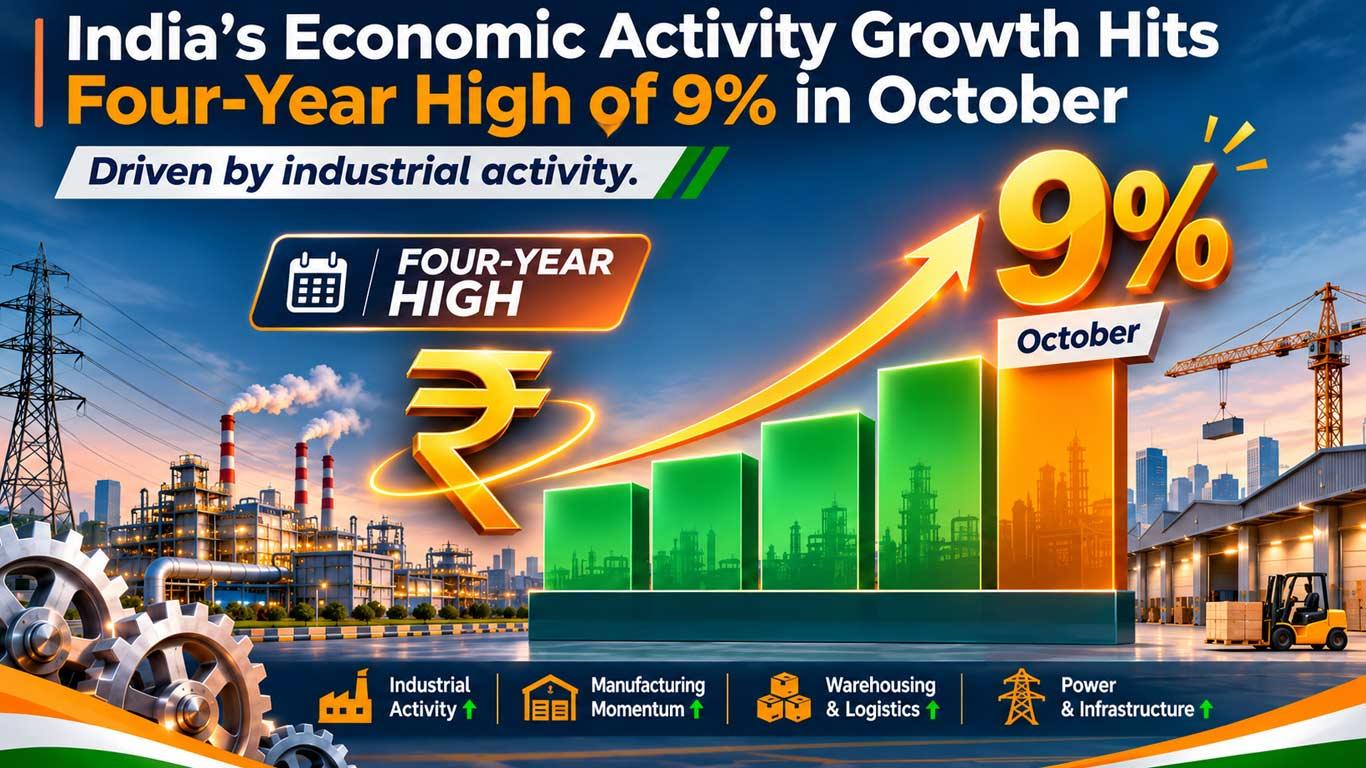
India's Economic Activity Growth Hits Four-Year High Of 9% In October, Driven By Industrial Activity: Jefferies


The Jefferies Economic Indicator (JEI), which tracks 35 monthly indicators, improved by 2.2 percentage points month-on-month in October. "The improvement was broad-based, with several industrial and movement indicators at multiyear highs," the report said.
However, Jefferies cautioned that the delayed festive season and shifting of Diwali-related shutdowns to November had boosted October activity, potentially leading to some moderation in November, as per ANI.
Industrial Activity and Consumption Trends
Electricity demand grew 22 percent year-on-year in October, its highest growth in 15 years, excluding the post-Covid surge in April 2021.
Diesel demand increased 12 percent, a three-and-a-half-year high, while port traffic growth reached 19 percent, its highest in three years.
Festive consumption remained mixed. UPI transaction values increased around 18 percent year-on-year, indicating resilient spending.
However, two-wheeler retail sales grew only 4 percent, while passenger vehicle sales declined 7 percent. Jefferies also noted that smartphone sales faced volume pressure due to sharp price increases.
Rural Demand Remains Weak
Rural demand indicators remained subdued following a weak monsoon. Demand for work under the employment guarantee scheme increased around 82 percent year-on-year.
"Rural wage growth of 3.3 percent YoY in Sep '26 is close to a 5-year low, amid rising rural inflation affecting real wages," the report noted.
Meanwhile, capital expenditure indicators remained strong, with cement production growing 15 percent and steel consumption rising 7 percent in October.
Inflation and Banking Liquidity Under Pressure
Bank credit growth reached a nearly 12-year high of 19.5 percent, while deposit growth moderated to 17 percent.
Wholesale inflation remained near a four-year high at 12.2 percent, while retail inflation reached a two-year high of 6.1 percent.
Banking system liquidity also moved into a deficit of Rs 10,000 crore, compared with an average surplus of Rs 2.4 lakh crore in October, following the Reserve Bank of India's shift towards a 'calibrated tightening' stance.
(KNN Bureau)

Legal Disclaimer:
MENAFN provides the
information “as is” without warranty of any kind. We do not accept any
responsibility or liability for the accuracy, content, images, videos,
licenses, completeness, legality, or reliability of the information
contained in this article. If you have any complaints or copyright issues
related to this article, kindly contact the provider above.


Comments
No comment