


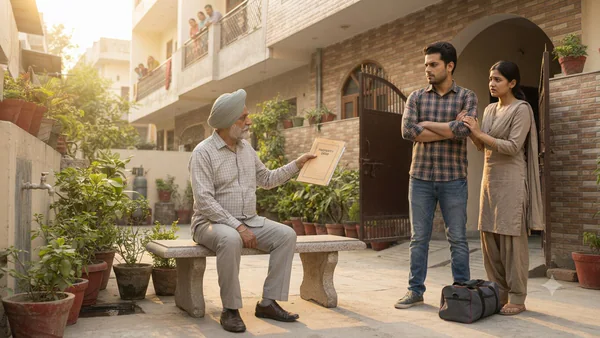
Delhi HC Says Senior Citizens Can Evict Children From Own Property Without Proving Harassment, Ill Treatment


The statement was made by the court while allowing an 85-year-old man's plea against orders passed by the District Magistrate and the Divisional Commissioner. The senior citizen moved court seeking eviction of his eldest son and daughter-in-law from his house in South Delhi's Masjid Moth, reported news agency PTI.
The court directed the couple to vacate the property within four weeks. It also asked the concerned Station House Officer (SHO) to provide the senior citizen with necessary police assistance to ensure compliance, the news agency added.
The court noted that the petitioner was the absolute owner of the property. However, the son and daughter-in-law had no ownership claims. Reportedly, they resided in the house solely because of their relationship with the 85-year-old.
According to Live Law, the judgement was passed on November 20, 2026, in Subhash Chander Malhotra v. Raman Malhotra & Ors.
Also Read | Lakshmi Venu moves Madras HC for partition of Venu Srinivasan family assets Why senior parents can evict their children from homeJustice Mahajan held that the authorities had wrongly insisted that the senior citizen establish allegations of harassment through clear and cogent evidence before ordering the eviction. The court said that neither the 2007 Act nor the Delhi Maintenance and Welfare of Parents and Senior Citizens Rules, 2009, mention such a requirement.
It observed that mistreatment cases involving elderly parents often take place within the confined walls of homes, which may make it difficult to report with evidence.
The High Court also raised questions regarding two enquiry reports submitted by the Sub-Divisional Magistrate (SDM). The first report, filed on February 25, 2023, reportedly only stated that the harassment claims could not be verified. The second report, filed on September 17, 2025, also mentioned that harassment had not been established. However, the evidence or findings behind the conclusion remain missing in the reports.
The court said a conclusion without supporting evidence cannot be treated as a finding. It also dismissed the authorities' reliance on a business dispute between the petitioner's sons as a reason to dismiss his grievance.
Similar rulingsHC relied on the Supreme Court 's August 2026 ruling in Ravi Kant Gupta v. State of Uttar Pradesh, which recognised the power of Maintenance Tribunals to order eviction where necessary to protect senior citizens. It also referred to Pritam Singh v. Government of NCT of Delhi, which clarified that proof of ill-treatment is not always required for eviction.
Case historyThe petitioner had acquired the property from the Delhi Development Authority in 1980, which was later converted into freehold in 2000.
According to PTI, the dispute arose years ago when the senior citizen approached the authorities in 2022. He had alleged that his son and daughter-in-law had refused to vacate despite being asked to.
The District Magistrate rejected his plea in August 2023 and again in October 2025, which was also upheld by the Divisional Commissioner in April 2026. The senior citizen subsequently approached HC.

Legal Disclaimer:
MENAFN provides the
information “as is” without warranty of any kind. We do not accept any
responsibility or liability for the accuracy, content, images, videos,
licenses, completeness, legality, or reliability of the information
contained in this article. If you have any complaints or copyright issues
related to this article, kindly contact the provider above.


Comments
No comment