


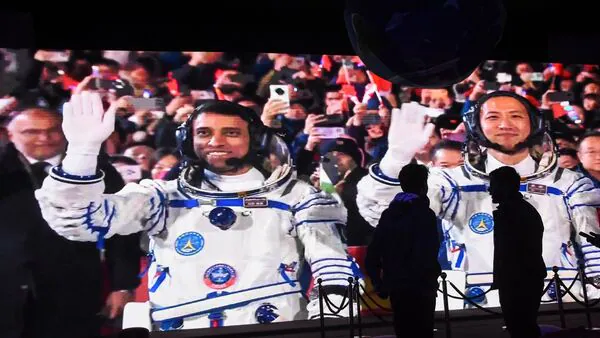
Pakistan's First Astronaut Reaches China's Space Station: What Xi Jinping, Asif Ali Zardari Said In Letter Exchange


However, the milestone also underscores Pakistan's dependence on Beijing for access to human spaceflight, with the mission being conducted under China's space programme rather than an independent Pakistani initiative.
While Islamabad has described the development as a major achievement, the flight highlights the gap between Pakistan's space ambitions and its ability to independently send astronauts into orbit.
The mission also provided an opportunity for Pakistani President Asif Ali Zardari and Chinese President Xi Jinping to reaffirm their strategic partnership.
The two leaders exchanged congratulatory letters, presenting the spaceflight as another symbol of bilateral cooperation as the countries mark 75 years of diplomatic relations.
The Shenzhou-24 spacecraft carrying Ali docked with China's Tiangong space station at 11:56 AM (0356 GMT) on Wednesday, around three-and-a-half hours after lifting off from the Jiuquan Satellite Launch Centre in northwestern China aboard a Long March-2F rocket.
The 40-year-old pilot will serve as a payload specialist and is expected to spend five to 10 days aboard the station.
He is accompanied by Chinese astronauts Tang Hongbo, the mission commander, and flight engineer Wu Yi.
What Asif Ali Zardari said in his letter to Xi JinpingIn his letter to Xi, Zardari congratulated the Chinese government and people on the successful mission and expressed appreciation for selecting Pakistan as the first foreign partner in China's human spaceflight programme.
He acknowledged the support of the China Manned Space Agency (CMSA) and the Astronaut Centre of China, whose technical expertise and assistance made the collaboration possible.
Zardari described the achievement as a reflection of China's progress in space science and technology and its commitment to international cooperation in the peaceful exploration of outer space.
Also Read | Dany Group buys former US Consul General's Karachi home: What's next?He also presented the mission as evidence of the longstanding friendship and mutual trust between Pakistan and China.
Highlighting cooperation between CMSA and Pakistan's Space and Upper Atmosphere Research Commission (SUPARCO), he said the partnership had opened new avenues for scientific research, technological development and space exploration.
The Pakistani president said the mission would inspire young Pakistanis to pursue scientific research, innovation and technological advancement.
He also linked the achievement to the 75th anniversary of diplomatic relations between the two countries, expressing hope that it would provide fresh momentum to cooperation in space science, research, technological innovation and capacity building.
What Xi Jinping said about Pakistan-China relationsIn his response, Xi congratulated Pakistan's government and people, along with the astronauts and teams from both countries involved in the mission.
Describing Pakistan and China as all-weather strategic cooperative partners, Xi said their friendship had remained strong throughout the 75 years since the establishment of diplomatic relations.
He said the participation of astronauts from both countries in space exploration represented their deep-rooted friendship and marked another outcome of bilateral cooperation.
Xi also emphasised the importance of international partnerships in the peaceful exploration of outer space.
Describing China's space station as an "ark of peace, friendship and cooperation", he said Beijing was ready to work with Pakistan and other countries to deepen international space cooperation and improve global governance of outer space.
He added that such cooperation should ensure that the benefits of space exploration are shared by humanity.
Why Pakistan's first human spaceflight mattersFor Pakistan, the mission offers international visibility and access to China's advanced human spaceflight infrastructure.
But it should not be confused with an independent breakthrough in the country's space capabilities.
The spacecraft, launch vehicle and space station are all part of China's space programme. Pakistan's participation has been facilitated through its partnership with Beijing, with SUPARCO working alongside Chinese space agencies.
The arrangement highlights the disparity between China's established human spaceflight capabilities and Pakistan's reliance on external support to put an astronaut into orbit.
The exchange of letters between Xi and Zardari, meanwhile, shows how both governments are using the mission to reinforce the political narrative of their longstanding strategic relationship.

Legal Disclaimer:
MENAFN provides the
information “as is” without warranty of any kind. We do not accept any
responsibility or liability for the accuracy, content, images, videos,
licenses, completeness, legality, or reliability of the information
contained in this article. If you have any complaints or copyright issues
related to this article, kindly contact the provider above.


Comments
No comment