


Why Are People Listening To Train Journeys To Fall Asleep?


Sleep stories on meditation apps revive one of humanity's oldest practices, bedtime storytelling, and repackage it for the digital age. Since their introduction on the meditation app Calm, they have been listened to more than 1 billion times. At a time when many adults struggle to fall or stay asleep, their popularity suggests a growing interest in stories that offer something different from conventional narratives.
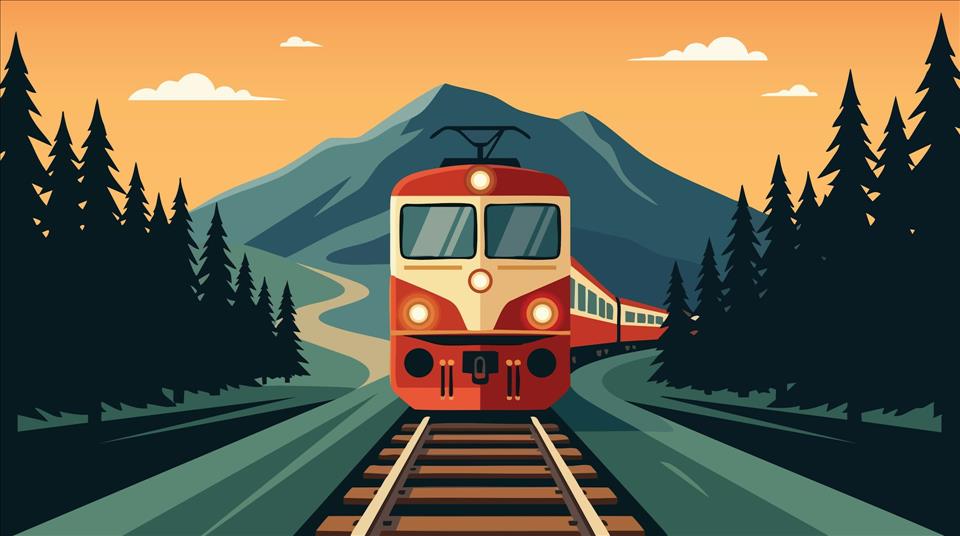
One of the most popular forms of sleep story is the train genre, which features scenic rail journeys through a variety of real and fictional landscapes around the world. You could travel through Johannesburg in Africa, Darjeeling in Asia and Switzerland in Europe or even take a magical ride on the North Pole's Christmas Express.
Some of the most famous stories set on trains feature action, murder and mystery, often requiring a bit of detective work from the reader. Think Murder on the Orient Express by Agatha Christie (1934) or Strangers on a Train by Patricia Highsmith (1950). The train-themed sleep stories in Calm's library are very different. These audio narratives contain no conflict, suspense or adversary. They are designed to be engaging – but not so engaging that listeners will still be awake to hear the ending.
The train journey is particularly well suited to this purpose. Its steady movement along a predetermined route transforms falling asleep into a journey in which the listener can relinquish control and simply be carried towards their destination.
A study of train sleep stories I worked on with Paula Ghintuialǎ, an expert in how style in language and screen media shapes interpretation, explores the recurring linguistic features and storytelling choices that make these narratives unique, and which encourage sleep. Understanding how these unusual stories work offers an opportunity to rethink the linguistic and narrative strategies through which stories both hold, and deliberately release, our attention.
Sleep is a journeyEach story is structured around the same metaphor: sleep as a journey. The listener becomes the traveller, relaxation becomes movement along the route and sleep becomes the destination. Importantly, the journey is smooth and stress-free. Trains run on time, the seat is comfortable and spacious, and fellow passengers are few and quiet.
Every story also has a narrator who becomes your travelling companion. First, they give instructions for relaxing. You are told to“take in a few long deep breaths”, to“close your eyes” and to“let the weight of your body sink comfortably into your bed”. Similar to guided meditation practices, you are addressed through direct second-person (“you”) to help focus your attention on your immediate physical or physiological experience.
Gradually, you become a character inside the story. The narrator continues their instructions asking you to“imagine” or“picture” yourself, to shift your focus to another time and place.
Through these invitations, listeners are encouraged to inhabit the perspective of a fictionalised character who embarks on a journey. Instead of thinking about tomorrow's meeting or an unfinished email, you're crossing the Scottish Highlands or travelling through the Alps. These characters are generic and simply described, in order to make this embodiment a more effortless experience.
Along for the rideAnother key feature of these stories is that you don't have to exert a lot of energy, nor do any active decision-making. Your actions take place within the confines of the train and are performed in the simple present –“you enter”,“you walk through”,“you come to”. This creates a perpetual“now”, similar to the language of mindfulness and guided imagery. These actions are also often low-energy, and paired with moments of reflection or reception. For instance, you are told that you“look”,“watch” or“see” and“notice”,“think” or“remember”.
In contrast, verbs describing the train's movements are dynamic and incomplete (“running”,“passing”,“rolling”,“crossing”). Taken together, these patterns suggest continuous movement along a pre-set path, and establish a sense of ongoing, ambient motion. In other words, the train does the travelling for you. The route has already been decided, so all you have to do is be carried along it.
Finally, at the end of the journey, you're described as disembarking the train, reaching a hotel room and settling into a bed. In these closing moments, the narration reconnects the fictional journey with the listener's physical position. You might be told, for instance, that you climb into the wide bed, savouring the clean, pressed linen. The train, meanwhile, continues without you. You are asked to imagine it receding into the distance, while the end point of your own metaphorical journey – the destination of sleep – has been reached.


Legal Disclaimer:
MENAFN provides the
information “as is” without warranty of any kind. We do not accept any
responsibility or liability for the accuracy, content, images, videos,
licenses, completeness, legality, or reliability of the information
contained in this article. If you have any complaints or copyright issues
related to this article, kindly contact the provider above.


Comments
No comment