


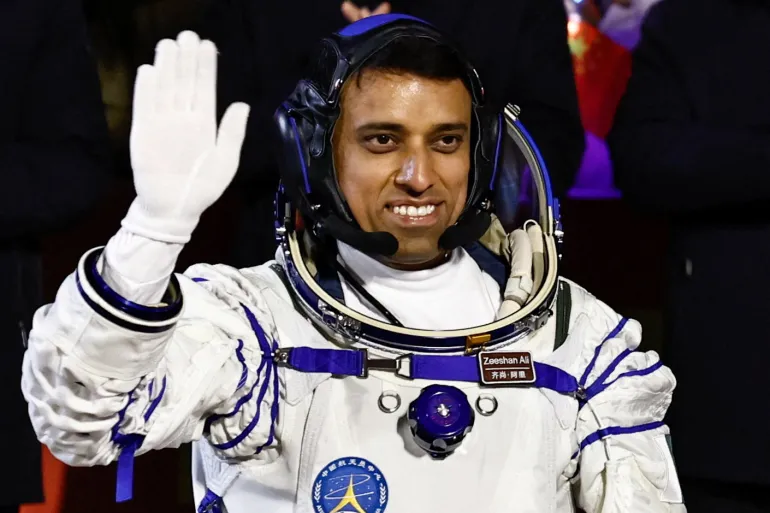
Pakistan Sends First Astronaut To China's Tiangong Space Station


Muhammad Zeeshan Ali lifted off early Wednesday, November 25, aboard the Shenzhou-24 spacecraft, carried by a Long March-2F rocket from the Jiuquan Satellite Launch Centre in China's Gobi Desert. The spacecraft entered its planned orbit, with two Chinese astronauts, Tang Hongbo and Wu Yi, also aboard, according to the mission report published by Reuters on Wednesday.
The Pakistani astronaut is expected to travel to China's Tiangong space station, where he will spend approximately one week conducting scientific experiments in microgravity and participating in educational activities. The mission marks Pakistan's first participation in a government-sponsored orbital human spaceflight programme.
The flight represents a significant step in space cooperation between Islamabad and Beijing, which have expanded collaboration in satellite technology, communications, Earth observation and remote sensing over the past decade.
The spacecraft successfully docked with Tiangong approximately three hours and 38 minutes after liftoff, making Ali the first foreign astronaut to board China's space station. The China Manned Space Agency confirmed the docking, marking a milestone in Beijing's efforts to open its space programme to international partners.
Ali, a 40-year-old former Pakistan Air Force pilot, is serving as a payload specialist rather than a tourist. He is expected to spend between five and 10 days aboard the station, conducting scientific experiments and working alongside Chinese astronauts. Reuters reported on November 25 that he had completed seven months of training in Beijing, including intensive Chinese-language instruction and preparation for spaceflight operations.
Pakistan targets the Moon by 2035.
For 72-year-old electronics engineer Saif- Islam Qureshi, Pakistan's growing interest in space reflects five decades of efforts to promote astronomy. He began observing the night sky at the age of 12 with a small pair of binoculars, starting with the Big Dipper constellation. Qureshi later co-founded PakAstronomers, an organisation that introduced astronomy to schools, universities and public spaces, helping young people learn about planets and stars. He said interest in astronomy had grown significantly over the past decade, describing it as a positive wave of enthusiasm among Pakistan's younger generation.
Pakistan is also setting its sights on future space exploration. Speaking before the launch, Muhammad Yousaf Khan, chairman of the Space and Upper Atmosphere Research Commission (SUPARCO), said the country aims to reach the Moon by 2035. He told Al Jazeera that Pakistan's first step would be to send a lunar rover in 2028. Khan said cooperation with China could help Pakistan gradually develop its own space capabilities and achieve further milestones in exploration.
For Pakistani students and astronomy enthusiasts, Muhammad Zeeshan Ali's journey represents an opportunity to advance the country's scientific ambitions. Farooq, a physics undergraduate at the National University of Sciences and Technology (NUST), said cooperation with China could provide access to established space technology and platforms, helping Pakistan develop satellites and expand scientific research. Qureshi described Ali's launch as a moment of national significance, saying it symbolised the aspirations of an entire generation rather than the achievement of one astronaut alone.
The mission's scientific programme includes around 90 experiments and technology tests, according to the China Manned Space Agency. Four projects involve cooperation between China and Pakistan in biotechnology and materials research. Ali is also expected to conduct an experiment involving photosynthetic cyanobacteria, which could contribute to research into biological systems for future space missions.
The mission is the first time China has included a foreign astronaut in its crewed space programme and reflects the growing strategic and technological partnership between Beijing and Islamabad. The two countries have expanded cooperation in satellite technology, communications, Earth observation and remote sensing.
China is also seeking to position Tiangong as an international platform for scientific research and cooperation, particularly as the future of the International Space Station approaches uncertainty. The United States and its partners currently operate the ISS, while Beijing has developed its own orbital station after being excluded from the international project.
Pakistan's achievement follows the country's earlier milestone in 2023, when Namira Salim became the first Pakistani to travel to space through a Virgin Galactic suborbital tourism flight. However, Ali's mission represents a different level of participation, taking him into orbit to live and work aboard a space station.
Pakistani officials have described Ali's mission as a landmark for the country's scientific ambitions and its partnership with China. Ali has said he hopes the cooperation will lead to further joint missions, potentially extending to future lunar and Mars exploration.

Legal Disclaimer:
MENAFN provides the
information “as is” without warranty of any kind. We do not accept any
responsibility or liability for the accuracy, content, images, videos,
licenses, completeness, legality, or reliability of the information
contained in this article. If you have any complaints or copyright issues
related to this article, kindly contact the provider above.


Comments
No comment