


TRIPP, Trade And Security Redraw Washington's Caucasus Priorities In Caspian


On November 22, a U.S. Homeland Security Secretary traveled to Baku with a mandate that was global in scope. Markwayne Mullin went to meet President Ilham Aliyev to talk about a strategic alliance and the developing peace between Azerbaijan and Armenia. The official narrative focused on the diplomacy of Donald Trump and the planned Trump Route for International Peace and Prosperity, or TRIPP. But part of the importance of the trip was in the meaning of the trade route itself, as more than just a train, but in who is watching the goods and protecting the ports and the data.
The US is trying to deepen its role in a region where Russia and Iran have longstanding interests, without sending its warships into the Caspian Sea. Azerbaijan, meanwhile, wants American expertise and stronger east-west trade, but not the role of a forward base in somebody else's confrontation. That tension may determine whether the new relationship becomes durable.
The political groundwork was created on February 10, when the U.S. Vice President JD Vance and Aliyev signed the charter of strategic partnership. The text of the document touches upon such topics as customs control, border crossing, logistics at sea, cybersecurity, critical infrastructure, and counterterrorism. There was a need to form working groups that would turn ambitions into projects.
But there was one concrete declaration made by Vance: boats from Washington would be sent to assist Azerbaijan in protecting its territorial waters. The number of boats and other technical specifications were not revealed by him. Still, it is possible to understand from this declaration how Washington may cooperate in terms of security with Azerbaijan's coast guard. This decision can be understood through geography and international law. In the 2018 agreement on the Caspian, signed by all five countries along its coast, there will be no armed forces of foreign states. The agreement does not allow the use of the territory of one of the parties in order to conduct aggressive actions towards other parties. The US previously helped with patrolling and border control of the seas that were the subject of protection.
The sea has also lost any claim to being insulated from wider conflict. Israeli strikes in March targeted Iranian naval facilities at Bandar Anzali on its southern shore, illustrating how quickly an inland trading basin can acquire the risks of a military theatre.
"Iron Gate" initiative
Well, there is another initiative by the Americans which must not be taken for the stated agenda of Mullin. The Task Force Iron Gate was created by the United States Central Command on November 7. It includes about 20 people from the civil and military sectors, working from Tampa and focusing on disrupting the shipment of sophisticated weapons, dual-use technology, and sanctioned materials through Iran's borders in the Caspian region. According to Reuters, Russian-Iranian trade routes have been used to bypass sanctions.
The complaints from Tehran are on record, indeed. According to Iran's deputy foreign minister for European affairs, Kazem Gharibabadi, he“discussed possible measures to oppose the US-led scheme with the Russian ambassador.” This shows how there is something awkward about the U.S. strategy, namely that a customs database or tracking system can be considered a tool of trade security by one nation but economic pressure by another. There is no report of any request by Mullin for Azerbaijan to join Iron Gate, so claiming so would be not other than a speculation.
Economics of secure crossing
Now, the key point to emphasize is the security of trade routes that hold global significance. Although participants in the Middle Corridor initiative often focus on the project's profitability, this aspect must take precedence. Recent developments in the Strait of Hormuz have undeniably heightened the importance of the Middle Corridor - and, notably, the Caspian Sea, which stands as the "jewel" of this route. In this context, the recent maritime attacks on two separate occasions [e.g., Ukraine and Israel strikes] have brought the issue of security sharply into focus.
For Baku, for example, the immediate commercial prize is considerable. In January–September 2026, 4.1mn tonnes of freight moved through Azerbaijan along the Middle Corridor, a rise of 20 per cent from a year earlier. The Port of Baku handled 100,000 twenty-foot-equivalent containers, up 29 per cent. Its planned expansion would eventually lift annual container capacity to 500,000. These are signs of demand, not proof that every additional railway or port project will pay for itself.
Bottleneck issues are becoming more administrative as well as physical in nature. The containers will have to be loaded onto ships, transferred to trains, go through various jurisdictions, and arrive with documentation that will be easy to anticipate. Customs declarations in electronic form, risk-based inspections, interoperability of cargo information, and secure ports could reduce bottlenecks while detecting prohibited shipments.
Caspian Sea and Black Sea form the same commercial equation. Goods shipped from Central Asia first arrive in Azerbaijan via water and then go through Georgia and into Europe. Thus, any disruption in the Caspian ports could have a domino effect on the economy thousands of kilometers away. Maritime security is important not only because of the patrol ships but also for the dependable schedule and low insurance costs.
Iran's red line...
TRIPP introduces an additional test. The plan for the route from southern Armenia will link mainland Azerbaijan with Nakhchivan and provide more western transportation options. In Dublin on November 12, President Aliyev and Nikol Pashinyan, Prime Minister of Armenia, talked about the construction of its railway and road infrastructure. Also, they mentioned that 105,000 tonnes of goods had been delivered to Armenia through Azerbaijan after November 2025. These deliveries represent transit cooperation; however, they are not the cargo transported by the already constructed TRIPP railway.
Iran perceives and has always perceived the shifting map differently. On November 23, Mohammad Mokhber, the adviser to Iran's supreme leader, argued that“fake routes” cannot substitute the existing corridors and that Iran's interests in the region represent a red line. Such worries on Tehran's part stem both from economic competition and dissatisfaction with foreign security presence in the neighbourhood. A route providing shippers more options looks like an encroachment on the adjacent country's sphere of influence.
Azerbaijan has set out a limit of its own. Its Foreign Minister said in January that the country would not allow its territory or airspace to be used for military operations against Iran; President Aliyev reiterated in March that Azerbaijan would not participate in such operations. That position does not preclude cooperation on customs or maritime safety. It does make any assumption that Baku has enlisted in an American containment campaign misleading.
Bottom line
Washington and Beijing can both benefit commercially from improved transit across the South Caucasus, even while competing elsewhere. China's exporters seek alternative connections to Europe; American businesses want secure supply chains and access to critical minerals. This is overlapping commercial interest, not an emerging US–China alliance. Azerbaijan's advantage is precisely that the corridor need not belong exclusively to either power.
So, the visit of Mullin does not signal any military realignment, nor does it mean any unambiguous commercial progress. Instead, it signals the competition for the regulation and technologies of the transport of goods between two seas. The success of Washington means stable and prosperous trade and partners; the success of Baku means obtaining all that without losing any freedom of manoeuvre. In the Caspian, this is turning into the most important kind of sovereignty.
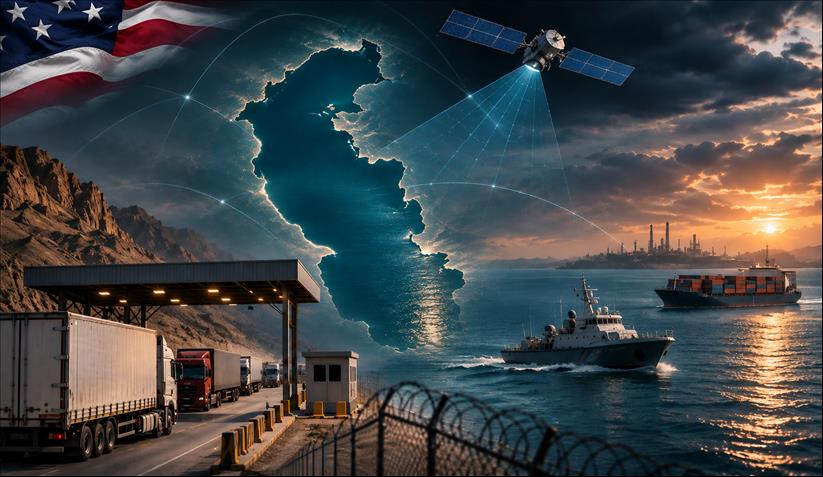
*cover image created by artificial intelligence

Legal Disclaimer:
MENAFN provides the
information “as is” without warranty of any kind. We do not accept any
responsibility or liability for the accuracy, content, images, videos,
licenses, completeness, legality, or reliability of the information
contained in this article. If you have any complaints or copyright issues
related to this article, kindly contact the provider above.


Comments
No comment