


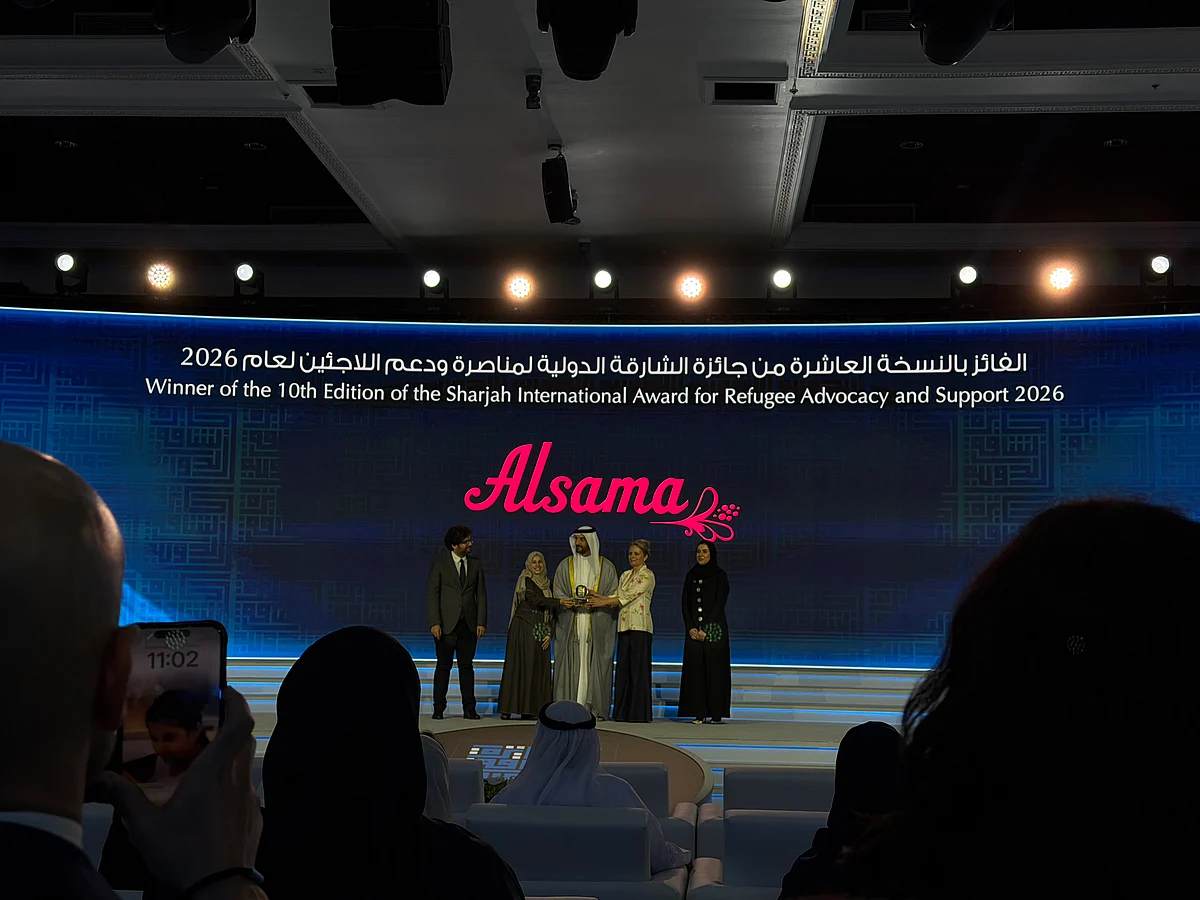
Lebanese Project Wins Sharjah Refugee Award As All Ten Winners Gather For 10Th Anniversary


- By: Ruqayya Al Qaydi
Lebanon's Alsama Project, which helps refugee and displaced teenagers return to education after years out of school, was presented with the 2026 Sharjah International Award for Refugee Advocacy and Support on Wednesday. Representatives of all ten organisations honoured since 2017 attended the award's tenth anniversary ceremony.
Recommended For YouThe award is organised by TBHF in collaboration with UNHCR, the UN Refugee Agency. The winner receives AED 500,000 to expand its work.
Alsama's accelerated learning programme has reached 3,277 students across five education centres in Beirut and Homs. Sixteen of its graduates have gone on to higher education, at universities in Lebanon, Canada, the United Kingdom and India.
Stay up to date with the latest news. Follow KT on WhatsApp Channels.
Alsama began in January 2020 and opened its first learning centre that November. Its levels run from complete illiteracy to international baccalaureate standard. This year its first graduating cohort of 17 students moved on to jobs and universities abroad.
'From illiteracy to the world stage'While accepting the award, Alsama's co-founders, Meike Ziervogel, Co-Founder and Chief Executive Officer, and Kadria Hussien, Co-Founder and Chief Operating Officer – Education, said the programme was shaped by what its students asked for.
When students asked for higher education, Alsama created an accelerated programme that lets teenagers who arrive unable to read or write complete about twelve years of schooling in six. When they asked for a qualification equal to a secondary certificate, it developed the international G12++ certificate in partnership with Cambridge University Press & Assessment.
“Today I can say with pride that our students go from illiteracy to the world stage,” Meike Ziervogel said, adding that students who have endured displacement gain resilience and adaptability.“These are the future leaders the world needs.”
Students tell their storiesAlsama's co-founder Kadria Hussien told the audience the story of Wessal, a student from a very small village in Deir Ezzor, Syria. The war and displacement cut short her education, and she became a refugee in Beirut's Shatila camp.
She joined Alsama in 2020 completely illiterate, unable to read or write. After six years she graduated this year and moved to Canada, where she is studying psychology.
A film shown at the ceremony featured also Maram, 19, from the countryside of Deir Ezzor. Her family moved to Lebanon after the war in Syria and settled in Shatila camp.
She said she spent three years not studying at all, because girls were not allowed to leave the home. She and other girls then asked Alsama's leaders to teach them to read and write, learn Arabic and English, and study maths.
Luai, speaking on a panel, said he found cricket by chance, entering a playground out of curiosity and joining the game. He said he used to take his sister to Alsama's centre for awareness sessions and creative writing, and felt envious because he was working and could not study.
He asked Alsama's leaders why boys could not join if they believed in gender equality, and he was admitted. After six years, he is studying business and management at university. He took leave from his studies to attend the ceremony and he now holds a quality assurance and strategy role in cricket.
Luai said he hopes to see Alsama open more centres in north-east Syria, including Raqqa, an area he said has been marginalised and where education has been neglected.
The panel was moderated by Stanley Anigbogu, founder of LightED Impact Foundation (Nigeria), the 2024 winner. It also featured two beneficiaries of other past winners.
Christina from Dignity for Children Foundation Malaysia, which was the 2018 winner, said she finished her IGCSEs in 2019. She grew up watching her mother, the sole breadwinner for a family of eight, work late nights to keep six children in school.
“Coming to Dignity was truly a gift for me and my family,” she said. Beyond the classroom she had vocal classes, sports, field trips and lessons in coding and sewing.
She now holds a diploma in mass communications and a job she is passionate about, which she said lets her give back to her community.
She said Dignity has educated more than 12,000 children in 28 years and hopes to educate 10,000 more refugees in the next decade, helping them finish school and find work.
Ireri, from 2021 winner RefuSHE Kenya, said she struggled to find work with little experience and worried about her future. At RefuSHE she learned dressmaking and other skills and, she said, grew in confidence.
“I've got the courage to express myself without worry and fear,” she said. She hopes to start a company that employs people who have completed upskilling programmes, and to be part of an organisation that empowers others.
Award marks a decadeOver ten editions, the award has recognised work in education, protection, healthcare, social inclusion and economic empowerment. This year's edition received 736 nominations from 57 countries. Over the decade, it has drawn more than 3,000 nominations from about 70 countries.
UNHCR: 118 million displacedAntón Leis García, UNHCR Assistant High Commissioner for Operations said UNHCR's partnership with TBHF has supported more than a million displaced people across Africa, Europe and Asia in education, healthcare, shelter and livelihoods.
About 118 million people worldwide were forcibly displaced by the end of June 2026, or one in every 70 people, he said, as humanitarian resources are increasingly stretched.
UNHCR has set out a“50 by 35” vision, which aims to help more than half of the world's refugees, nearly eight million people, move beyond aid through self-reliance and pathways to solutions by 2035.
“This is a goal that UNHCR cannot achieve alone,” he said. He called Alsama“a compelling example” of how such efforts can deliver change on the ground. He said local and refugee-led organisations often understand community needs best, and need predictable, sustained support.
ALSO READ- Blind student, 13-year-old horse rider among 68 winners of RAK education awards 'Lifesaver': How Filipino school girls built flood-rescue app to 'answer cries for help' From refugee camp to global stage: Lebanon's Alsama Project wins $500,000 education prize Zakat, Sadaqah donations from UAE, region raise millions to support refugees worldwide

Legal Disclaimer:
MENAFN provides the
information “as is” without warranty of any kind. We do not accept any
responsibility or liability for the accuracy, content, images, videos,
licenses, completeness, legality, or reliability of the information
contained in this article. If you have any complaints or copyright issues
related to this article, kindly contact the provider above.


Comments
No comment