


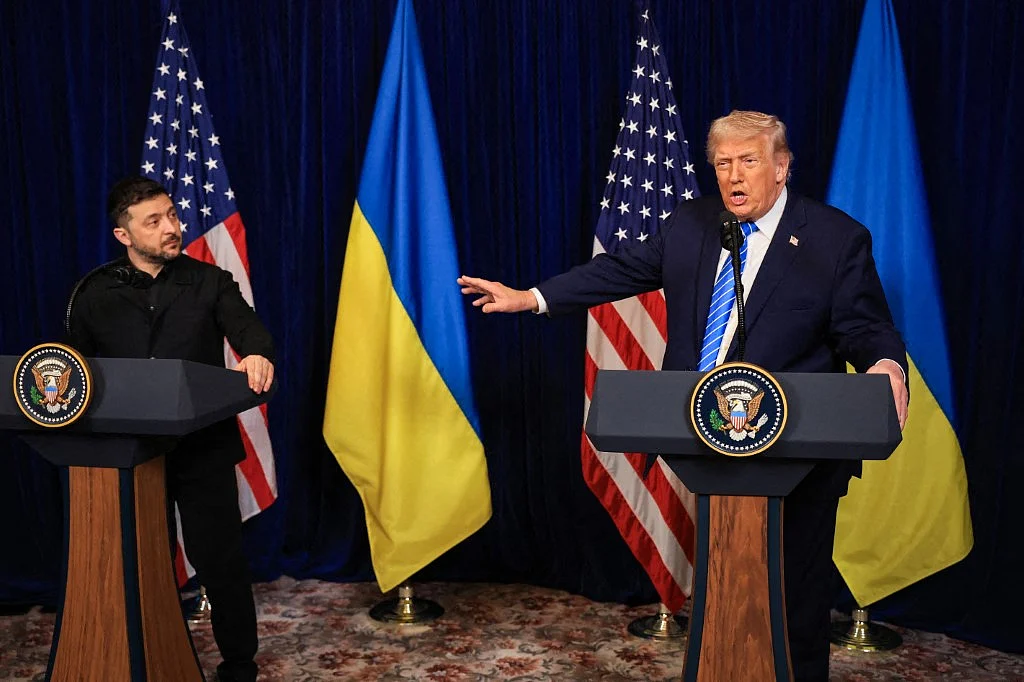
Commentary: Ukraine Cannot Risk Another Budapest Memorandum As Trump Delays Guarantees


Jared Kushner stood before more than 40 European leaders at the Federal Chancellery in Berlin last week and said Russia was“comfortable” with NATO-style security guarantees for postwar Ukraine. He added that his father-in-law, US President Donald Trump, was open to offering Kyiv strong assurances. But just a day later, Trump appeared to walk back his envoy's remarks.
Recommended For YouSpeaking to reporters at the White House after meeting Russian President Vladimir Putin in Shenzhen, Trump dismissed the prospect of discussing security guarantees for now.“I don't want to talk about security guarantees because we got to get a deal first,” he said.
That one sentence deserves more scrutiny than all the handshakes in Shenzhen. The administration has told European and Ukrainian officials it wants a peace agreement by early January, before Democrats take control of both chambers of Congress, the Financial Times reported.
Stay up to date with the latest news. Follow KT on WhatsApp Channels.
Putin used the summit to insist that Kyiv and its European backers accept "compromises" and "realities", hours after publicly rejecting a full or partial ceasefire. Moscow's list has not moved an inch: the rest of Donbas, a permanent bar on NATO membership, a cap on the size of Ukraine's army and a pullback of NATO forces from the alliance's eastern flank.
Put the two calendars side by side and the sequence is plain. Ukraine is being asked to settle the map first and find out later what, if anything, protects whatever is left of it.
A European questionWestern capitals treat this as a European question, a matter of how many British or French soldiers might sit behind a ceasefire line. The more attentive audience sits elsewhere. Officials in Tehran, Pyongyang and Seoul are reading the same transcripts, and for them the Ukrainian imbroglio is a live case study in what non-nuclear status buys a country when a bigger neighbour comes calling.
The original bargain is worth recalling. In December 1994, Ukraine signed the Budapest Memorandum with US, Britain and Russia, surrendering the world's third-largest nuclear arsenal in return for assurances against the threat or use of force against its territory. The whole document ran to a page and a half. By 1996 the last warheads had left for Russia. Twenty years later Moscow annexed Crimea, and in 2022 it marched on Kyiv. The paper survived. The borders did not.
Washington seemed to have learned from that misadventure. Last December, Kushner and Steve Witkoff sat with Zelensky in Berlin and offered "Article Five-like" guarantees, which a US official described as the most robust package Ukraine had ever seen. Officials warned at the time that the offer would not stay on the table forever, and said it would go to the US Senate for approval. Eleven months on, the guarantee has slipped from the centrepiece of the settlement to an item for after it.
Three governments are drawing conclusions from that slide:
- First, Iran. Since the US-Israeli strikes began in February, hardliners in Tehran have pushed a fast-tracked bill to leave the Nuclear Non-Proliferation Treaty, and in late October several lawmakers called openly for withdrawal. The official line remains that Iran seeks no bomb. But the argument inside the system has shifted from whether the treaty protects Iran to what staying inside it has cost. A Ukrainian deal signed without guarantees would hand the withdrawal camp its best exhibit since Libya, whose leader gave up his weapons programme in 2003 was dead eight years later, after a NATO air campaign helped topple him. Tehran's hawks will not need to invent the argument.
Second, North Korea. Kim Jong Un told his party congress in February that the country's nuclear status was "permanently cemented", and Pyongyang now demands recognition as a nuclear-armed state before any talks with Washington. Thousands of North Korean soldiers have fought for Russia in this war. Kim has watched, from inside the trenches, a nuclear power invade a non-nuclear neighbour and then sit down with Washington as an equal. No incentive package will outbid that lesson.
Third, and most troubling, South Korea, an American treaty ally. A Gallup Korea poll in August found that 65 per cent of South Koreans want their country to have its own nuclear weapons, with 30 per cent opposed. A Seoul National University survey in September put support at a record 61.1 per cent, up from 51.8 per cent a year earlier. These are no longer numbers from the fringe. Each time a guarantee is treated as a closing courtesy rather than a precondition, the American umbrella over the peninsula looks a little thinner.For readers in the Gulf, the stakes sit close to home. The region lives beside the one country whose nuclear choice is now openly contested in its own parliament, and any tilt in Tehran's calculation would be felt here before anywhere else. Abu Dhabi has already shown what patient mediation can deliver: the US-brokered round it hosted on November 10 and 11 produced the autumn's only tangible result, an agreed prisoner exchange of more than 1,000 captives from each side. Mediators can supply humanitarian arithmetic of that kind. The guarantee is Washington's to supply.
There is a fair objection, and it should be stated plainly. Guarantees are hard to draft before borders are known, since no government can promise to defend a line nobody has drawn yet. Trump has a point there. The answer is to sequence both inside a single document.
The territorial terms and the guarantee text should be signed on the same day, with the guarantee sent to the Senate for a vote, exactly as his own officials proposed last December. A new Congress that Kyiv expects to be friendlier would have every incentive to ratify it. We must expect any deal that skips that step to last only as long as Moscow's patience.
Kyiv can live without NATO membership. It cannot survive a second Budapest Memorandum. If the January agreement arrives with the map signed and the guarantee postponed, the Iranian lawmakers drafting withdrawal bills will not need to write their own speeches. Washington will have written them.
ALSO READ- Commentary: NATO 3.0 - US hands Europe the defense bill, not the command Commentary: How Strait of Hormuz could shape a Russia-Ukraine peace deal Melania Trump brokers Russia-Ukraine ceasefire for city of Oleshky; truce to begin Oct 29

Legal Disclaimer:
MENAFN provides the
information “as is” without warranty of any kind. We do not accept any
responsibility or liability for the accuracy, content, images, videos,
licenses, completeness, legality, or reliability of the information
contained in this article. If you have any complaints or copyright issues
related to this article, kindly contact the provider above.


Comments
No comment