


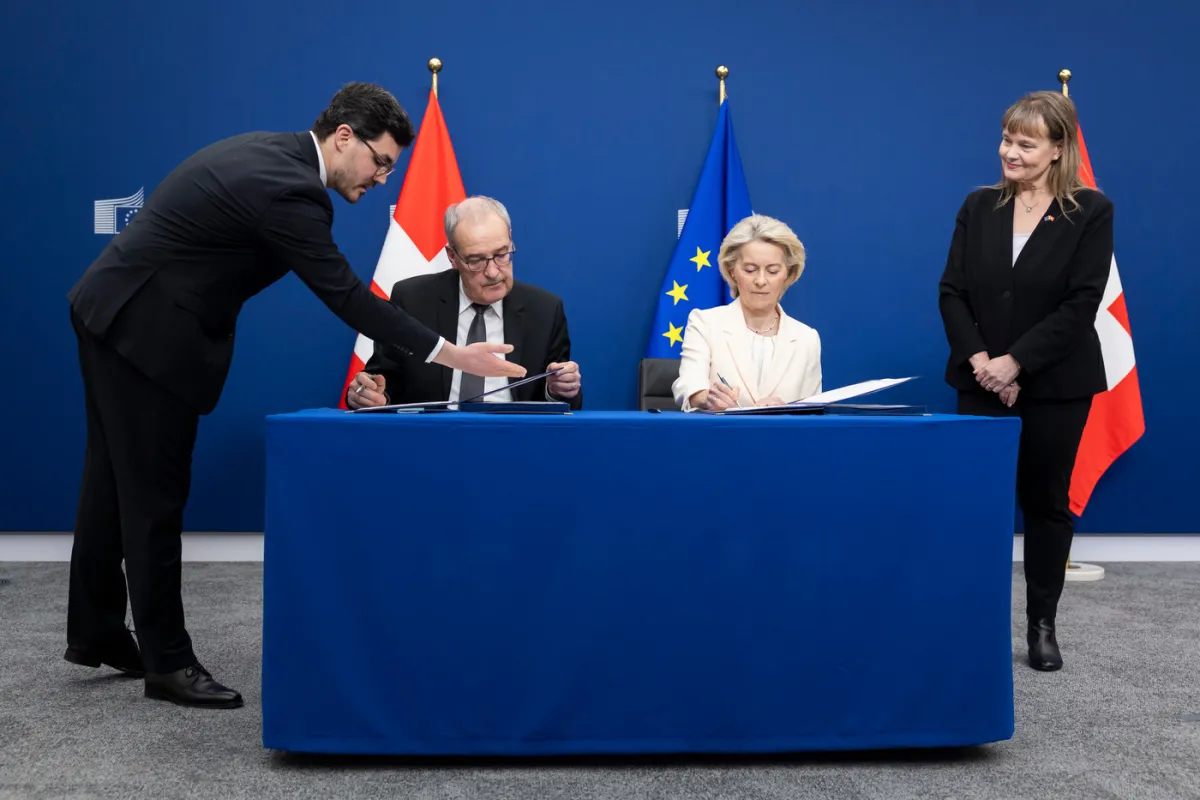
How A 2028 Vote Could Change The Fate Of The Swiss-EU Treaty Package


I work as editor and correspondent at the Federal Palace. I report on Swiss politics for the Swiss Abroad and manage our political talk show Let's Talk. I started in local journalism in the early nineties and have worked in many journalistic fields, held management positions and covered a range of topics. I joined SWI swissinfo in 2017.
-
More from this aut
German Departm
-
Deutsch
de
EU-Verträge erst 2028: Was dieser Aufschub verändert
Original
Read more: EU-Verträge erst 2028: Was dieser Aufschub verä
Français
fr
Les accords avec l'UE ne seront soumis au vote qu'en 2028: quelles sont les conséquences de ce report?
Read more: Les accords avec l'UE ne seront soumis au vote qu'en 2028: quelles sont les conséquences de ce re
Italiano
it
Trattati con l'UE alle urne solo nel 2028: quali effetti avrà il rinvio
Read more: Trattati con l'UE alle urne solo nel 2028: quali effetti avrà il r
Español
es
Los acuerdos con la UE no se someterán a votación hasta 2028
Read more: Los acuerdos con la UE no se someterán a votación hasta
Русский
ru
Новые соглашения Швейцарии с ЕС: референдум состоится не раньше 2028 года
Read more: Новые соглашения Швейцарии с ЕС: референдум состоится не раньше 2028
Ultimately, it is a formality in line with the usual parliamentary procedures. In general, an issue is debated over three sessions: first in one house, then in the other – and the third session usually involves the resolution of differences. The process can only be fast-tracked if this latter stage is accelerated.
This is not the case with the European Union (EU) treaties, as was revealed earlier this week. The Senate Office has decided not to include the resolution of differences in the upcoming 2026 winter session. Council president Stefan Engler told Swiss public broadcaster SRF that there were many other matters already on the agenda: the federal budget, army funding, and elections to the Federal Council and the Federal Court.“As a result, there was no longer any room on our agenda for the resolution of differences,” said Engler, which would rule out a referendum next year.
Parliamentary deliberations will therefore continue at least until the spring session in March 2027. However, the last possible date for a referendum next year is June – exceptionally early, because 2027 is an election year.
What does this mean for the 2027 elections?Had the EU treaties been put to a referendum next June, the issue would have dominated Swiss politics well into the summer.
“Now there is scope for other issues to feature in the election campaign,” says political scientist Corina Schena of Swiss research institute gfs. She cites affordable housing and healthcare costs, two classic issues for the political left, which can now focus more on cultivating these topics.
It appears to be a double-edged sword for the right-wing Swiss People's Party.
“By campaigning against the treaties, they could have mobilised many first-time voters and won them over as supporters,” says Schena, recalling the 1992 European Economic Area (EEA) referendum, which generated significant growth in voter support for the People's Party.
On the other hand, the party is grateful for the delay because more time means more scope for attack.“It would have been dubious to rush these treaties through without proper debate in parliament,” People's Party campaign manager Manuel Strupler told SRF.“And it would also be irresponsible if we had little time to inform the public about the major implications of these treaties”.
Yet the EU treaty package will be a key issue in the election campaign. The Centre Party and the centre-right Radical-Liberals, which have so far been unable to establish a clear stance, are now under pressure, and must put forward a clear proposal by autumn 2027.
Fabio Wasserfallen, professor of European politics at the University of Bern, is convinced that a referendum in June could have cast a considerable shadow over the autumn elections. Depending on the outcome and the role of the cantonal majority, Switzerland would have gone into the elections amid a major clash – a difficult situation, particularly for the centrist parties.“The elections are now much more predictable,” says Wasserfallen.“Positions have been established there.”
What does the delay mean for the Swiss-EU package at the ballot box?The general view in Swiss politics is that, even with lengthy consideration, the package of treaties is unlikely to improve – at least not in the eyes of the electorate. That is why the“yes” camp wanted to press ahead as quickly as possible, and why the“no” camp welcomes the delay.
“The pro-European forces wanted to get the package off the table quickly and efficiently. They fear a never-ending process,” says Schena.“Conservative circles, on the other hand, wanted to put the brakes on,” as with more time, they are more likely to succeed in raising the hurdle of requiring a cantonal majority.
“The more time they have, the more they can highlight the weaknesses,” adds Schena, noting that with such a complex proposal it is easier to build a“no” campaign than to highlight the strengths of the accord in its entirety.
Wasserfallen points out that“it is by no means certain that the later referendum date will work in favour of the treaties' opponents. It is possible to mobilise very intensively and successfully even within a shorter timeframe.” Moreover, the People's Party has been campaigning against the EU for 30 years, so a few months more or less will have little consequence.
What about the issue of cantonal majority?Whether the EU treaties are decided by a simple voter majority, or whether the majority of cantons must also approve them, remains decisive. The latter would give the smaller, conservative cantons greater weight and would raise the threshold at the ballot box by a few percentage points.
The Senate has already come out in favour of a cantonal majority; the House of Representatives is due to give its opinion in mid-December. Its Political Institutions Committees also recommend a cantonal majority. This makes the issue a key sticking point ahead of the actual debate.“The question of the cantonal majority is far more decisive for the treaty package than the timing of the vote,” says Wasserfallen.
What are the next steps?Following the Senate, the House of Representatives will debate the treaties, the accompanying resolutions and the cantonal majority requirement from December 7. On March 19, 2027, the final day of the spring session, parliament will pass its resolution, followed later by the autumn elections. Public opinion will take shape in 2027.“So far, according to our polls, public opinion on the treaty package remains rather vague,” says Schena.“Sympathies are there, but anything is still possible.”
According to Wasserfallen, what will ultimately be decisive is what the broader political climate looks like at the time of the vote.
“The situation in the EU, regarding Russia's war of aggression, or in the US, will have some influence on the acceptance of the treaties,” he says. From his perspective, whether the vote is held in June 2027 or spring 2028 matters less than the issues dominating the political conversation at that time.
Edited by Samuel Jaberg. Adapted from German by Katherine Price/ds
Popular Stories Most DiscussedSee more Swissinfo articles in your Google results. Learn
In compliance with the JTI standards
More: SWI swissinfo certified by the Journalism Trust Initiati
You can find an overview of ongoing debates with our journalists here. Please join us!
If you want to start a conversation about a topic raised in this article or want to report factual errors, email us at ....
Read more
Legal Disclaimer:
MENAFN provides the
information “as is” without warranty of any kind. We do not accept any
responsibility or liability for the accuracy, content, images, videos,
licenses, completeness, legality, or reliability of the information
contained in this article. If you have any complaints or copyright issues
related to this article, kindly contact the provider above.


Comments
No comment