


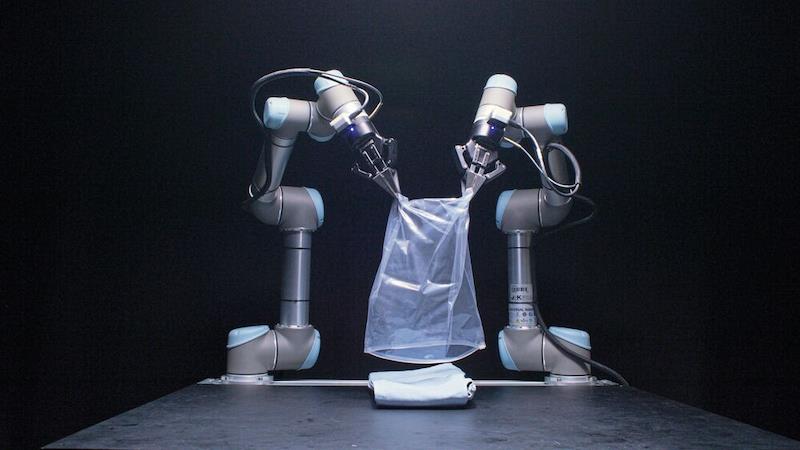
Bentic Advances Physical AI With Nearly 100 Industrial Robots


The Munich-based company is preparing to enter the US market with technology that enables robots to handle deformable materials such as textiles, cables, carbon fiber and food. These are tasks that have traditionally required human dexterity and have resisted conventional automation.
Formerly known as sewts, bentic addresses a longstanding limitation in industrial robotics: the difficulty of reliably handling materials that change shape, move unpredictably or lack a consistent structure.
The company's approach relies on training AI with real-world industrial data. Rather than depending primarily on laboratory testing and simulation, its systems learn from actual production environments, using operational experience to improve their ability to recognize and manipulate materials under changing conditions. Emerald led bentic's €7 million Series A financing in August 2023, backing its approach to making industrial automation more adaptable.
Mehran Zaker, partner and head of industrial AI and robotics, Emerald Technology Ventures, says:“For decades, industrial robots have been limited by the assumption that the world around them must be predictable. Physical AI is changing that equation.
“bentic is showing that robots can learn to work with the complexity of the real world, handling materials and performing tasks that have long resisted automation. This is no longer a theoretical possibility. It's already happening on factory floors.”
Bringing physical AI to industrial operationsbentic's technology combines two core capabilities: a foundational intelligence that predicts how deformable materials behave and an action model that translates those predictions into robot movements. Together, they enable robots to manipulate materials that conventional automation struggles to handle consistently.
Applications include textile processing, e-commerce returns, automotive cable harnesses, technical textiles, carbon fiber components and food processing.
The company's robot-agnostic platform, Jupiter, allows individual robots to benefit from operational experience gathered across the installed fleet. This growing body of real-world training data can improve performance across different materials and applications.
US expansion backed by Emerald's established robotics investment track recordbentic is preparing to expand its commercial presence in the United States, where it expects to deliver its first systems before the end of 2026. The expansion will bring its technology to manufacturers seeking to automate operations involving flexible, irregular and difficult-to-handle materials.
bentic builds on Emerald's longstanding investment in robotics and industrial automation. Its previous investments in the sector include autonomous maritime systems developer Sea Machines Robotics, collaborative robotics company Mantis Robotics and automated line-marking specialist TinyMobileRobots.

Legal Disclaimer:
MENAFN provides the
information “as is” without warranty of any kind. We do not accept any
responsibility or liability for the accuracy, content, images, videos,
licenses, completeness, legality, or reliability of the information
contained in this article. If you have any complaints or copyright issues
related to this article, kindly contact the provider above.


Comments
No comment