


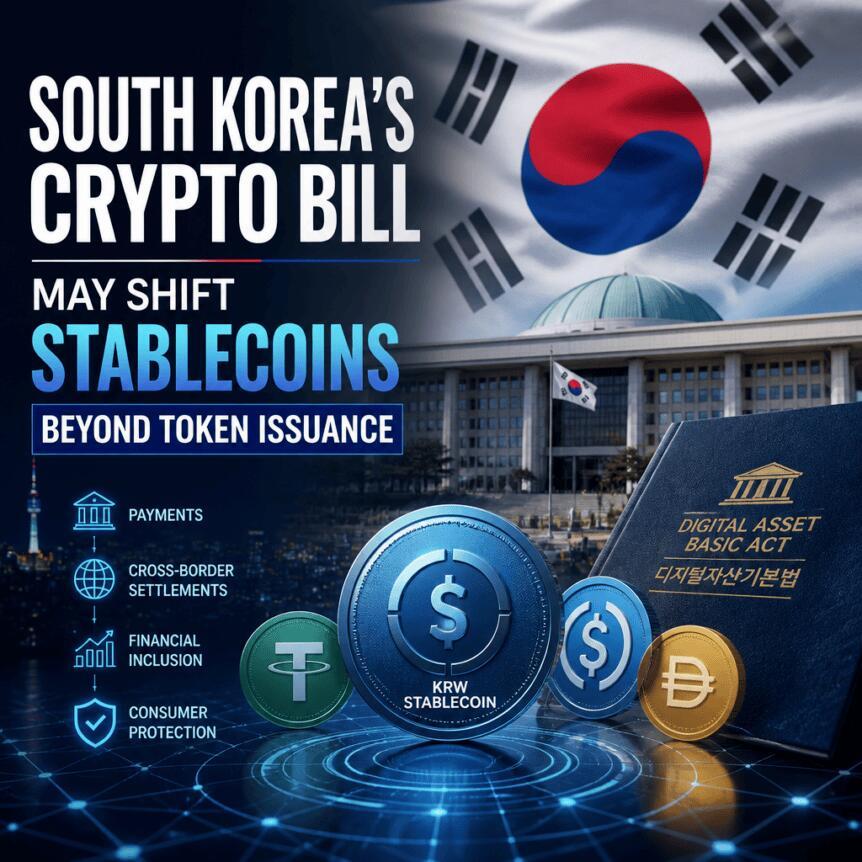
South Korea's Crypto Bill May Shift Stablecoins Beyond Token Issuance


In a Tuesday report, the Asia-focused research company said relationships that help people actually spend stablecoin value in KRW terms may end up mattering more to business outcomes than the raw volume of tokens issued. That distinction becomes more important as regulators design the rules for consortium structures.
Key takeaways- South Korea's Financial Services Commission (FSC) draft bill would initially restrict issuance of won-denominated stablecoins to consortiums where banks collectively hold a majority stake. A tech or fintech company could still hold a larger stake than any single bank, but the consortium must be bank-majority at inception. Banking Act limits-such as a 15% cap on a bank's stake in a nonfinancial company-could require at least four banks to join each consortium to reach majority control, Tiger Research estimates. Tiger Research argues that fintech influence may shift toward building on- and off-ramps and spending rails that connect KRW to global dollar liquidity.
On Tuesday, South Korea's Financial Services Commission unveiled its draft digital assets bill. The proposal would, at least initially, limit issuance of won-denominated stablecoins to consortiums in which banks collectively maintain majority ownership.
The FSC approach reflects an ongoing regulatory struggle inside the country's financial system. Earlier, the Bank of Korea had argued for bank-led issuance, citing concerns tied to monetary policy and financial stability. The FSC, by contrast, previously leaned toward allowing nonbank companies to issue stablecoins.
Under the latest draft, banks would have to be the collective controlling force. However, Tiger Research noted that the structure would not necessarily prevent a fintech or technology company from holding a bigger stake than any individual bank within the consortium-so long as the group of banks together retains the majority.
Why consortium math could favor multi-bank structuresOne reason the framework may be consequential for industry strategy is how existing ownership restrictions could interact with the new consortium requirement.
If the Banking Act's 15% limit on a bank's stake in a nonfinancial company applies to stablecoin issuers, Tiger Research said at least four banks would likely need to participate in each consortium to secure a majority stake. That arithmetic matters because it can determine how power is distributed at launch: multiple banks may bring broader networks, compliance capabilities, and distribution channels, while also complicating governance and decision-making.
For fintech firms, that environment changes the negotiation dynamics. Rather than competing solely for issuer status, technology partners may seek roles that are harder to replicate-such as integration into merchant payment workflows, remittance-related infrastructure, or operational rails that reduce friction between KRW and liquidity elsewhere.
Fintech influence may shift toward spending, not issuance volumeTiger Research's central point is that certain relationships-especially those supporting KRW-denominated usage-could prove more commercially important than token issuance volumes.
The report emphasized that partnerships enabling people to spend won-denominated stablecoins may matter more than the total amount of stablecoins issued. In practical terms, this reframes the value proposition: a stablecoin offering can appear successful even with modest issuance if it becomes embedded in real-world payments, while large volumes may fail to translate into sustained adoption without effective usage channels.
Vincent Chok, founder and CEO of First Digital-whose subsidiary issues the FDUSD stablecoin-told Cointelegraph that bank-majority consortiums could strengthen credibility at launch. At the same time, he argued fintech participation could help protect innovation by keeping emphasis on efficient infrastructure and user experience.
Chok specifically pointed to the importance of“efficient on- and off-ramps and rails connecting KRW with global dollar liquidity,” arguing that Korea's ability to capture broader economic activity around stablecoins depends on these connections rather than who simply has the issuance label.
Industry groundwork is already underwayEven before the bill takes effect, several South Korean companies have been exploring how stablecoins could fit into payments and partner ecosystems.
In May, KB Financial Group completed a won-denominated stablecoin pilot that covered merchant payments and cross-border remittances, according to earlier reporting from Cointelegraph: South Korea's KB Financial completes stablecoin pilot.
In July, Viva Republica-operator of the Toss payments app-partnered with Optimism and Sunnyside Labs to test stablecoin-based payments for financial institutions, as noted in Cointelegraph coverage: Toss partners with Optimism and Sunnyside Labs.
These efforts align with Tiger Research's thesis that the competitive battleground may be less about issuance ownership and more about integration: how stablecoin rails connect into existing payment ecosystems, how quickly value can move between KRW usage and external liquidity sources, and how well users and merchants can participate without operational complexity.
What happens next: Assembly approval and enforcement detailsThe draft bill is not yet law. It still needs to pass South Korea's National Assembly before presidential promulgation.
Tiger Research said it is expected to take effect one year after promulgation. Even after passage, key components-including stablecoin consortium shareholder requirements-are likely to be defined further through subsequent enforcement decrees, leaving uncertainty around how strict the final implementation will be.
For market participants, that means the next phase will likely focus on clarification: how bank-majority control is operationalized, how consortium governance is handled, and whether fintech partners can secure meaningful roles in on- and off-ramp infrastructure that determines day-to-day usability.
As the bill moves through the Assembly and enforcement drafting, investors and builders will want to watch how the ownership rules translate into real consortium structures-and whether regulation steers adoption toward bank-led credibility while still allowing fast-moving technology partnerships to drive spending and liquidity connectivity.
Risk & affiliate notice: Crypto assets are volatile and capital is at risk. This article may contain affiliate links.
Legal Disclaimer:
MENAFN provides the
information “as is” without warranty of any kind. We do not accept any
responsibility or liability for the accuracy, content, images, videos,
licenses, completeness, legality, or reliability of the information
contained in this article. If you have any complaints or copyright issues
related to this article, kindly contact the provider above.


Comments
No comment