


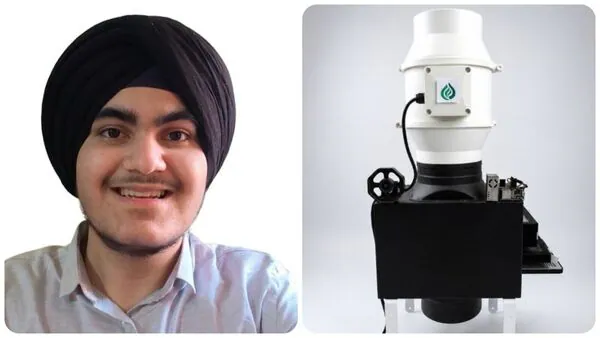
How Tanjot Singh Aims To Make Delhi's Air Cleaner: Meet The Mind Behind India's First Bio-Based Air Filtration Platform


His project has earned him a place among the top 60 national winners at the 12th National Level Exhibition and Project Competition (NLEPC) under the INSPIRE-MANAK programme, an initiative of the Department of Science and Technology (DST), Government of India, implemented in collaboration with the National Innovation Foundation (NIF)-India.
Here's all you need to know about Tanjot Singh and his award-winning innovation.
Who is Tanjot Singh?Singh is a founder of PraaNavya, an initiative focused on developing climate hardware and deep-tech engineering solutions for cleaner air. According to his blog, PraaNavya is backed by Emergent Ventures US, Antler India and Masters' Union. He had previously co-founded SES Clean Air, his blog stated.
He is currently a Class 11 student at Delhi Public School, RK Puram. He completed Grade 9 (2025) and 10 (2025) at Lilawati Vidya Mandir.
Singh dropped out of school after Grade 10 in 2025-2026 to work full-time on his hardware startup PraaNavya. He self-studied Grade 11–12 Physics and Mathematics, wrote in his blog, built three prototype generations, filed a patent, raised grants, pitched to 30+ stakeholders and deployed school pilots. He rejoined school as an 11th grader in 2026.
Tanjot Singh's achievementsAccording to his blog, Tanjot Singh built his "first serious engineering project" - a 10-foot industrial scrubber - at age 14 with a team of five under CEEW mentorship. That project became the second-largest engineering build in his school's history and laid the foundation for everything that followed, he claimed.
"Today, I'm building PraaNavya - India's first bio-based air filtration platform - with a published patent, school pilots protecting 300+ students, and a clear mission: to build globally scalable climate technologies through engineering research and entrepreneurship," he wrote.
About Singh's award-winning innovationSingh positioned his PraaNavya Climate Tech as "India's first bio-based air filtration platform - sustainable alternatives to disposable HEPA filters." His innovation explores the possibility of using bio-based materials for air filtration while addressing concerns about the disposal of synthetic filter materials.
The problem he aims to solve is Delhi's air pollution crisis. His blog says current solutions (Dyson, Philips, etc.) are expensive, generate massive plastic waste, and are inaccessible to many people. HEPA filters are single-use, petroleum-based, and environmentally costly.
Notably, Conventional air purifiers commonly use HEPA filters, ideal for capturing airborne particles as air passes through a dense network of filter fibres. Although these filters play an important role in improving air quality, their synthetic fibre filters eventually need replacement.
How PraaNavya is differentDeveloped through his initiative, PraaNavya, the prototype uses compressed wool felt and electrostatic cotton as bio-based alternatives to conventional synthetic HEPA filter media, the Times of India reported.
Singh claims that a five-stage bio-based filtration stack - triboelectric wool, electrostatic cotton, activated charcoal, polyester, PLA bio-polymer - achieves 99.7 percent PM2.5/PM10 reduction with ~80 percent less plastic waste than conventional HEPA filters.
Some of the key features he highlighted in his blog are:
> 5-stage filtration - multi-layer bio-based media
> ₹5,000 purifier - with ₹800 biodegradable replacement filters
> 5 application domains - consumer, HVAC, industrial, automotive, respiratory
> Flutter BLE companion app - with AI-powered purifier placement
> Published Indian patent - co-inventor, 2025
Real-world deployment
His innovation, he claims, is currently piloting across two schools, five classrooms - serving 300+ students. An analysis measured ~40 percent lower PM levels in-situ, he wrote, adding that school pilots demonstrate tangible impact: cleaner air, healthier students, validated technology.
RecognitionThe project is backed by Antler India, Masters' Union, ThinkStartup. At Shark Tank India S5 Stage 2, he was selected from 120,000+ startup registrations for virtual pitch submission. Other notable recognitions include: Masters' Union Elevator Pitch - youngest finalist & winner; Youth Ideathon - National Winner (2022) & Top 3 (2025); INSEF National Science Fair - Bronze Medal; InnoHEALTH Young Innovator Awards; EMERGE Sustainable Leaders - National Top 10. He has pitched to 30+ stakeholders including VC firms, IITD, Ministry of Environment, Government of Delhi.

Legal Disclaimer:
MENAFN provides the
information “as is” without warranty of any kind. We do not accept any
responsibility or liability for the accuracy, content, images, videos,
licenses, completeness, legality, or reliability of the information
contained in this article. If you have any complaints or copyright issues
related to this article, kindly contact the provider above.


Comments
No comment