


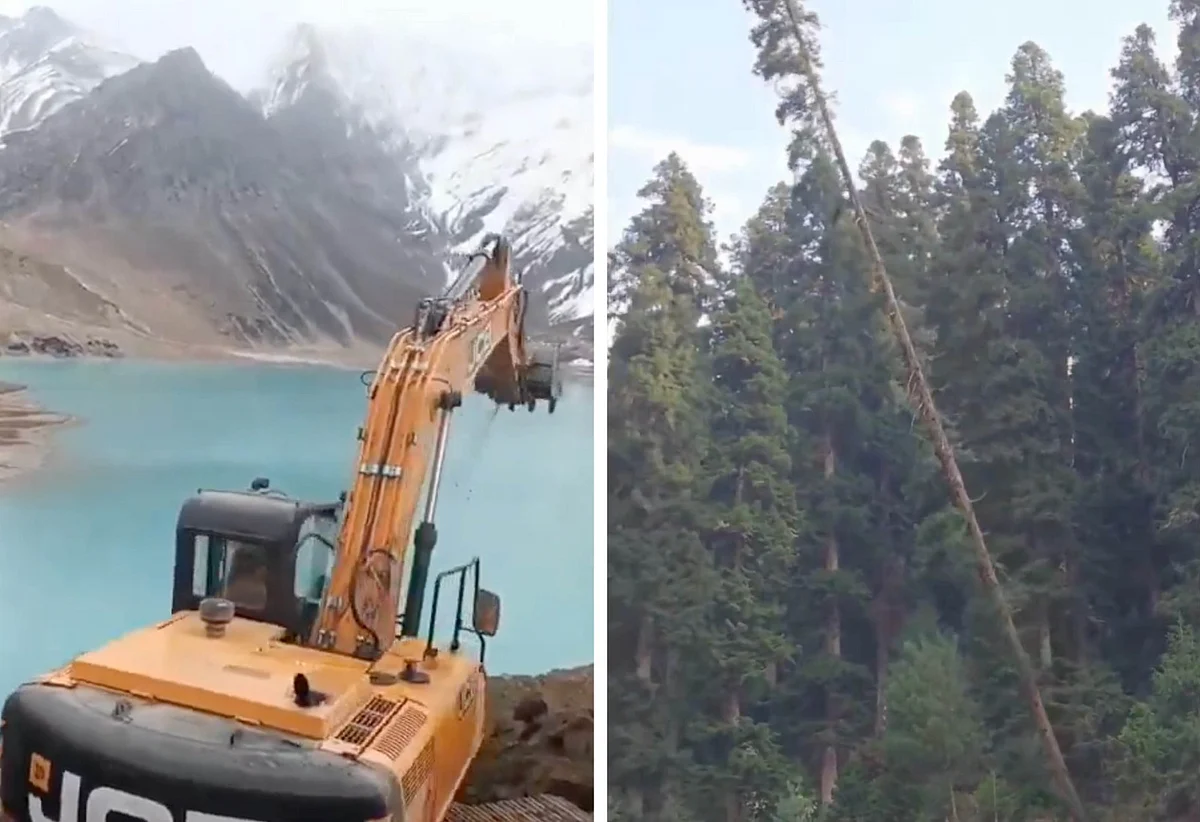
Excavator Near Kashmir's Sacred Sheshnag Lake Sparks Outrage Over Himalayan Ecosystem


The video, showing an excavator operating near Sheshnag Lake, a pristine glacial lake situated at around 3,590 metres above sea level in Kashmir's Anantnag district, went viral on social media earlier this week.
Recommended For YouIt triggered widespread criticism, with many describing the activity as a“devastation” of the region's fragile ecosystem.
Stay up to date with the latest news. Follow KT on WhatsApp Channels.
The Kashmir Valley, which lies at an average elevation of around 1,600 metres, is ecologically sensitive because of its fragile Himalayan mountain system, characterised by glaciers, alpine meadows, forests, wetlands and interconnected river systems.
It is particularly vulnerable to climate change, with rising temperatures accelerating glacial retreat, altering snowfall patterns and increasing the risk of flash floods and landslides.
Sheshnag Lake, which remains snow-covered for much of the year, is among 14 high-risk glacial outburst lakes identified in Jammu and Kashmir and monitored for potential environmental hazards.
“Development at the cost of nature and the disruption of ecosystems is devastation. Kashmir is sitting on an ecological ticking time bomb that could explode at any moment, and we may have to pay a huge price for it in the near future,” said the video uploader Mr Bisht.
Mohit Bhan, a leader of Kashmir's Peoples Democratic Party (PDP), called the activity“a crime against Hinduism and faith in nature”.
“What is being projected as development must not come at the cost of a fragile alpine ecosystem and a landscape deeply embedded in Hindu religious belief,” Bhan wrote on X.
Mirwaiz Umar Farooq, Kashmir's chief cleric, called the visuals“disturbing” and raised concerns about the ecological impact of construction in the fragile Himalayan region.
“With our glaciers already retreating, and recent devastating glacier-related floods in neighbouring Nepal reminding us of the growing vulnerability of the Himalayas, such activities raise alarm,” he wrote on X.
Mehbooba Mufti, the region's former chief minister, said on Tuesday that she was stopped from proceeding towards Sheshnag.
“The questions surrounding construction in this fragile glacial ecosystem are only growing louder. What is being concealed today could become a man-made disaster tomorrow,” she said.
Ecologically sensitive HimalayasThe anger and anxiety are not baseless. Kashmir, the Muslim-majority disputed region divided between India and Pakistan and claimed by both in its entirety, lies in the Himalayas - the world's highest and geologically youngest mountain range, known for its fragile ecosystem.
Like other Himalayan regions bearing the brunt of climate change, Kashmir has also been experiencing increasingly erratic and extreme weather patterns.
There have been changes in rainfall and snowfall patterns in recent years, accelerated melting of glaciers due to rising temperatures, and periods of both flooding and drought.
More than 280 people were killed and nearly two million affected after catastrophic floods in Kashmir in 2014 following unprecedented rainfall. The disaster was exacerbated by the encroachment of wetlands and floodplains, rapid urbanisation, deforestation and inadequate drainage infrastructure.
Fears have also been heightened by devastating disasters in neighbouring states of Himachal Pradesh and Uttarakhand, as well as in the Himalayan nations of Nepal and Bhutan.
More than 1,500 people were killed and thousands reported missing in Nepal after a massive ice-and-rock avalanche near the Nepal-China border triggered catastrophic flash floods, sweeping through villages and destroying roads, bridges and hydropower infrastructure, in August.
In Bhutan, a glacial lake outburst flood (GLOF) struck Sintaphu Lake in the Gasa district in October and triggered flooding downstream, damaging infrastructure.
These disasters have renewed concerns about the vulnerability of the Himalayan region to glacial instability and extreme weather events.
Sheshnag Lake is a high-altitude, glacier-fed alpine lake. It also holds religious significance as it lies along the traditional Pahalgam route to the Amarnath cave shrine, one of Hinduism's most revered pilgrimage sites. The cave houses a naturally formed ice stalagmite of the deity in south Kashmir.
The lake is an important stopover for pilgrims undertaking the arduous trek to the cave shrine.
While infrastructure development and track maintenance are important, particularly given the large seasonal influx of pilgrims, environmentalists say construction along the lake could aggravate the risks associated with glacial lake outburst floods.
A study titled 'Glacial Lake Outburst Flood Susceptibility and Potential Downstream Implications Across the Kashmir Himalaya', published in the Journal of Glaciology in January, found that roads, bridges, hydropower projects and settlements located downstream of unstable glacial lakes could be vulnerable to catastrophic flooding and debris flows.
Following the outrage, the Border Roads Organisation (BRO), which is responsible for developing and maintaining road infrastructure in challenging and border areas, said the work was confined to existing tracks and was not new construction.
It added that it was taking measures to ensure the safe disposal of excavated material, protect natural drainage and minimise disturbance to the surrounding terrain.
“Based on the experience of previous yatras (pilgrimage) and requirements highlighted for wider roads during the Shri Amarnath Ji Yatra, BRO has started widening the tracks, focusing on stabilising vulnerable stretches and widening them as prescribed to ease congestion and allow safer passage,” it said in a statement.
Anil Prakash Joshi, environmentalist and founder of Himalayan Environmental Studies and Conservation Organization, said that any infrastructure along the lake would have long-term effects.
Construction involving blasting, excavation or slope cutting near the lake could destabilise fragile mountain slopes and surrounding moraines, increasing the risk of landslides and potentially triggering glacial lake outburst floods (GLOFs), putting downstream roads, infrastructure and settlements at risk.
“Doing anything in the mountain in the name of so-called beautification, infrastructure, and overuse of a resource, be it a lake or a water or a river, will have long-term effects. That unfortunately is never taken into account when we think of developing a place,” Joshi told Khaleej Times.
“[This] is also a case again where you are disturbing it, not understanding that a lake is a natural structure. Its total functioning depends on nature, and disturbing one factor would affect another one and will have a far effect in the future,” he said.
Government's infrastructure pushSince first coming to power in 2014, Prime Minister Narendra Modi 's Bharatiya Janata Party government has placed considerable emphasis on infrastructure development, investing billions of dollars in highways, roads, tunnels and other connectivity projects, including those linking remote pilgrimage sites in the Himalayas.
In June last year, Modi inaugurated the Chenab Bridge in Jammu and Kashmir, the world's highest railway arch bridge, which stands 359 metres above the Chenab River.
In neighbouring Uttarakhand, his government has been pushing major infrastructure projects, including road construction under the Char Dham highway project, which aims to improve connectivity to four major Hindu pilgrimage sites in the state, as well as strategic roads leading towards the Chinese border and hydropower projects.
The mountainous state has witnessed deadly landslides, floods and other natural disasters. In 2013, devastating floods and landslides around Kedarnath, one of Hinduism's holiest shrines, killed hundreds and left thousands missing and presumed dead.
The disaster raised serious questions about infrastructure development, environmental degradation and disaster preparedness in the Himalayan region.
“We cannot deny basic services like roads to people living in remote and far-flung areas, where facilities such as hospitals and educational institutions are often unavailable,” Joshi said.
“[But] if you look at the project timelines, road construction in the mountains is often undertaken in exactly the same way as in the plains,” he said.
Joshi underlined the importance of carrying out work slowly in the mountains so as not to disturb the surrounding terrain.
“The idea is that constructing one kilometre of road in the mountains should take at least two to six months. In many places, these pilgrimage roads are being constructed, but the manner in which they are being built is raising questions.”
“We have to be extremely careful about road construction. Science and technology must be used properly so that we can provide connectivity to people living in remote areas without damaging the surrounding environment,” he said.
ALSO READ- India's $87 billion river-linking project sparks protests as floods hit homes, temples Himalayas approaching tipping point, millions of livelihoods at stake: Report 'Suffering for crime we didn't commit': Nepal seeks climate justice after flood disaster

Legal Disclaimer:
MENAFN provides the
information “as is” without warranty of any kind. We do not accept any
responsibility or liability for the accuracy, content, images, videos,
licenses, completeness, legality, or reliability of the information
contained in this article. If you have any complaints or copyright issues
related to this article, kindly contact the provider above.


Comments
No comment