


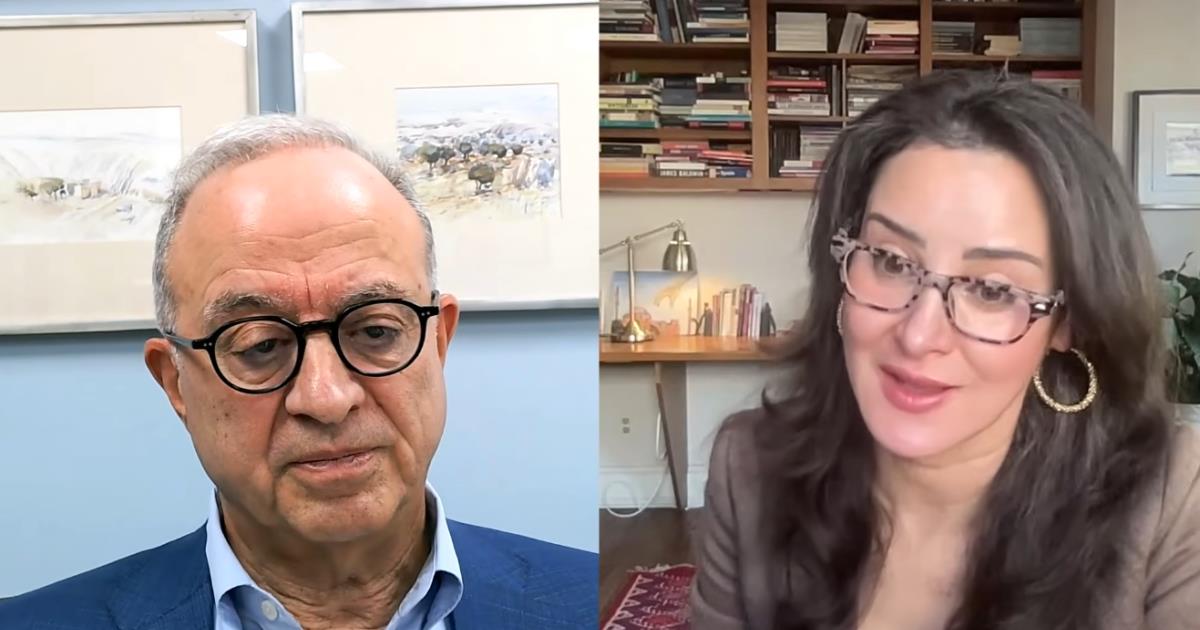
Muasher: Middle East Undergoing Major Strategic Changes, Two-State Solution No Longer Viable


Speaking in the first episode of the Middle East Institute's Re-Orient podcast, hosted by Gönül Tol, Muasher said the transformation had begun well before the October 7, 2023 attacks and the subsequent war on Iran, but that these events had fundamentally challenged several long-standing assumptions about regional security and international power.
Muasher said the centre of political gravity in the Middle East had gradually shifted eastward, away from Egypt and towards the Gulf, particularly Saudi Arabia, a process that began roughly a decade before October 7.
He argued that one of the most significant changes was the growing realisation that the United States could no longer be regarded as the region's sole security guarantor.
"The US bases in the region have not prevented attacks, whether by Iran or Israel, against Gulf countries and others, including Jordan," he said.
Muasher added that recent developments had also demonstrated the limitations of military power. Despite its military superiority, the United States had failed to bring the conflict with Iran to a successful conclusion, while Israel's military dominance had not translated into political compromises with neighbouring countries.
He said Israel had also failed to demonstrate its ability to act as a member of the regional neighbourhood.
Two emerging regional axes
Muasher identified two emerging regional alignments following the war on Iran.
The first, led by Saudi Arabia, seeks to diversify security partnerships and strategic options without replacing the United States as a regional partner.
He said this approach reflected a growing understanding that countries in the region must take greater responsibility for their own security rather than relying exclusively on external powers.
Muasher pointed to the emerging security cooperation involving Saudi Arabia, Turkey and Pakistan, describing it as an indication that regional security arrangements were beginning to extend beyond the Arab world.
He said the Saudi-led approach also involved adopting a more cautious position towards Israel, particularly given what he described as Israeli violations of the sovereignty of seven Arab countries since October 7.
Discussions about normalisation with Israel, he argued, could not move forward without agreement on fundamental principles, particularly what Saudi Arabia describes as a credible pathway towards a Palestinian state.
The second emerging alignment, led by the United Arab Emirates, favours strengthening ties with both Washington and Israel in response to the war on Iran.
Muasher said the differences between Saudi Arabia and the UAE extended well beyond their respective relationships with the United States and Israel. They also involved sharply contrasting positions on Yemen, Sudan, Libya and the future of the Palestinian territories.
He described the Saudi-UAE rift as serious, warning that it could undermine efforts to establish a regional collective security framework.
Although shared concerns about Iran could provide common ground, Muasher said the differences could not be resolved through a single meeting between the two countries' leaders.
"These days are over," he said, arguing that the disagreements reflected fundamentally different strategic outlooks requiring sustained political dialogue.
Regional security and the limits of US protection
On the emerging security arrangements involving Saudi Arabia, Turkey and Pakistan, Muasher said it was too early to determine whether they would lead to a more stable regional order or create additional competing blocs.
He described the initiative as a loose coalition whose members do not necessarily share the same threat perceptions or strategic priorities.
However, he said its significance lay in the growing recognition that decades of dependence on external security guarantees, particularly those provided by Washington, had failed to deliver lasting security.
Muasher said the region needed to move beyond rhetoric and begin developing concrete mechanisms for collective security, potentially drawing lessons from the Helsinki process and the Organisation for Security and Cooperation in Europe.
He stressed that such arrangements should not be designed to replace the United States, but rather to diversify regional partnerships and reduce excessive dependence on a single power.
Asked whether the Middle East was witnessing the end of the American-led regional order, Muasher rejected the idea that Washington's role was about to disappear.
The United States, he said, remained a powerful partner, but its security relationship with regional countries needed to evolve.
He cited Qatar as an example, noting that despite hosting the largest US military base in the region and playing a mediating role between Iran, the United States and Israel, it had nevertheless been subjected to attacks by both Israel and Iran.
Muasher also criticised the record of American military interventions in Iraq, Afghanistan and Iran, arguing that Washington had repeatedly demonstrated its ability to achieve military superiority without succeeding in building institutions or advancing diplomatic solutions.
Weak Arab institutions and the governance crisis
Muasher attributed much of the region's instability to weak state institutions and the absence of effective political, economic and social governance.
He said the Arab League had been established as a weak institution because member states were unwilling to transfer meaningful decision-making powers to a regional body.
Its requirement for consensus had become increasingly ineffective as membership expanded from seven founding states to 22.
He said attempts to establish smaller regional groupings, including the Gulf Cooperation Council and the Arab Maghreb Union, had achieved some economic progress but struggled when political disagreements emerged.
The dispute between Algeria and Morocco over Western Sahara, he noted, had effectively paralysed the Maghreb Union for years.
According to Muasher, the central problem remains the lack of political will among Arab governments to delegate meaningful authority to regional institutions.
He also warned that weak governance across the Arab world had created political and institutional vacuums that regional and international powers, including Israel, Turkey and Iran, had sought to exploit to advance their interests.
Political accountability, institutional development and systems of checks and balances, he argued, were essential foundations for sustainable economic development and political stability.
Stability based on coercive power alone, he said, could not last indefinitely, as demonstrated by the Arab uprisings.
The twilight of the oil era and a changing social contract
Turning to the region's economic future, Muasher warned that the Arab world was entering what he described as the "twilight of the oil era".
For decades, oil revenues had underpinned economic development across the region, supporting welfare systems in oil-producing countries while providing financial resources to oil-importing states.
However, this model had also entrenched a culture of dependence on the state, with governments providing jobs, subsidies and basic services in exchange for limited public participation in political decision-making.
Muasher said this arrangement was now beginning to unravel.
Citing estimates, he said oil revenues to the region could decline by half over the next 25 years.
He stressed that economic diversification was therefore not simply a technical or financial challenge. It would have far-reaching political and social consequences, particularly for the relationship between governments and their citizens.
As state revenues decline and governments become less capable of providing traditional services, citizens will increasingly question why they should continue accepting limited political participation in return for diminishing economic benefits.
Muasher predicted growing pressure for new social contracts and a different relationship between the state and society across both wealthy and poorer Arab countries.
He said these changes would unfold over the next 20 to 30 years, adding that governments would be better placed to preserve stability if they began preparing for them now.
Muasher: The two-state solution has become impossible
On the Palestinian issue, Muasher said he had reached the conclusion around 15 years ago that a two-state solution was no longer achievable, despite having spent much of his professional career advocating for it.
He described himself as a former supporter of the two-state approach, arguing that political realities on the ground had made its implementation increasingly impossible.
He cited the presence of approximately 750,000 Israeli settlers in the West Bank and East Jerusalem, alongside the absence of political will within Israeli society to end the occupation.
According to Muasher, opposition to a Palestinian state was no longer confined to Prime Minister Benjamin Netanyahu, but had become the position of almost every Jewish Israeli political party, with the exception of the new Democrats party, which he said held eight seats in the Knesset.
He also criticised the international community for continuing to advocate a two-state solution without establishing a credible mechanism to implement it.
This, he argued, had allowed Israel to expand settlements and further undermine the possibility of establishing a viable Palestinian state.
Muasher compared the situation to two people arguing over a slice of pizza while one of them continues eating it.
He said the international community had focused excessively on the shape of a political settlement while overlooking the more fundamental issue of equal rights.
Any future solution, he argued, must recognise equal national rights, including the rights to language, culture and self-determination, rather than focusing solely on individual human rights.
Muasher also questioned how Israel could describe itself as both Jewish and democratic while refusing to treat its Arab citizens as equal partners.
He pointed to the fact that Arabs make up approximately 20 per cent of Israeli society, arguing that future Israeli governments would find it increasingly difficult to function without the support of Arab political partners.
He said this demographic and political reality could eventually force Israeli society to reconsider its approach to equality and citizenship.
Muasher further noted that the number of Palestinians living in areas under Israeli control, including Palestinian citizens of Israel and those under occupation, stood at approximately 7.5 million, compared with 7.2 million Israeli Jews.
If Israel continued rejecting Palestinian statehood while maintaining control over these territories, he argued, it would face a choice between perpetuating an apartheid system and developing a political arrangement based on equal rights for all.
He cited Switzerland's federal system as one possible example of how different communities with distinct languages and cultures could coexist within a shared political framework.
Changing US public opinion and growing pressure on Israel
Muasher also pointed to a significant shift in American public opinion towards Israel, saying criticism was growing across both major political parties.
He cited figures indicating that around 80 per cent of Democrats viewed Israel negatively, alongside approximately 60 per cent of Republicans under the age of 50.
He said the motivations differed between the two groups. Democrats were increasingly concerned about human rights and equality, while younger Republicans were questioning why American taxpayers should continue funding Israel instead of prioritising domestic needs.
Muasher said this shift was unlikely to produce an immediate and complete change in US policy, but predicted that future administrations would face growing pressure to reconsider their relationship with Israel.
He suggested that a future Democratic administration, following the 2028 presidential election or beyond, would be unlikely to follow the same approach as the Biden administration.
He also predicted that Washington could move towards restricting arms shipments to Israel and imposing sanctions on goods and services produced in West Bank settlements.
Muasher stressed that American pressure on Israel was not unprecedented, pointing to previous interventions by both Republican and Democratic presidents, including Dwight Eisenhower and Ronald Reagan.
Arab uprisings and the prospect of renewed protests
On political reform, Muasher argued that the problems that triggered the Arab uprisings had never been properly addressed.
He said people had left the streets for reasons largely unrelated to the resolution of their original grievances, including fears of instability and the possibility of Islamist groups taking power.
The underlying political, economic and social problems, he added, remained unresolved.
Muasher predicted successive waves of protests demanding better governance as long as these structural problems persisted.
He said he preferred the term "Arab Awakening" rather than "Arab Spring", arguing that the latter had created unrealistic expectations of a rapid transition from popular protests to democracy.
He pointed to the protest movements in Lebanon, Algeria, Sudan and Iraq in 2019, as well as the fall of Bashar al-Assad's regime in 2024, as evidence that the region's political transformations were continuing.
He criticised the international community for initially describing the uprisings as an Arab Spring and then declaring them failures only two or three years later.
Historical political transformations, he said, often take decades rather than a few years.
The future of the Middle East depends on its people
Concluding the interview, Muasher said the future of the Middle East would ultimately depend on the willingness of its people and governments to actively shape the region's political direction.
He rejected the idea of simply observing regional developments and hoping for better outcomes, arguing that meaningful change required active participation.
As an example, he cited Latin America, which four decades ago was largely dominated by military dictatorships and extensive foreign intervention.
Today, he said, most countries in the region are democracies, even if they remain far from perfect.
The experience demonstrates, Muasher argued, that political transformation is possible despite deep-rooted challenges.
He said the Middle East could also move towards a more stable and democratic future if its societies and governments were prepared to address the structural problems that have shaped the region for decades.
Source: Dr Marwan Muasher's interview with Gönül Tol on the first episode of the Middle East Institute's Re-Orient podcast.

Legal Disclaimer:
MENAFN provides the
information “as is” without warranty of any kind. We do not accept any
responsibility or liability for the accuracy, content, images, videos,
licenses, completeness, legality, or reliability of the information
contained in this article. If you have any complaints or copyright issues
related to this article, kindly contact the provider above.


Comments
No comment