


Inside Xpeng's Physical AI And Humanoid Robotics Ambitions


| Level | Degree of automation |
|---|---|
| 0 – No driving automation | The driver performs the driving task, although warning systems and momentary safety interventions may be present. |
| 1 – Driver assistance | The system provides sustained assistance with either steering or acceleration and braking. |
| 2 – Partial automation | The system can assist with both steering and acceleration and braking simultaneously, but the driver must remain attentive and responsible. |
| 3 – Conditional automation | The system performs the driving task under defined conditions, but a person must be available to respond to a request to take over. |
| 4 – High automation | The vehicle can operate without human intervention within its defined operating conditions. |
| 5 – Full automation | The vehicle can perform the driving task under all road conditions in which a human driver could operate. |
Perhaps, as I get older, I will find myself increasingly willing to allow a car to drive me around. But for the time being, I still prefer to do all the driving myself.
Ironically, one of the most enjoyable aspects of driving the XPeng was not the prospect of the car taking over from me, but how pleasant it made the experience of being in control – the steering, the accelerator and brake pedals were all perfectly attuned to how I wanted to use them.
From smart vehicles to physical AIAfter the drive and lunch, Dr Brian Gu, vice chairman and president of XPeng, took to the stage to outline the company's wider strategic direction.
One of the ideas underpinning his presentation was that an intelligent vehicle can be regarded as a“robot on wheels”.
It is a description that might be familiar to many readers of Robotics & Automation News, although its implications for the automotive industry are perhaps only now becoming fully apparent.
Gu emphasised that artificial intelligence needs to have an impact on the real world, rather than existing solely within the digital environments with which most people have come to associate it.
One of the presentation slides described XPeng as the“Explorer of Mobility in the World of Physical AI”.
Underneath were three illustrations representing autonomous driving and robotaxis, humanoid robots and flying cars.
All three types of machine were effectively presented as parts of the same technological endeavour.
Gu discussed three particularly important ingredients in the development of intelligent machines – AI models, computing power, and data.
XPeng has been developing its own computing hardware, including its Turing AI processor, alongside the software and AI models needed to translate information about the physical world into actions.
Impressively enough, the Turing AI processor is an automotive-grade AI processor developed by XPeng to run large AI models on-device across vehicles, robots, and flying vehicles.
A single chip delivers up to 750 TOPS – trillions of operations per second – of computing power, features a 40-core processor and dual self-developed neural network processing units (NPUs), and supports large AI models up to 30 billion parameters.
In the case of a car, those aforementioned actions might involve steering, accelerating or braking in response to information gathered by cameras and other sensors.
For a humanoid robot, they could involve moving an arm, picking up an object or walking through an unfamiliar environment.
For a flying vehicle, the calculation becomes more complicated still, although the broad principles of perception, decision-making and physical control remain relevant.
XPeng has also been placing considerable emphasis on its camera-based approach to intelligent driving, moving towards increasingly sophisticated visual perception rather than relying on lidar as an essential component.
There are different schools of thought within the autonomous vehicle industry regarding the relative merits of cameras, lidar, radar and combinations of sensing technologies.
But XPeng's approach illustrates the growing importance of the AI systems interpreting sensor information, as well as the sensors themselves.
The company wants to apply its accumulated expertise in these areas to machines of various shapes and sizes.
And standing in the reception area outside the conference room was a particularly striking example of that ambition.
The humanoid in the roomUnusually, XPeng's Iron humanoid robot did not appear to be attracting a great deal of attention from the journalists attending the event.
It stood on a small circular platform in the middle of the reception area, where people were talking, drinking coffee and generally going about their business.
Perhaps that is a glimpse of the future – humanoid robots becoming so commonplace that nobody pays them much attention.
Although, in this instance, I suspect it had rather more to do with most of the guests being automotive journalists.
As a robotics journalist, I naturally found myself spending quite a bit of time with Iron.
The robot has a highly anthropomorphic appearance, with a reflective, featureless face and a white, textured exterior covering much of its body.
Its design is unusually smooth and refined for a humanoid robot, many of which still have the appearance of relatively conventional industrial machinery arranged in human form.
There appeared to be something of a common design language connecting XPeng's cars and its humanoid.
Unfortunately, Iron remained stationary throughout my visit, so I was unable to assess its practical capabilities.
The specifications provided by XPeng, however, suggest that the company has ambitions for it that extend considerably beyond standing in automotive showrooms.
Approximately 170 cm tall, Iron has 76 degrees of freedom across its body and 21 in each hand, according to the company.
Its computing system incorporates three XPeng Turing AI chips, providing a combined processing capacity of up to 2,250 TOPS, which is enough processing power to have beaten all the world's supercomputers as recently as 2010.
XPeng says the robot can run its physical AI foundation model locally, enabling it to perform tasks autonomously without being remotely controlled by a human operator.
It's a scary thought, quite frankly, because this is just the beginning for these things. They're still in the amoeba stage of their evolutionary development – primitive, if you will. If they start packing modern supercomputing levels of processing power, along with advanced sensors and motor skills, what will they be capable of? Maybe the question should be: what will they not be capable of?
The company says its latest generation of Iron emerged from a newly commissioned production line in September 2026, following eight years of research and development.
Its robotics business also secured more than $900 million in equity financing in August, at a valuation exceeding $6.3 billion following the investment.
Those are substantial sums of money, even in the context of the extraordinary levels of investment currently being directed towards humanoid robotics.
And XPeng is by no means the only automotive manufacturer taking an interest in the technology.
Tesla has its Optimus humanoid robot, while Hyundai Motor Group's ownership of Boston Dynamics gives it access to some of the most advanced robotics engineering in the world.
Perhaps the ultimate vision is that one day XPeng's Iron robots will be working in XPeng factories, making ever more sophisticated XPeng cars with increasingly little human intervention. And, of course, they'll no doubt be procreating by then, sort of.
Whether such visions are realised or not, there are some compelling technological and commercial reasons for an automotive company to enter the robotics industry.
Explaining XPeng's approach to robotics and AIStanding next to Iron, I spoke to Sven De Smet, head of brand and marketing for XPeng in Europe, about the company's ambitions in robotics and physical AI.
De Smet was quick to point out that he was not a robotics specialist, although representing the company increasingly means communicating its activities across several different areas of technology.
What I particularly wanted to understand was whether XPeng regarded robotics as a relatively independent business or a natural extension of the work it had already been doing in intelligent vehicles.
His explanation suggested it was very much the latter.
The company's existing technology stack, encompassing AI models, computing hardware and data, provides a foundation from which it can develop intelligent vehicles, robotaxis, flying vehicles and humanoid robots.
De Smet says:“The computing happens on the device itself.”
The significance of local, or on-device, computing is particularly apparent when considering machines that need to interact with the physical world.
A humanoid robot attempting to maintain its balance or manipulate an object cannot necessarily afford to wait for information to be transmitted to a distant computing facility, processed and transmitted back.
The same applies to autonomous vehicles making decisions in rapidly changing road environments.
Processing information locally can reduce latency and dependence on communications infrastructure, although developing and training the AI models that operate these machines may still require substantial external computing resources.
But one of the most interesting points De Smet made concerned something rather more traditional than artificial intelligence: manufacturing.
Automotive companies have decades of collective experience in establishing supply chains, operating factories and producing highly complex machines to consistent standards.
For a robotics start-up, acquiring that expertise and infrastructure can be an enormous undertaking.
A company that already manufactures sophisticated vehicles has a considerable body of knowledge on which to draw.
De Smet highlighted the difficulty that younger companies can encounter when moving from developing prototypes to establishing large-scale manufacturing operations, particularly given the investment required.
XPeng believes the manufacturing expertise accumulated through its automotive activities can help it overcome some of those challenges in robotics.
The transfer of knowledge could ultimately operate in both directions. Advances in robotics might improve the manufacturing of cars, while developments in automotive manufacturing could help improve the quality, reliability and affordability of robots.
De Smet also recounted how, when an Iron humanoid emerged from the company's production facility, it was presented with an employee badge.
De Smet says:“And it's more than symbolic because our vision is that a humanoid robot like Iron can become your companion, your colleague.”
He acknowledged that robots would require further training to understand unfamiliar situations and perform new tasks.
And that remains one of the biggest challenges facing the humanoid robotics industry.
Building a machine that resembles and moves somewhat like a human being is an impressive engineering achievement. Building one that can perform even a fraction of the physical tasks a human being can easily complete is another matter entirely.
XPeng also brought one of its experimental flying vehicles to the Surrey event.
With its compact passenger cabin, upward-opening door and electrically powered rotors, the aircraft looked rather like a cross between a futuristic sports car and a substantially enlarged drone.
Placed alongside the cars and the humanoid, it provided another physical illustration of what XPeng is trying to achieve.
The company is effectively exploring how far a common foundation of intelligent technology can take it, while adapting the hardware and engineering to the requirements of each machine.
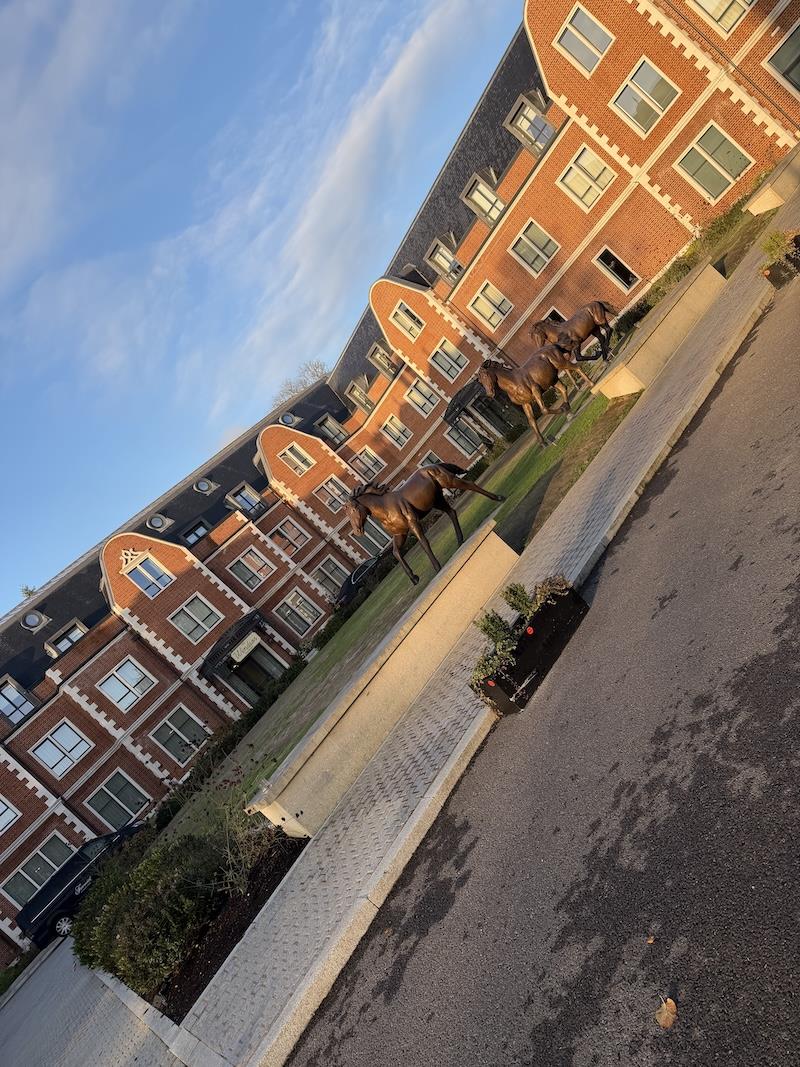
Bird brainThe Fairmont Windsor Park hotel is situated in the sort of surroundings that might provide the backdrop for a James Bond film.
Indeed, approaching it through the extensive grounds, having passed through a security checkpoint at the entrance, I thought it looked rather like the lair of a particularly successful Bond villain.
The building itself is beautiful, and the grounds include a lake, landscaped gardens and enough trees to make you almost forget how close you are to Heathrow Airport and London.
And, as I mentioned earlier, there were the birds.
I thought they were eagles, although it is entirely possible they were red kites or another species of bird of prey. I'm not an ornithologist or even a birdwatcher really. But I definitely saw a road runner bird, and it run off exactly like the one in the cartoons, with a little jump and scurrying feet at the start. Probably a common sight in Surrey, which is mostly rural countryside.
But some people might not believe I saw eagles at all. Apparently there are no eagles in Britain.
There definitely are. I've seen them. Although establishing whether any of them were flying around my XPeng on that particular day is another matter.
And to stretch the metaphor a bit more, it seems to me that XPeng wants to fly among the eagles, so to speak. It wants to reach the highest high.
The company is operating in an increasingly competitive automotive market, particularly among the many technologically sophisticated manufacturers emerging from China.
The challenge for these companies is not simply to manufacture vehicles more affordably, but to establish their own distinctive identities and reputations for engineering and design excellence.
The importance of originality in automotive design was highlighted recently by a legal dispute involving Chinese manufacturer BYD and Jaguar Land Rover.
A court in the Netherlands issued a preliminary ruling restricting European Union sales of a BYD vehicle over its resemblance to the Land Rover Defender. BYD disputes the ruling and says its vehicle was independently designed.
But BYD itself is also a good example of the considerable engineering innovation taking place within the Chinese automotive industry.
The company's eight-in-one electric powertrain integrates eight major components, encompassing functions associated with propulsion, charging and electrical control, into a single integrated system.
Rather than simply adding more components to a machine, there is something particularly interesting about engineering that combines several components into one, reducing the amount of space required and potentially improving manufacturing efficiency.
Nature has been doing something similar for rather longer than the automotive industry.
Research into avian intelligence has shown that some birds possess remarkably high concentrations of neurons in their relatively small brains, with certain species having forebrain neuron counts comparable to those of some primates. In other words, a bird's brain contains about as many neurons as the brain of a monkey, despite being approximately a tenth of the size.
Miniaturisation has always been a thing, both in nature and in technology, and greater intelligence and capability do not necessarily require a larger or more physically complicated machine. Sometimes they require a better arrangement of what is already there.
The integration of intelligence, computing and physical hardware is central to XPeng's ambitions, and the company is exploring how that integration might produce machines capable of travelling along roads, flying through the air or walking around the rooms in which we live and work.
It is an ambitious undertaking, and there is still a considerable distance between the capabilities of today's intelligent machines and some of the visions presented by companies developing them.
XPeng intends to provide further details of its progress at its annual AI Day in Guangzhou, China, on November 25, when it will showcase its latest developments in humanoid robotics, autonomous driving and flying vehicles.
For the moment, however, judging by my admittedly limited experience of driving one of its cars through the Surrey countryside, XPeng already appears to have a rather good understanding of something that has occupied automotive engineers for more than a century: how to make a car that someone simply enjoys driving.
And, however intelligent cars eventually become, I hope that is something the automotive industry never loses sight of.

Legal Disclaimer:
MENAFN provides the
information “as is” without warranty of any kind. We do not accept any
responsibility or liability for the accuracy, content, images, videos,
licenses, completeness, legality, or reliability of the information
contained in this article. If you have any complaints or copyright issues
related to this article, kindly contact the provider above.


Comments
No comment