


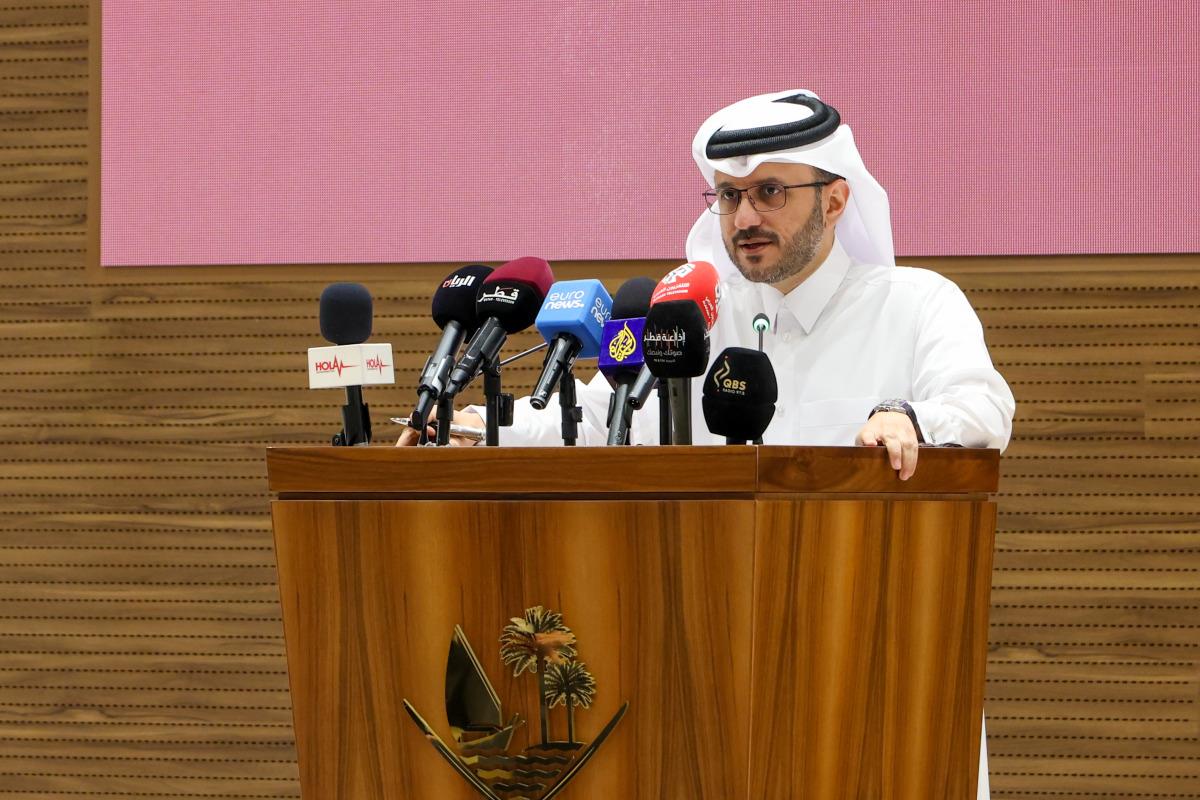
Qatar's Sovereignty Determines Its Positions Toward All Parties In The Region: Foreign Ministry Spokesperson


Doha, Qatar: Advisor to the Prime Minister and Official Spokesperson for the Ministry of Foreign Affairs Dr. Majed bin Mohammed Al Ansari affirmed that Qatar's sovereignty remains the determining factor in shaping its positions toward all parties in the region.
He stressed that Qatar would not tolerate aggression in any form and maintained that diplomacy remains the only viable path to resolving the crisis.
Speaking at the Foreign Ministry's weekly media briefing, Dr. Al Ansari said Qatar is determined to safeguard its sovereignty and independence through establishing a collective regional security framework that addresses the security challenges and concerns of all parties and helps ensure stability throughout the region.
He stressed that such a framework is essential to guaranteeing regional security and stability, adding that preventing the region from reaching the brink of war required addressing its underlying issues, foremost among them the Palestinian cause.
Dr. Al Ansari said that Iran is a major regional power with which Qatar shares longstanding historical ties in trade, culture and other areas. He reiterated that Qatar consistently favors resolving differences through diplomacy and dialogue rather than hostility.
He said the region had undergone profound changes since Oct. 7, 2023, the consequences of which continue to shape the current situation. He attributed much of the region's present difficulties to the genocide suffered by the Palestinian people, Israel's continued attacks across the region and the cycle of violence that has unfolded since that date.On the latest developments in mediation efforts between Washington and Tehran, Dr. Al Ansari said Qatar, in its capacity as a mediator, wanted discussions to remain within the negotiating process and to proceed through direct engagement with the parties. He confirmed that Qatar continued to hold meetings, maintain communications and exchange views with the parties, including in recent days.
Addressing the impact of military escalation on mediation efforts, he warned that any escalation on the ground in the region would adversely affect the mediation efforts Qatar is conducting with its partners.
He cited remarks made on Monday by HE Prime Minister and Minister of Foreign Affairs Sheikh Mohammed bin Abdulrahman bin Jassim Al-Thani, who urged all parties to exercise restraint and pursue diplomacy following meetings with U.S. officials in Washington.
HE the Prime Minister warned that the region could not withstand further escalation and that any military developments on the ground would undermine prospects for reaching an understanding between the parties.
Al Ansari said Qatar did not wish to prejudge developments or speculate on whether an agreement would be reached, but emphasized that its mediation efforts remained ongoing.
In a separate context, Al Ansari reaffirmed Qatar's support for Libya's sovereignty and stability, as well as for efforts to fulfill the aspirations of the Libyan people and secure lasting stability in their country. He cautioned against any developments that could threaten Libya's stability.
On Gulf coordination, Al Ansari highlighted the extensive contacts over the previous week between Qatari officials and their counterparts in other Gulf countries. He said these consultations were aimed at coordinating a unified Gulf position and noted that efforts to support Qatar's mediation initiatives were continuing in cooperation with Gulf partners.
Regarding the humanitarian situation in the Gaza Strip and efforts to revive the peace plan and increase the delivery of aid, Al Ansari reiterated Qatar's longstanding position.
He said Qatar had worked from the outset to secure an agreement that would establish peace in Gaza and Palestine as a whole and put an end to the ongoing Israeli massacres and crimes against defenseless civilians in the Gaza Strip.
He argued that Israeli attacks in the West Bank, Lebanon and Syria reflected a lack of commitment to peace initiatives.
Qatar, he added, had repeatedly conveyed its position through various diplomatic platforms and discussions with the United States and other parties involved in implementing the peace plan. He maintained that Israel now bore clear responsibility for fulfilling its commitments under the plan's various phases.
Al Ansari called for coordinated efforts with regional and international partners to pressure the Israeli government to honor those obligations, in accordance with the understandings reached through the intensive mediation efforts of Qatar, Turkiye and Egypt.
Describing the situation on the ground, he said developments continued to run counter to the objectives of the peace process, with attacks and assassinations persisting and Palestinians facing conditions that no population should have to endure, even during wartime.
These included restrictions on humanitarian aid deliveries, growing public health warnings and the spread of disease.
He said Palestinians are dying from causes that would not be fatal a few meters from the border, describing what is happening as deliberate starvation and a slow killing of the Palestinian people.
Advisor to the Prime Minister and Official Spokesperson for the Ministry of Foreign Affairs Dr. Majed bin Mohammed Al Ansari concluded by reaffirming Qatar's commitment to pursuing a comprehensive and lasting solution to the Palestinian cause that fulfills the aspirations of the Palestinian people, protects their lives and guarantees their rights under international law.

Legal Disclaimer:
MENAFN provides the
information “as is” without warranty of any kind. We do not accept any
responsibility or liability for the accuracy, content, images, videos,
licenses, completeness, legality, or reliability of the information
contained in this article. If you have any complaints or copyright issues
related to this article, kindly contact the provider above.


Comments
No comment