


SwitzerLand's First Time At The Helm Of The World's Largest Regional Security Body


This content was published on November 24, 2026 - 09:00 12 minutes Thomas Bürgisser, Swiss National Museum blog
-
Deutsch
de
Erstmals an der Spitze der grössten regionalen Sicherheitsorganisation der Welt
Read more: Erstmals an der Spitze der grössten regionalen Sicherheitsorganisation der
Français
fr
Crise et responsabilités: la première présidence suisse de l'OSCE
Read more: Crise et responsabilités: la première présidence suisse de l
العربية
ar
رئاسة سويسرا لمنظمة الأمن والتعاون في أوروبا عام 1996: اختبار البوسنة
Read more: رئاسة سويسرا لمنظمة الأمن والتعاون في أوروبا عام 1996: اختبار ال
中文
zh
危机与责任:瑞士的首个欧安组织轮值主席国任期
Read more: 危机与责任:瑞士的首个欧安组织轮值
Swissinfo regularly publishes articles from the Swiss National Museum's blog External link dedicated to historical topics. The articles are always written in German and usually also in French and English.
When French President Jacques Chirac visited Switzerland on 11 June 1996, an embarrassing gaffe occurred that says a lot about Switzerland's standing in European politics. As guest of honour, Chirac had given a speech before the International Labour Conference at the Palais des NationsExternal link in Geneva, before meeting with the head of the Swiss foreign ministry, Flavio Cotti, for a brief working session. Between the two appointments, Chirac fielded questions from journalists at a press conference.
One asked when Monsieur le Président thought the conditions would be in place to hold general elections in war-ravaged Bosnia-Herzegovina, which was under extensive international supervision, and whether his view tallied with Mr Cotti's decisions. Chirac, looking bewildered, turned to his adviser with his microphone on, and asked:“Who is Mr Cotti?” After a few explanatory words, Chirac nodded and replied with conviction:“I have absolute trust in Mr Cotti, OSCE Chairman-in-Office, and I believe that the sooner the elections take place, the better.”
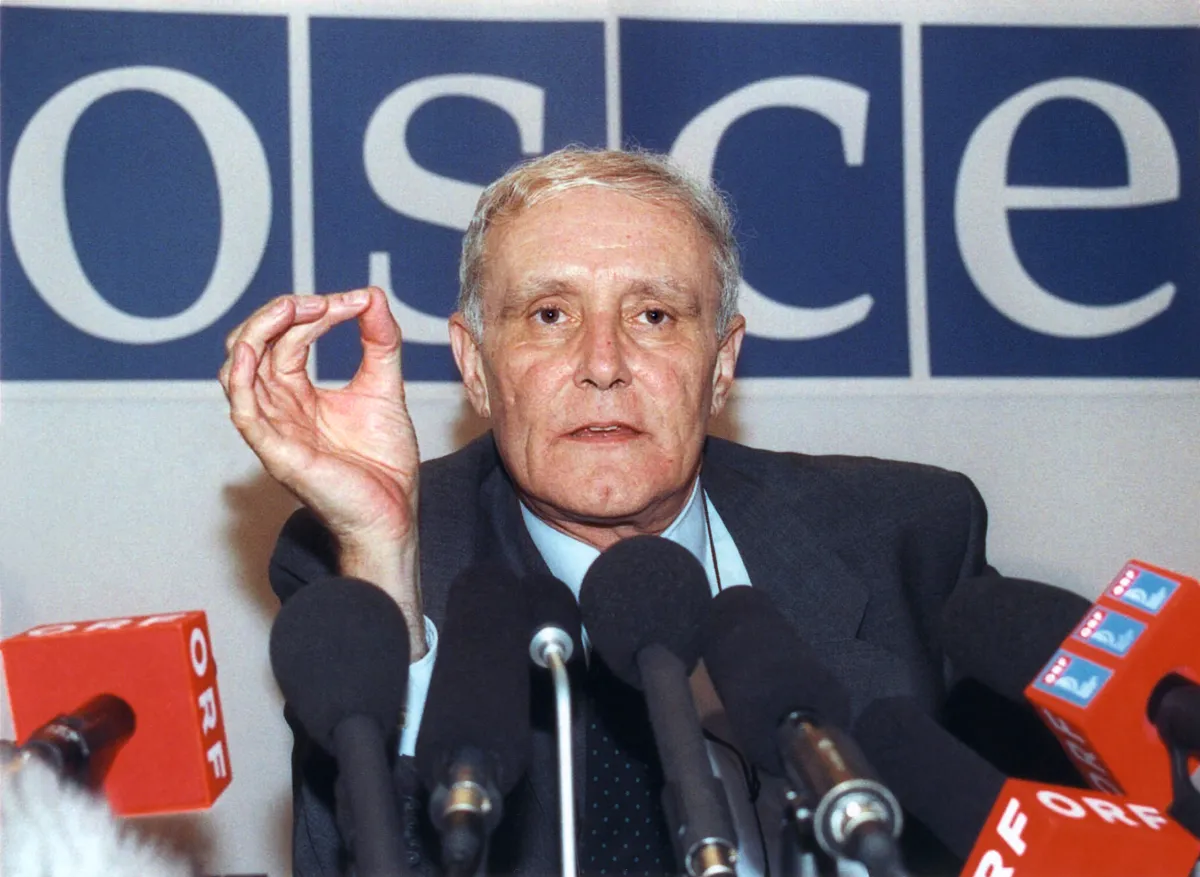
The episode clearly shows that just because Federal Councillor Flavio Cotti was OSCE Chairman-in-Office in 1996 did not mean that the major players of European politics were aware of the role of the politician from canton Ticino who had headed up the foreign ministry since 1993. That was set to change in the days that followed. Because when Cotti stood before the media on 25 June 1996 after a special meeting of the OSCE Permanent Council at Vienna's Hofburg Palace, the eyes of the world were on him. This is because the future of Bosnia-Herzegovina – a flashpoint in European politics at the time – depended on his decision.
Switzerland's great responsibilityLet us rewind for a moment: in November 1995, under massive pressure from the US and following sustained NATO air strikes, the presidents of Bosnia, Croatia and Serbia had agreed on a peace treaty at the isolated Wright-Patterson Air Force Base in Dayton, Ohio. Years of murder, torture, destruction and forced displacementExternal link were finally to come to an end. Through its presence, the NATO-led multilateral Implementation Force was to secure the fragile peace in Bosnia-Herzegovina. The OSCE had a key role to play in the implementation of the Dayton Agreement. It was to monitor the peace process and organise the first free post-war elections.
On 1 January 1996, Switzerland took over as Chair of the OSCE – and assumed a responsibility of exceptional magnitude. As Chairman-in-Office, foreign minister Cotti had to decide whether the elections, as set out in the peace treaty, could take place by 14 September 1996. He also had to confirm that the elections could be held under free and fair conditions. This proved to be a dilemma.
From CSCE to OSCEThe OSCE emerged from the Conference on Security and Cooperation in Europe (CSCE). The Final Act of the CSCEExternal link, which was signed in Helsinki on 1 August 1975 by the heads of state and government from 33 countries in eastern and western Europe as well as the US and Canada, set out the political principles for relations between these states and agreements on security, economic cooperation and human rights. This masterpiece of pan-European diplomacy established an ongoing dialogue between East and West in the midst of the age of rival blocs. Up until the end of the Cold War, the CSCE process was the only forum in which members of NATO and the Warsaw Pact, as well as neutral and non-aligned states, could talk to each other as equals.
Neutral Switzerland played an important role as a bridge-builder within the CSCE. When the East-West conflict came to an end in 1989, however, this role soon fell away. A CSCE Special Summit was held in Paris in November 1990 to establish the outcomes of the transition and to usher in a new age of pan-European cooperation. But the general euphoria quickly gave way to disillusionment. In view of the outbreak of hostilities in the disintegrating Yugoslavia, Swiss diplomats strongly advocated an expansion of the CSCE's scope for actionExternal link, calling for it to become more of an instrument for conflict prevention, crisis management and peacekeeping.
At the same time, Switzerland was seeking a new role in international politics due to neutrality losing relevanceExternal link. By voting against the European Economic Area (EEA) Agreement, Swiss voters narrowly opposed closer ties with European structures in December 1992. Shortly afterwards, by adopting the Alpine Initiative and rejecting the Federal Act on Swiss Troops for Peacekeeping Operations ('Blue Helmet Bill'), the Swiss electorate again opposed the government's desire to open Switzerland up internationally. In late June 1994, three weeks after the rejection of the“Blue Helmet Bill”, the Federal Council decided that Switzerland should apply to chair the CSCE in 1996External link. It thus signalled“Switzerland's presence on the political map of Europe in a phase in which Switzerland was threatened with further political marginalisation.”
Given the CSCE's limited organisational structure, the Chairperson-in-Office took on the leading political role, although the Federal Council stated that their scope for action and chances of success remained restricted due to“diverging views, particularly of Russia and the NATO states.” At the time, Moscow already vehemently opposed the planned expansion of NATO to the east.
After member states had decided to rename the organisation OSCE and accepted Switzerland's candidacy at the CSCE summitExternal link in December 1994, foreign ministry boss Flavio Cotti took a seat in the OSCE Troika as future Chairman. According to Cotti, the OSCE's most important task was to“allay Russia's fears of isolation” and, as part of a genuine pan-European security cooperation, to grant the country“a European home, but not a guaranteed special status.” Throughout the course of 1995, preparations for the chairmanship were shaped by crisis diplomacy, not only in Bosnia but also in the former Soviet Union, including in Chechnya.
In November 1995, Flavio Cotti invited diplomat Heidi TagliaviniExternal link to brief the Foreign Policy Committee of the House of Representatives on her spectacular mission in Grozny, where, in extremely difficult conditions and following arduous negotiations, the OSCE had succeeded in getting the Russian Federation and the Chechen rebel groups to sign a military agreement.
When Cotti travelled to WashingtonExternal link shortly afterwards, it became clear that Switzerland's chairmanship would revolve around the implementation of the future peace order for Bosnia-Herzegovina rather than the conflicts in the former USSR. The implementation of the Dayton Agreement was not only intended to allow the rebuilding of war-torn Bosnia, but also to anticipate“the model of future European security cooperation” and to clarify the roles of NATO, the OSCE, the US and Russia. After the agreement entered into force, the OSCE faced its biggest field operation to date in 1996. Around 70 unarmed volunteers from the Swiss Army, known as “yellow hats” External link provided the OSCE mission with logistical support.
Over 2,000 international supervisors and observers – including many Swiss citizens – were deployed for running and monitoring the elections alone. Chairman-in-Office Cotti set about assiduously assessing the political situation on the ground. Between January and June 1996, he travelled to Bosnia a total of five times.
By May, he still felt that the conditions for free and fair elections were not met. The public sphere was being dominated by nationalist parties, Bosnian Serb leader Radovan Karadžić, who had been indicted for war crimes by the International Criminal Tribunal, was still exerting an influence, freedom of movement in Bosnia remained limited, and the return of refugees was making slow progress.
Voter registration became a politically explosive topic, as the consequences of ethnic cleansing could be cemented after the fact through democratic means if displaced people were allowed to vote at their new place of residence. In technical terms, the election date in September seemed achievable, but politically the certificationExternal link remained questionable.
Growing pressure for electionsIn Florence on 14 June, Cotti surprised the international community, which was pressing for swift elections, by announcing that he had not yet made his decision. At the eleventh hour, on 25 June, the Chairman-in-Office called a special meeting of the Permanent Council at the OSCE headquarters in Vienna's Hofburg Palace. International pressure was intense. In the end, even German Chancellor Helmut Kohl called his friend Cotti. According to the foreign ministry head's former staff, Kohl reportedly told Cotti:“Sometimes in life we have to say yes, Flavio.”
Cotti opened his eagerly awaited address by saying that despite progress, the minimum conditions for free elections in Bosnia were still not met. But delaying them would sow uncertainty, could bolster centrifugal forces and deepen political divisions in the country, he added. The advantages and disadvantages of scheduling the elections as planned practically cancelled each other out.“After careful consideration of all the factors, I conclude,” said CottiExternal link,“that there are no convincing alternatives to holding the elections.”
By giving the green light for the elections in Bosnia on 25 June 1996 in his capacity as Chairman-in-Office, Cotti was probably the first Swiss foreign minister to take a decision of such international magnitude, one that was also set to have a direct impact on the lives of people in Bosnia's post-war society. During its first term as Chair in 1996, Switzerland actively helped shape the OSCE's development – and even Jacques Chirac ended up knowing who Mr Cotti was. At the same time, it became apparent that Switzerland's possibilities for action within the OSCE and in helping shape European security policy remained limited. This was also shown by the fundamental conflict between NATO expansion and Russian integration, in which the OSCE, according to Cotti's sober conclusionExternal link at the end of the year, would“play a subsidiary role”.
Thomas Bürgisser is a historian at the Diplomatic Documents of Switzerland (Dodis) research centre.
In 2026, Switzerland assumes the chairmanship of the Organisation for Security and Co-operation in Europe (OSCE) – the world's largest regional security organisation – for the third time. It is thus continuing a commitment that began with the drafting of the CSCE Final Act in 1975. Fifty years on, the Swiss Diplomatic Documents research centre (Dodis) looks back on the history of the CSCE process and discusses the past and present challenges facing the OSCE.
On Friday 30 October 2026, Dodis presented the new source editionExternal link Security and cooperation in Europe. Diplomatic documents of Switzerland from the early days of the CSCE process to Switzerland's first OSCE chairmanship, 1969–1996 at the University of Bern. In the panel discussion that followed, organised by Dodis in collaboration with the Swiss Foreign Policy Society, former top diplomat Heidi Tagliavini and Ambassador Christoph Späti, special representative of the OSCE Chairperson-in-Office, discussed Switzerland's role in the OSCE.
Those who missed the event can watch the video recording hereExternal link.
The original articleExternal link can be found on the Swiss National Museum blog page.
Popular Stories Most Discussed Prefer Swissinfo on GoogleSee more Swissinfo articles in your Google results. Learn
In compliance with the JTI standards
More: SWI swissinfo certified by the Journalism Trust Initiati
You can find an overview of ongoing debates with our journalists here. Please join us!
If you want to start a conversation about a topic raised in this article or want to report factual errors, email us at ....
Read more
Legal Disclaimer:
MENAFN provides the
information “as is” without warranty of any kind. We do not accept any
responsibility or liability for the accuracy, content, images, videos,
licenses, completeness, legality, or reliability of the information
contained in this article. If you have any complaints or copyright issues
related to this article, kindly contact the provider above.


Comments
No comment