


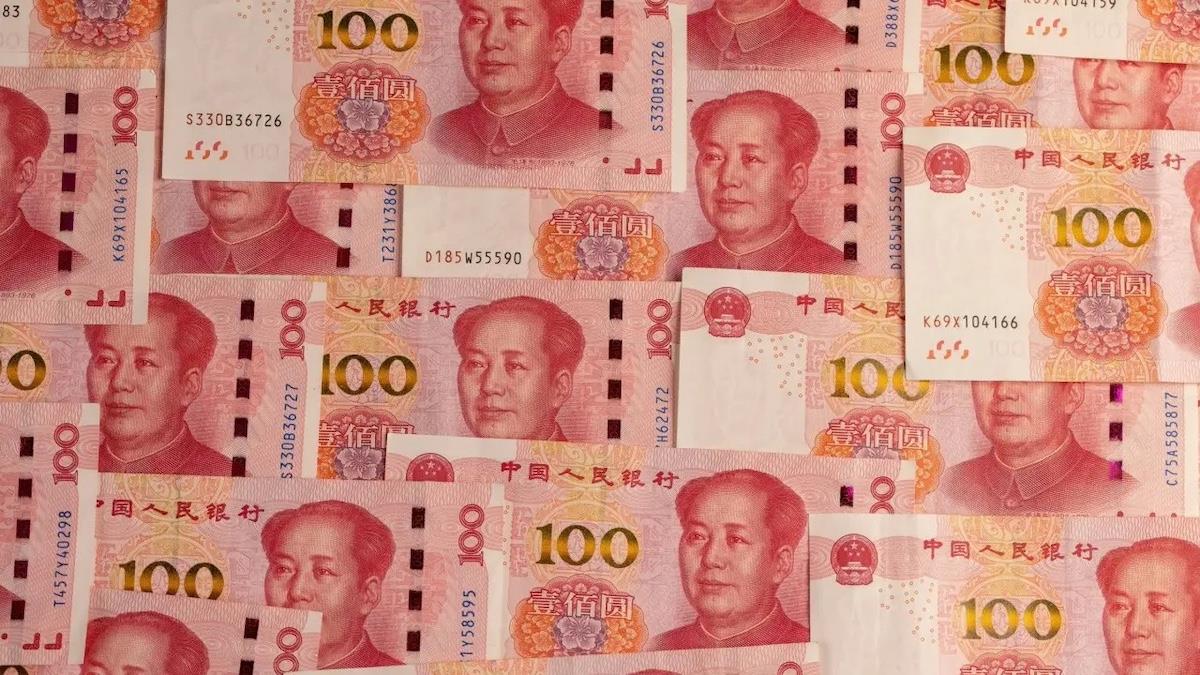
Yuan Strength Is Changing The Math On Dollar Holdings


China's currency is at its strongest against the dollar in more than four years, and Beijing is in no hurry to stop it. The People's Bank of China (PBOC) set its daily reference rate at 6.7118 per dollar last week, its firmest fixing since July 2022.
The yuan has gained around 5% this year. For years, Beijing has held the yuan down to keep exporters competitive.
Letting it climb now, with household demand weak and factories leaning on overseas buyers, makes little sense on growth grounds alone. Beijing wants the yuan held more widely around the world, and a currency the world is asked to hold has to look like it keeps its value.
In June, the central bank opened a repo facility giving foreign central banks and sovereign wealth funds yuan liquidity against their Chinese bond holdings.
Direct participants in China's own cross-border payments system have risen from 139 to 193 since 2024, and close to 30% of China's goods trade is now settled in yuan, up from 12% to 13% in 2018.
Latest stories Google's AI helps a thriller writer-investor think about Micron Huang comeback, Trump data center push recharge US AI stocks Jensen Huang's return locks Nvidia deeper into US statecraftThe yuan still makes up only around 2% of official reserves and roughly 3% of payments on the main global bank messaging network, where the dollar handles about half. Those figures increasingly miss the yuan flows running through China's own system, which PBOC Governor argued last month would lift its share of global payments to 6% to 7%.
Either way, the gap with the dollar remains huge, though Beijing is plainly working to close it.
For most of the past decade, foreign money in Chinese assets was fighting a currency that Beijing allowed to drift lower, quietly eating into gains once they were converted back. A yuan guided gently higher works the other way, adding to returns instead.
A currency gain like this year's 5%, on top of an asset's local return, is a material difference, and it changes how Chinese bonds and equities compare with alternatives elsewhere. Chinese government bonds yield well below US Treasuries, which have long made them a hard sell to income-focused buyers.
A steadily appreciating currency, low correlation with Western bond markets and better liquidity for official holders through the new repo facility close much of that gap, particularly for reserve managers and long-term institutions deciding how much fixed income to hold outside the dollar.
In equities, a firmer yuan squeezes Chinese exporters' margins when overseas revenue converts back into fewer yuan, while lifting the spending power of Chinese consumers and the companies that import for them.
Multinationals selling into China see their yuan revenues worth more in dollars. Sector performance can diverge sharply even when the overall index barely moves.
Many Asian economies trade heavily with China and their currencies tend to track the yuan, so a managed climb in Beijing tends to lift regional currencies alongside it, with knock-on effects for anyone holding Asian bonds or equities in dollar terms.
Global portfolios typically hold the large majority of their assets in dollars, whether deliberately or simply because the US dominates global markets.
The dollar will remain the world's main reserve and funding currency for the foreseeable future. Its depth, legal protections and the sheer size of US capital markets have no rival.
Yet a world with two sets of financial fundamentals running side by side, one built around the dollar and a smaller one around the yuan, raises the cost of treating dollar exposure as automatic.
The yuan is a managed currency, and its rise depends on Beijing's continued tolerance. Capital controls remain, and access can tighten when Beijing feels pressure.
Sign up for one of our free newsletters-
The Daily Report
Start your day right with Asia Times' top stories
AT Weekly Report
A weekly roundup of Asia Times' most-read stories
After the shocks of 2015, controls were tightened and the internationalization drive went quiet for years. A sharp downturn at home, a fresh property scare or a new confrontation with Washington could push officials to favor growth over currency strength again.
Today, though, exports are strong, the trade surplus is enormous and the central bank appears comfortable with a gradual climb. I believe the yuan is likely to keep grinding higher into 2027, with Beijing smoothing any move it considers too fast.
Volatility that low, combined with a gentle upward trend, is precisely what makes a currency attractive to the large, conservative global institutions Beijing is courting.
Every step that makes the yuan easier to hold, borrow against and pay with chips away at the dollar's convenience advantage, and the money that follows will shape returns around the world.
Beijing is betting that a currency which holds its value will, in time, draw the capital that has always gone to the dollar first. Reserve managers, exporters and global investors are already adjusting to that shift.
Nigel Green is founder and CEO of the de Vere Group
Sign up here to comment on Asia Times stories OrThank you for registering!
-
Share on X (Opens in new window)
Share on LinkedIn (Opens in new window)
LinkedI
Share on Facebook (Opens in new window)
Faceboo
Share on WhatsApp (Opens in new window)
WhatsAp
Share on Reddit (Opens in new window)
Reddi
Email a link to a friend (Opens in new window)
Emai
Print (Opens in new window)
Prin

Legal Disclaimer:
MENAFN provides the
information “as is” without warranty of any kind. We do not accept any
responsibility or liability for the accuracy, content, images, videos,
licenses, completeness, legality, or reliability of the information
contained in this article. If you have any complaints or copyright issues
related to this article, kindly contact the provider above.


Comments
No comment