


The Silk Road Vs. The Spice Route: Which Project Will See The Light, And Where Does Jordan Stand?


الموقع الرسمي لراديو البلد
Main navigation- أخبار تقارير مقالات تحقيقات فيديو راديو البلد مشاريع نشاطات ومقابلات بودكاست عمان نت لايت English
- مجلس النواب، يعقد الاثنين، جلسة تشريعية يستمع خلالها إلى خطاب الموازنة العامة للسنة المالية 2027، الذي يلقيه وزير المالية، ويناقش مشروع قانون الموازنة المحال من الحكومة رئيس الوزراء جعفر حسان، الاثنين، إن الحكومة ستبدأ خلال الأشهر المقبلة بطرح عطاءات تنفيذ مشاريع المرحلة الأولى من مدينة عمرة، بمكونات أساسية متنوعة مجلس الوزراء يقر في جلسته التي عقدها الأحد برئاسة رئيس الوزراء جعفر حسان 3 مشاريع قوانين ذات العلاقة بقضايا الإرهاب تمهيدا لارسالها إلى مجلس النواب البنك المركزي الأردني يلزم شركات التأمين وشركات إدارة أعمال التأمين باعتماد أدوات وقنوات الدفع الإلكتروني المرخصة والمعتمدة من البنك المركزي، لتسديد المستحقات المالية لمقدمي الخدمات الطبية الناشئة عن عقود التأمين الطبي، وحظر تسديد هذه المبالغ نقدا، اعتبارا من 1 كانون الثاني 2027 قوات الاحتلال الإسرائيلي، اقتحمت الاثنين، مناطق متفرقة في الضفة الغربية، وداهمت منازل ومحال تجارية، وعرقلت حركة الفلسطينيين، ونفذت اعتقالات في عدد من المناطق تنخفض درجات الحرارة قليلاً اليوم الاثنين، ويكون الطقس لطيف الحرارة في أغلب المناطق، ومعتدلًا في الأغوار والبحر الميت والعقبة
11/23/2026 - 13:57 by: Mohammad Ersan
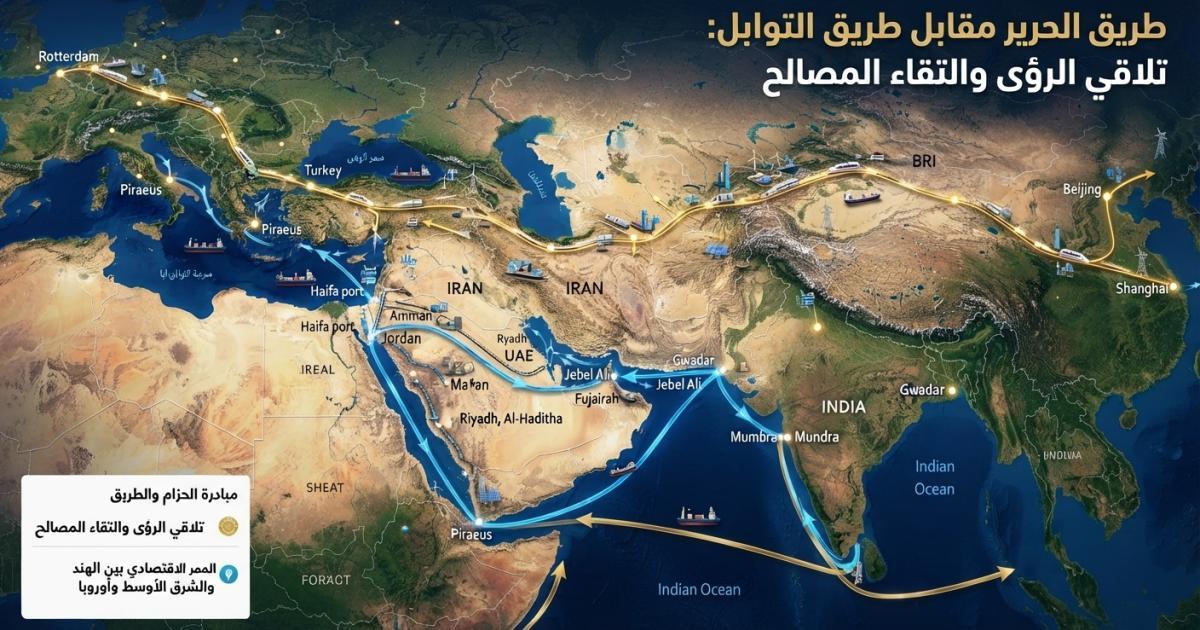
Between China's ambition to redraw the global trade map and the Western-backed Indian project to open an economic corridor linking Asia with the Middle East and Europe, two visions are competing over roughly the same geography: the Silk Road versus the Spice Route.
Jordan sits at the heart of both projects' geopolitical calculations, yet faces a different test: how to turn its strategic location into real economic gains, rather than settling for the role of a transit country. Competition over international trade corridors has returned to the forefront of political and economic calculations, as transport routes, energy lines, and digital connectivity grow in importance.
The issue is no longer about shortening distances between ports and markets. Every new route carries political leverage, economic alliances, and an attempt to redistribute centers of power. On one side of the competition stands China with its Belt and Road Initiative, widely known in the media as the New Silk Road. On the other side advances the India-Middle East-Europe Economic Corridor, tied to the idea of reviving the historic Spice Route.
The two projects differ in their nature and degree of maturity, yet they converge on a core objective: securing alternative routes for global trade, reducing reliance on traditional corridors, and building networks that connect Asia with Europe through the Middle East.
The question worth watching is not which project sounds more appealing in political statements, but which one can move from agreements and maps to railways, ports, and actual freight movement.
The Silk Road: A Chinese Project Beyond TransportChina launched the Belt and Road Initiative in 2013 under President Xi Jinping, aiming to build a broad network of trade and economic corridors linking China with Central Asia, the Middle East, Africa, and Europe.
The initiative is not limited to a single railway line or overland road. It is a web of investments spanning ports, roads, railways, energy, telecommunications, and digital infrastructure, giving Beijing room to expand its economic and political presence across participating countries.
China views trade as an instrument of strategic influence. Every port it helps develop, every railway line it finances, and every economic deal it signs adds to its ability to build long-term ties with countries in need of investment and infrastructure.
The initiative has proven its ability to move into execution across a wide range of countries, despite criticism over debt, the feasibility of certain projects, financing terms, and beneficiary states' reliance on Chinese firms and institutions.
Data from the first half of 2026, published by the Green Finance and Development Center at Fudan University, show Chinese investments in Belt and Road countries reaching roughly $49.8 billion, alongside construction contracts worth $76.5 billion. That reflects a Silk Road that remains an active economic project, even as its financing model shifts.
China's dilemma is no longer proving it can build roads and ports, but managing political and economic balances in highly sensitive regions, especially as U.S. and Western competition for influence in Asia and the Middle East intensifies.
The Spice Route: An Indian Bid to Redraw the Trade MapThis economic corridor was announced in September 2023 on the sidelines of the G20 summit in New Delhi, linking India, the Middle East, and Europe, with participation from the United States, the European Union, India, Saudi Arabia, the UAE, France, Germany, and Italy.
The project is sometimes referred to as the New Spice Route, a symbolic nod to the historic trade routes that connected India with the Middle East and Europe, though its official name is the India-Middle East-Europe Economic Corridor (IMEC).
The idea centers on linking Indian ports with Emirati ports by sea, then moving goods via a rail network passing through the UAE, Saudi Arabia, and Jordan to Israeli ports on the Mediterranean, and from there to Europe.
The project is not aimed solely at moving cargo; it includes plans for power grid interconnection, clean energy and hydrogen transport, digital infrastructure, and communications cables.
Its political weight lies in offering a strategic alternative to China-dominated corridors, giving India a chance to boost its global economic footprint, while the United States and the European Union see an opportunity to reduce dependence on Chinese supply chains.
Still, the Spice Route faces a basic problem: the political idea outpaced logistical readiness.
So far, there is no continuous rail network that allows goods to move from India to Europe along this route. Major infrastructure gaps remain, alongside differences in rail gauge standards and customs and transit hurdles across countries.
An OECD report issued on November 5, 2026 notes that the corridor has moved beyond mere political commitment into a more structured phase, with specialized committees and working groups formed on transport, energy, digital connectivity, and financing. Even so, it stresses that rail infrastructure in the Middle East remains the project's weakest link.
Israel: The Political Bottleneck on the Spice RouteIt is hard to analyze the corridor's future without looking closely at Israel's place in its original route.
As proposed in 2023, the project relies on goods crossing Saudi and Jordanian territory to reach the port of Haifa before heading by sea to Europe.
That route gives Israel a prominent role in the proposed trade network and places it at the center of a major economic initiative backed by Washington, Brussels, and New Delhi.
Yet the Gaza war and its regional fallout, the ongoing Israeli-Palestinian conflict, and security tensions across the region have made executing the project in its original form far more complicated.
The issue is not only political opposition to normalizing economic ties with Israel, but also risks around investment, transport, insurance, and supply chain stability.
A cross-border transport network is hard to run efficiently if one of its key hubs sits in an area facing open conflict or recurring risks of escalation.
The OECD's assessment indicates that regional developments have gradually pushed the project from a single transport line toward a network of corridors and alternative options, with growing importance attached to the ports of Aqaba, Jeddah, Oman, and other Eastern Mediterranean ports.
That shift may be needed to salvage the project, but it brings another challenge: the wider the network grows, the greater the need for political, financial, and technical coordination among participating states.
Jordan: A Strategic Position Between Two ProjectsFor us in Jordan, the rivalry between the Silk Road and the Spice Route is not just a matter of signing onto an international initiative; the kingdom sees an economic opportunity that could shape its standing on the regional trade map over coming decades.
Jordan has sea access to the Red Sea through Aqaba, borders with Saudi Arabia, Syria, Iraq, and Palestine, and a geography that lets it act as a link between the Gulf, the Levant, and the Mediterranean.
Location alone, however, is not enough. Jordan suffers from a limited modern cross-border rail network, while its logistics base, customs clearance procedures, and transport costs need upgrading to compete with better-resourced regional hubs.
One notable development stands out: on April 15, 2026, Jordan and the UAE signed agreements to launch the Aqaba railway project, with an estimated investment of around $2.3 billion and a partnership between Jordanian and Emirati institutions.
The project aims to build a 360-kilometer line connecting phosphate and potash production areas in Shidiya and Ghor al-Safi with the port of Aqaba, targeting a transport capacity of up to 16 million tons per year.
On October 5, 2026, King Abdullah II and the Crown Prince of Abu Dhabi attended the groundbreaking ceremony for the Aqaba railway project, announcing a 403-kilometer network with a joint investment approaching $2.5 billion.
This step gives Jordan a practical start in developing rail transport and lays groundwork for expanding the network later, though it does not mean the kingdom is yet linked to the India-Middle East-Europe Economic Corridor.
The distinction matters: the Aqaba railway project primarily serves the transport of mineral wealth and Jordanian exports, whereas full integration into international trade corridors requires a broader network linking ports to borders and neighboring markets.
According to the OECD report, Jordan represents one of the key rail gaps in the proposed economic corridor, particularly as Jordan's railway network uses a different gauge from the standards used in Saudi Arabia and Israel, making direct connection more complex and requiring additional investment.
In addition, Jordan was not an original signatory to the corridor's 2023 memorandum of understanding despite being named in the route concept, and later requested formal membership while forming a government task force to follow the file.
Jordan can benefit from the competition between the two projects by drawing on its ties with China on one hand, and its partnerships with the UAE, Saudi Arabia, India, and the European Union on the other. Aqaba stands out as a key anchor that can be developed into a logistics hub serving more than one trade route.
Doing so requires completing rail projects and linking them to industrial and border zones, upgrading storage, freight, and re-export services, streamlining customs procedures, and modernizing transport and communications systems. Geography alone will not draw trade, especially given regional competition from ports and logistics hubs with far greater capacity.
Jordan also needs to keep its economic partnerships diversified rather than tying its interests to a single project or political bloc. The stronger its infrastructure and the faster its transit procedures, the better its chances of capturing gains from shifting global trade routes.
Scenarios for the Two Projects' FutureChina's Silk Road holds a clear execution lead, having grown into a wide network of projects, investments, ports, and railways across many countries.
The India-Europe corridor, meanwhile, enjoys U.S., European, and Indian backing, but still needs substantial financing, infrastructure completion, and solutions to political and logistical hurdles.
Success for one project will not necessarily mean the disappearance of the other. China has built a vast commercial network that is hard to bypass, while India and its partners are pushing for an alternative route that strengthens their global trade presence and trims reliance on Beijing-dominated corridors. Countries in the region could end up benefiting from both.
The most likely scenario is that both projects move forward in parallel, with the Silk Road advancing as an established, expanding network alongside gradual progress on the India-Europe corridor, allowing some countries to benefit from both tracks.
A second scenario would see the Spice Route delayed by ongoing regional tensions and stalled political understandings, especially around transit through Israel, pushing participating states toward costlier detours.
A third possibility is reshaping the India-Europe corridor into a multi-route network rather than a single line, expanding the role of ports and logistics hubs in Jordan, Egypt, Oman, and elsewhere.
For Jordan, waiting should not become a strategy. The kingdom does not need a Chinese victory to benefit from the Silk Road, nor a settlement to every regional dispute before upgrading its infrastructure and preparing for the India-Europe corridor.
What matters is that Aqaba and Jordan's transport network are ready to handle trade flows, and that Jordan can turn its geography into investments, jobs, and economic revenue.
China's Silk Road may stay years ahead of its rival, but Jordan's real test is making sure these routes do not pass right past it while their economic rewards go elsewhere.

Legal Disclaimer:
MENAFN provides the
information “as is” without warranty of any kind. We do not accept any
responsibility or liability for the accuracy, content, images, videos,
licenses, completeness, legality, or reliability of the information
contained in this article. If you have any complaints or copyright issues
related to this article, kindly contact the provider above.


Comments
No comment