


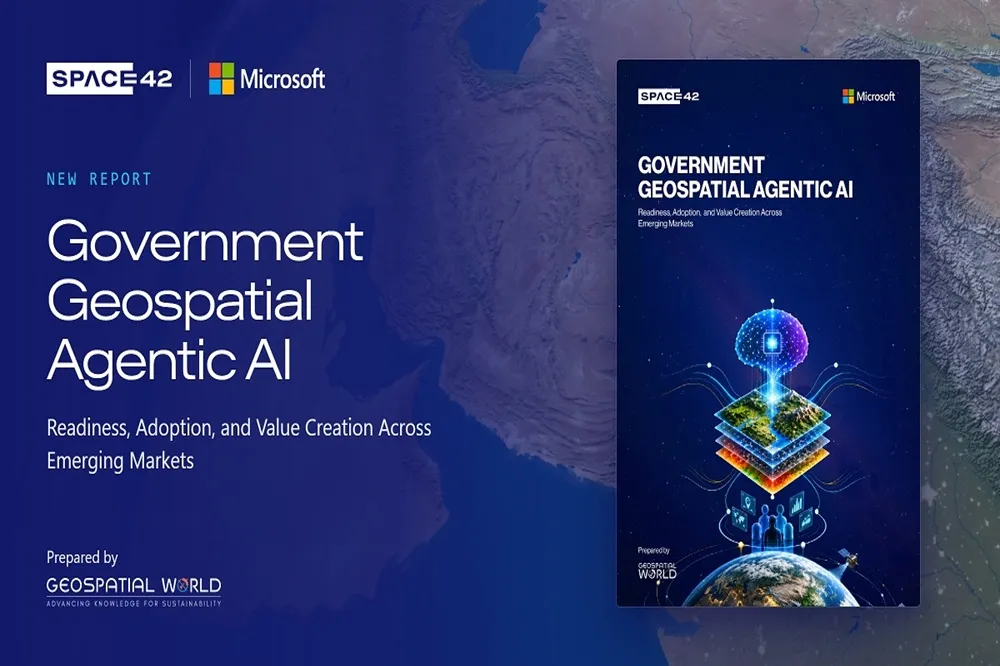
From Data To Decisions: Space42 And Microsoft UAE Release Report On Geospatial Agentic AI's Potential To Help Governments Better Serve Society


(MENAFN- Mid-East Info) Report examines how governments across the Middle East, Africa, and Southeast Asia plan to incorporate Geospatial Agentic AI into their operations
(GLOBE NEWSWIRE) - Fragmented intelligence is a key barrier to governments turning geospatial AI into better public services. Connecting trusted data across institutions offers an opportunity to make better-informed decisions-from responding to disasters to planning cities and managing infrastructure. That is the central message of Government Geospatial Agentic AI: Readiness, Adoption, and Value Creation Across Emerging Markets, released today by Space42 (ADX: SPACE42), the UAE-based, AI-powered SpaceTech company with global reach, and Microsoft UAE.
Borderless Finance. AI-Native.
Your digital companion for smarter everyday choices. Built for how you live, earn, and grow. Move money at your pace with AI-powered finance, all in one tap.
Join the waiting list. Earn The report, developed by Geospatial World as research and knowledge partner, examines current progress and advanced plans to incorporate Geospatial Agentic AI into government operations across the Middle East, Africa, and Southeast Asia. It draws on a survey of over 1,200 organizations, spanning 59 countries, and readiness assessments of 15 markets. Hasan Al Hosani, CEO of Smart Solutions at Space42, said:“The value of Geospatial Agentic AI shows up in the field, in the hours saved between a satellite observation and a government decision. Working alongside our government partners, we help build sophisticated geospatial and Earth observation capability; the advantage now goes to those who can connect it into trusted, accountable workflows where intelligence moves from observation to action within hours rather than weeks. This report shows that the institutions ready to lead are those treating connection as the next investment.” Yvonne Chebib, Health & Public Sector Lead, Microsoft UAE, said:“Geospatial data is one of the most powerful tools governments have to serve their people, whether that means seeing a flood before it reaches a community, directing resources to where they are needed most, or planning cities and infrastructure for generations to come. This research shows the opportunity is not more AI, but connecting the intelligence governments already hold, in ways that are trusted, secure and accountable. At Microsoft, we believe AI should help solve society's biggest challenges, with human judgment firmly in place where it matters most. We are proud to support governments across the region as they turn that intelligence into better outcomes for people and the planet.” Key findings Moving beyond isolated pilots is a central challenge for governments seeking to turn AI into operational value: 63% of respondents say Geospatial Agentic AI remains limited to isolated pilots. As governments move from experimentation to automating operations, the report identifies a lack of trusted and authoritative datasets as a key barrier to executive decision-making. A further 84% of organizations point to low enterprise visibility as a significant capability gap. Together, these findings highlight the importance of trusted data and visibility in supporting government decisions. Respondents see the greatest workflow opportunity in better-connected intelligence: 99% expect the biggest gains to come from decision intelligence, and 99% from data integration. Human oversight remains central to that ambition. Across respondent clusters, 86% to 100% would opt for mandatory human review for high-risk actions, while 71.5% favor an enterprise-wide transformation program. For governments, the findings point to an approach that connects data and decisions while retaining human authority over high-risk actions. Readiness varies by region and is concentrated in specific agencies and workflows:-
GCC and Middle East: Readiness is the most consistent within this region, with the smallest gap between national and state-level maturity
Southeast Asia: Mature national institutions are prepared for adoption, while the region shows growing provincial capability
Africa: Strong Earth observation and specialist capability are prevalent, with a steeper drop in readiness at state and local level. 88% of African respondents name limited enterprise visibility as the leading barrier.

Legal Disclaimer:
MENAFN provides the
information “as is” without warranty of any kind. We do not accept any
responsibility or liability for the accuracy, content, images, videos,
licenses, completeness, legality, or reliability of the information
contained in this article. If you have any complaints or copyright issues
related to this article, kindly contact the provider above.


Comments
No comment