


Dogwood Therapeutics Announces Halneuron® Meets Primary Endpoint With Statistically Significant Pain Reduction Vs. Placebo In Phase 2B Study Of Chemotherapy-Induced Neuropathic Pain


| PATIENT DEMOGRAPHICS | Halneuron ® n=120 | Placebo n=119 |
| Age | 65.4 | 64.9 |
| % Female | 83.3% | 78.2% |
| Baseline Pain Score | 6.1 | 6.0 |
| On Any Background Concomitant Pain Medication | 51.7% | 57.1% |
| On duloxetine/TCAs | 20.0% | 21.8% |
| On gabapentinoids | 39.2% | 42.9% |
| On opioids | 13.3% | 10.9% |
| Years since CINP Onset | 5.6 | 4.4 |
| Platinum Chemotherapy Agent Induced CINP | 38.3% | 42.0% |
| Taxane Chemotherapy Agent Induced CINP | 32.5% | 34.4% |
| Both Platinum and Taxane | 29.2% | 23.5% |
Halneuron ® Phase 2b CINP Top-Line Results
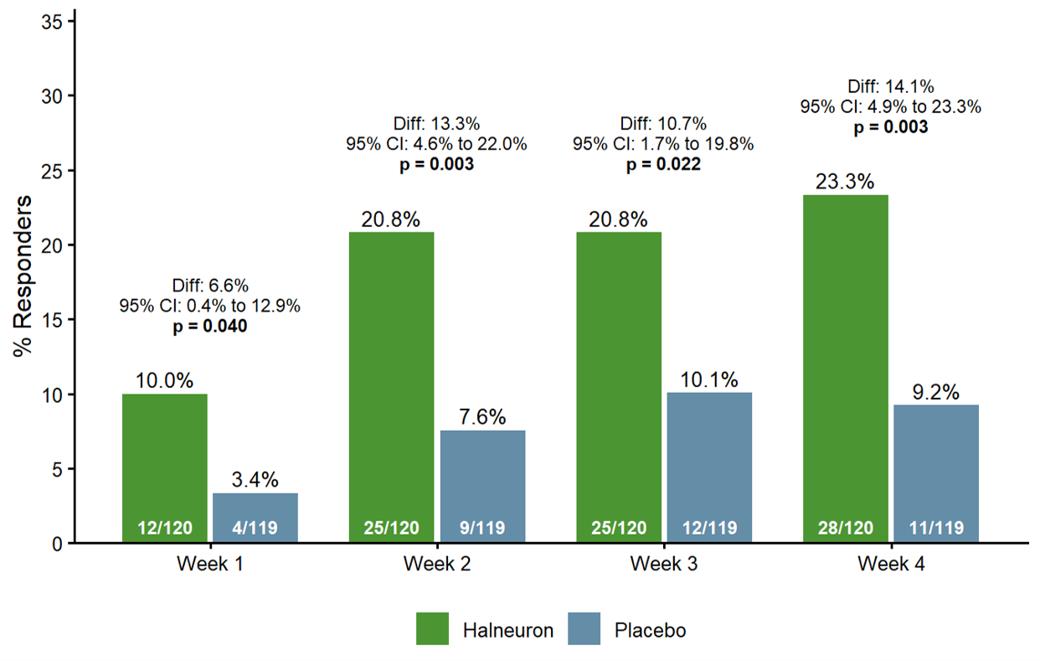
The prespecified primary endpoint was the proportion of patients completing the full study and achieving a 50% or greater reduction from baseline in the weekly average of daily 24-hour recall pain intensity scores, as measured by the 11-point Numeric Pain Rating Scale (NPRS), at Week 4.
Primary Endpoint Result
| Endpoint | Halneuron ® (n=120) | Placebo (n=119) | Treatment Difference | p-value |
| ≥ 50% NPRS responder rate at Week 4 | 23.3% | 9.2% | 14.1% | p=0.003 |
- Key findings included: 23.3% of patients receiving Halneuron® achieved at least a 50% reduction in pain intensity compared with 9.2% of patients receiving placebo ( p=0.003). Halneuron® treatment demonstrated a statistically significant improvement versus placebo on the primary endpoint at every study week.
Proportion of Patients Who Achieved ≥ 50% Reduction from Baseline in Average Weekly Pain Intensity at Week 4
Other Key Study Results
- Halneuron® treatment demonstrated statistically significant improvement on key secondary global assessment endpoints:
- Neuropathic pain (p=0.027) Numbness and tingling (p=0.025) QoL measures (p=0.006)
Detailed analyses of secondary endpoints will be reported following completion of ongoing statistical review.
Safety and Tolerability
Halneuron® was generally well tolerated. More than 95% of randomized participants completed the study.
Treatment-emergent adverse events (“TEAEs”) were reported in 90.0% of patients receiving Halneuron® and 54.6% of patients receiving placebo and were generally mild to moderate in severity.
The most frequently reported treatment-emergent adverse events were:
| TEAE Preferred Term | Halneuron® (N=120) | Placebo (N=119) |
| Paraesthesia oral (lips, tongue, mouth tingling) | 70.0% | 7.6% |
| Hypoesthesia oral (numbness in oral cavity) | 35.0% | 1.7% |
| Paraesthesia | 23.3% | 8.4% |
| Headache | 15.8% | 9.2% |
| Nausea | 15.0% | 6.7% |
| Hypoesthesia | 11.7% | 2.5% |
| Fatigue | 9.2% | 1.7% |
| Dizziness | 8.3% | 3.4% |
| Blood pressure increased | 6.7% | 0.8% |
| Dysgeusia (taste distortion) | 6.7% | 1.7% |
| Somnolence | 5.8% | 0.8% |
Most adverse events were mild to moderate in severity.
Discontinuations due to adverse events occurred in 2.5% and 1.7% of patients in the Halneuron® and placebo groups, respectively.
The safety profile observed in the Phase 2b study was generally consistent with that reported in previous clinical studies of Halneuron®.
About the Phase 2b Study
The Phase 2b study was a multicenter, randomized, double-blind, placebo-controlled clinical trial conducted at 27 sites in the United States evaluating Halneuron® in patients with chemotherapy-induced neuropathic pain.
Key Study Characteristics
- Enrollment: 239 patients Randomization: 1:1 Study duration: 4 weeks Primary endpoint: Proportion of patients achieving ≥ 50% reduction in weekly average pain intensity at Week 4 Assessment tool: 11-point Numeric Pain Rating Scale (NPRS) Mean CINP duration of 5.6 years for Halneuron®-treated patients and 4.4 years for placebo-treated patients. Mean baseline NPRS score: 6.1 for Halneuron® and 6.0 for placebo
About Chemotherapy-Induced Neuropathic Pain (CINP)
Chemotherapy-induced neuropathic pain is a chronic and potentially debilitating complication of cancer treatment resulting from damage to peripheral nerves caused by neurotoxic chemotherapy agents. Symptoms may include pain, numbness, tingling, burning sensations, and impaired physical function. CINP can persist long after completion of chemotherapy and may substantially affect quality of life and daily functioning. There are currently no FDA-approved therapies specifically indicated for the treatment of CINP.
Conference Call and Webcast
The Company will host a webcast presentation to discuss the top-line results today, November 23, 2026 at 8:30 a.m. Eastern Time.
Registration Details
Toll Free: 1-877-407-0784
International: 1-201-689-8560
Participant Access Code: 13763933
CallMeTM: Click here
Webcast: Click here
A replay of the webcast will also be available via the investor website after the call's conclusion.
About Halneuron ®
Halneuron® is an investigational, selective modulator of the NaV 1.7 sodium channel being evaluated for the treatment of neuropathic pain conditions. Halneuron® has not been approved by the FDA or any other regulatory authority. NaV 1.7 has been identified as a key regulator of pain signaling pathways, and the Company believes it is a promising biological target for pain modulation.
About Dogwood Therapeutics
Dogwood Therapeutics (Nasdaq: DWTX) is a development-stage biopharmaceutical company focused on developing potential first-in-class, non-opioid medicines to treat pain and neuropathic disorders. Dogwood's research pipeline includes two potential first-in-class development candidates, Halneuron® and SP16 IV.
Our lead product candidate Halneuron® is a non-opioid, NaV 1.7 analgesic which is a highly specific voltage-gated sodium channel modulator, a mechanism known to be effective for reducing pain transmission. Halneuron® delivered clinically significant pain reduction of 50% or greater as compared with a placebo in a recently completed Phase 2b CINP study (n=239) of patients with a mean five-year duration of illness. Halneuron® has been granted Fast Track Designation from the FDA for the treatment of CINP. Halneuron® treatment has also demonstrated pain reduction related to general cancer pain, including both neuropathic and non-neuropathic pain, as well as patients not treated with chemotherapy.
SP16 IV is a low-density lipoprotein receptor related protein-1 agonist (“LRP1”) with potential to treat neuropathy and prevent or repair nerve damage following chemotherapy. SP16 acts as an LRP1 agonist that in turn provides alpha-1-antitrypsin-like activity. Consistent with alpha-1-antitrypsin anti-inflammatory and immunomodulatory actions, SP16 preclinically demonstrated anti-inflammatory (analgesic) action via potential reductions in IL-6, IL-8, IL1B and TNF-alpha levels, as well as potential to repair damaged tissue via increases in pAKT and pERK that regulate fundamental processes like growth, proliferation and survival. The forthcoming SP16 IV Phase 1b CIPN trial is fully funded by the National Cancer Institute.
Dogwood Therapeutics' largest shareholder is a member of CK Life Sciences Int'l., (Holdings) Inc., which is listed on the Hong Kong Stock Exchange (Stock code: 0775).
For more information, please visit .
Forward-Looking Statements:
Statements in this press release contain“forward-looking statements,” within the meaning of the U.S. Private Securities Litigation Reform Act of 1995, that are subject to substantial risks and uncertainties. All statements, other than statements of historical fact, contained in this press release are forward-looking statements. Forward-looking statements contained in this press release may be identified by the use of words such as“anticipate,”“believe,”“contemplate,”“could,”“estimate,”“expect,”“intend,”“seek,”“may,”“might,”“plan,”“potential,”“predict,”“project,”“suggest,”“target,”“aim,”“should,” "will,”“would,” or the negative of these words or other similar expressions, although not all forward-looking statements contain these words. Forward-looking statements are based on Dogwood's current expectations and are subject to inherent uncertainties, risks and assumptions that are difficult to predict, including risks related to the completion, timing, enrollment, design and results of future clinical studies relating to Dogwood's product candidates; whether interim or final clinical data will support continued development, regulatory submissions or approval; and Dogwood's ability to finance its operations. Further, certain forward-looking statements are based on assumptions as to future events that may not prove to be accurate. These and other risks and uncertainties are described more fully in the section titled“Risk Factors” in the most recently filed Annual Report on Form 10-K, which has been filed with the Securities and Exchange Commission. Forward-looking statements contained in this announcement are made as of this date, and Dogwood undertakes no duty to update such information except as required under applicable law.
Investor Relations:
Dan Ferry
Managing Director
LifeSci Advisors, LLC
...
An infographic accompanying this announcement is available at


Legal Disclaimer:
MENAFN provides the
information “as is” without warranty of any kind. We do not accept any
responsibility or liability for the accuracy, content, images, videos,
licenses, completeness, legality, or reliability of the information
contained in this article. If you have any complaints or copyright issues
related to this article, kindly contact the provider above.


Comments
No comment