


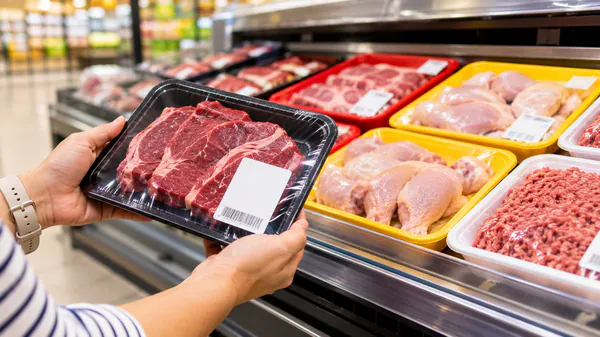
Why Do American Supermarket Meat Trays Come In Black, Red, Yellow, And White? What Colours Really Mean


While the colour-coded displays frequently spark questions over whether they denote premium cuts, pricing, or origin, there is no regulatory standard governing tray colours; retailers use them primarily to organise shelves and distinguish product lines.
There are no regulations standardising meat tray colours.
Instead, supermarket chains use different hues across their refrigerated counters to distinguish product lines and visually organise their shelves.
Also Read | Allana bets on meat-sourcing edge to crack India's pet-food market What does each meat tray colour usually mean?Although there is no universal rule, retailers commonly associate certain tray colours with specific product presentations:
-
Black trays: Often used for selected cuts or premium, higher-value lines. The dark background contrasts sharply with the red of the meat, conveying a more upscale image.
Yellow trays: Frequently used to highlight everyday cuts, promotions, or sale items.
Red trays: Commonly seen in traditional presentations or standard commercial lines.
White trays: Typically used as a standard presentation across different cuts of meat.
These associations serve only as general guidelines and vary from one supermarket chain to another. One retailer may reserve black trays for premium cuts, while another might use them purely for visual appeal or based on packaging availability.
Colour alone does not tell shoppers whether the meat is fresher, more tender, tastier, or of better quality-nor does it reveal its origin or how it was produced.
Also Read | India-New Zealand FTA: Zero duty on sheep meat, 15% tariff on kiwi fruit How to tell if packaged meat is actually freshRather than relying on tray colour, consumers should examine physical cues and packaging integrity-including marbling, fat colour, and muscle texture, as well as properly sealed film with minimal liquid inside the tray.
According to recommendations from Argentina's National Service for Agrifood Health and Quality (Senasa), shoppers should look out for the following indicators when buying from refrigerated supermarket shelves:
-
Texture and smell: Fresh meat should have a firm, elastic texture and no unpleasant odour. Abnormal colouring such as dark brown, surface slime, or softness can be signs of spoilage.
Colour and shelf temperature: Packaged meat that is not vacuum-sealed should be pink and stored in a refrigerated display case equipped with a visible thermometer reading between 0°C and 5°C.
Packaging condition: The wrap must be completely intact, with no tears or punctures, to ensure the meat remains protected.
Reading the label alongside a visual inspection is equally essential when selecting meat.
According to Senasa, packaged meat products must carry key details identifying their source, preparation, and shelf life:
- Product name: Identifies the specific cut of meat being purchased. Production and expiration dates: Show when the meat was prepared and how long it can be safely sold or consumed under prescribed conditions. Origin identification: Indicates where the food comes from. Lot identification: Allows the product to be traced. Storage conditions: Specify how the meat must be kept to maintain food safety.

Legal Disclaimer:
MENAFN provides the
information “as is” without warranty of any kind. We do not accept any
responsibility or liability for the accuracy, content, images, videos,
licenses, completeness, legality, or reliability of the information
contained in this article. If you have any complaints or copyright issues
related to this article, kindly contact the provider above.


Comments
No comment