


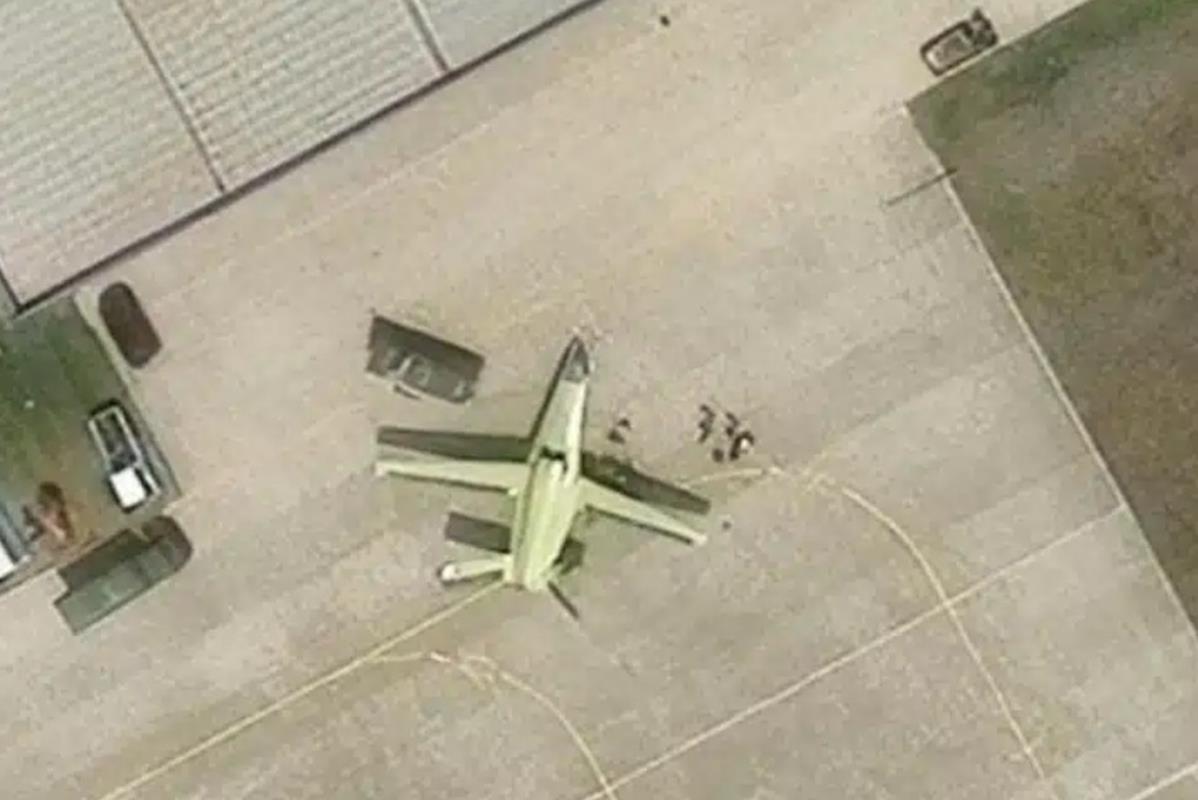
China's Mystery MQ-25-Like Drone Built For Pacific Power Reach


Measured by Vantor at roughly 20.12 meters in wingspan and 14.94 meters in length compared with the MQ-25's 22.86-meter span and 15.54-meter length, the yellow-primer airframe diverges in key details: a tapered nose suggests it could house a radar or radome, a dorsal intake with apparent serrations or channel separation and a laterally flared V-tail.
The design could point toward a multirole tanker or intelligence, surveillance, and reconnaissance (ISR) platform, though external imagery cannot verify internal fuel volume, propulsion, mission systems, or carrier catapult and arresting compatibility.
Media reporting on the imagery notes that any tanker role could ease fighter buddy-tanking burdens for J-15 and J-35 jets operating from Fujian or Type 076 vessels like Sichuan, where GJ-21 trials were reported in October 2026, while the aircraft could alternatively serve as a non-carrier unmanned combat aerial vehicle (UCAV), collaborative combat aircraft (CCA), or test surrogate.
That possibility matters because China's carrier-based fighters face clear reach and endurance limits that unmanned aerial refueling could help offset. A May 2026 China Aerospace Studies Institute (CASI) report notes that J-15 fighters operating from China's two ski-jump carriers, Liaoning and Shandong, face operating-radius and endurance limits tied to short takeoff profiles and takeoff weight ceilings.
That May 2026 CASI report adds that ski-jump launches restrict fuel and ordnance loads, leaving those fighters reliant on shore-based command-and-control and ISR aircraft for wide-area battlespace awareness.
Latest stories Jensen Huang, American Othello As the Kerch Bridge goes down, the Ukraine war clock is ticking China's open-weight AI models are coming for America's marketFurthermore, the Chosun Daily reported in February 2026 that China's J-35 stealth carrier fighter faces severe range and loiter limits because it relies on the WS-21 engine rather than the anticipated WS-19 powerplant. The Chosun Daily report states that this engine setup limits the J-35 to just seven minutes of operation at 900 kilometers from the Fujian carrier.
That report places this constraint within China's broader jet-engine gap behind the US despite over US$40 billion in development spending, and questions the J-35's long-range naval strike effectiveness far from its carrier group.
While current fighter capabilities can support operations inside the First Island Chain or brief surges beyond it, those limits can constrain organic carrier air-wing reach, motivating China's push for aerial refueling.
Using an uncrewed tanker to shuttle fuel from larger manned tankers to fighters in contested areas could keep vulnerable manned tankers farther from threats while sustaining fighter operations.
Carrier modernization could reinforce any uncrewed refueling or ISR role. In a November 2025 International Institute for Strategic Studies (IISS) analysis, Douglas Barrie notes that Fujian's electromagnetic catapults and arrester gear mark a major advance over earlier ski-jump carriers, allowing China's carrier-based aircraft to fly longer ranges with heavier payloads while supporting more aircraft and a broader aircraft mix.
Barrie mentions that Fujian's electromagnetic catapults, observed in trials with J-15 Flanker K, J-35, and KJ-600 aircraft, help enable more ambitious deployments beyond the First Island Chain and support a more capable air wing.
In an October 2026 Center for Strategic and International Studies (CSIS) report, Matthew Funaiole and co-authors state that China's upcoming Type 004 carrier, likely nuclear-powered and larger than Fujian, will enable longer-duration operations farther from China's shores, projecting naval and air power deeper into the Indo-Pacific and beyond.
Funaiole and co-authors write that nuclear propulsion on the Type 004 would remove ship-refueling limits, sustain higher speeds without draining fuel reserves, generate more power for electromagnetic catapults, and free interior space for more aircraft, munitions, fuel, and supplies.
Land-based tanker expansion adds a wider operational layer to long-range power projection. In a January 2026 Lowy Institute article, David Vallance argues that China is expanding its air-to-air refueling fleet to narrow a wide gap with the US and support long-range power projection, including a counter-intervention force capable of blocking allied relief to Taiwan and operating beyond the First and possibly the Second Island Chains.
Vallance writes that China is fielding Y-20B multirole tankers alongside YY-20As that could give the People's Liberation Army Air Force (PLAAF) over 100 refuelers within a decade while phasing out older IL-78s and converted H-6s.
He adds that these modular platforms also fulfill domestic airlift requirements for personnel and materiel across China's territory while extending air operations east and south across the maritime Indo-Pacific.
Uncrewed ISR and kill-web concepts further shape how such a platform could operate in a conflict. In an October 2026 American Foreign Policy Council (AFPC) brief, Robert Pierce and co-authors write that unmanned systems strengthen the People's Liberation Army's (PLA) ability to find, fix, track, and identify US forces across the First Island Chain and beyond.
Pierce and co-authors state that combining high- and low-altitude unmanned aircraft supports layered multi-intelligence collection, localized surveillance of surface ships, and persistent communications relays when satellites face degradation.
Sign up for one of our free newsletters-
The Daily Report
Start your day right with Asia Times' top stories
AT Weekly Report
A weekly roundup of Asia Times' most-read stories
They add that this force mix compresses sensor-to-shooter timelines, relays targeting data, and extends radar coverage, making US ships and aircraft more targetable and increasing the lethality of People's Liberation Army Rocket Force (PLARF) missiles, naval strikes and air defenses, raising intervention costs.
In a July 2026 CASI report, Catherine Welch and other authors report that Chinese researchers view uncrewed platforms as a cost-effective way to scale sensors and strike nodes across kill chains and kill webs, enabling clustering or swarming, wide-area coverage, rapid response, greater autonomy, and lower risk to costly or crewed systems.
Welch and her co-authors add that Chinese studies examine crewed-uncrewed teaming - including a crewed leader paired with uncrewed aircraft - using drones as early warning or interceptor platforms against swarm raids, providing communications and computing relays for distributed forces, and deploying them in distant waters for dynamic kill networks, while noting persistent hurdles in crewed-uncrewed task allocation and future operational deployment.
Whether the Pucheng Neifu drone becomes a carrier-capable tanker, ISR node, or test surrogate, uncrewed refueling and sensing could help China overcome fighter range limits and project power across the Indo-Pacific. This capability could pair with catapult-equipped, nuclear-powered carriers, more tankers, and distributed kill webs, despite engine, ship-endurance, and crewed-uncrewed operational constraints.
Sign up here to comment on Asia Times stories OrThank you for registering!
-
Share on X (Opens in new window)
Share on LinkedIn (Opens in new window)
LinkedI
Share on Facebook (Opens in new window)
Faceboo
Share on WhatsApp (Opens in new window)
WhatsAp
Share on Reddit (Opens in new window)
Reddi
Email a link to a friend (Opens in new window)
Emai
Print (Opens in new window)
Prin

Legal Disclaimer:
MENAFN provides the
information “as is” without warranty of any kind. We do not accept any
responsibility or liability for the accuracy, content, images, videos,
licenses, completeness, legality, or reliability of the information
contained in this article. If you have any complaints or copyright issues
related to this article, kindly contact the provider above.


Comments
No comment