


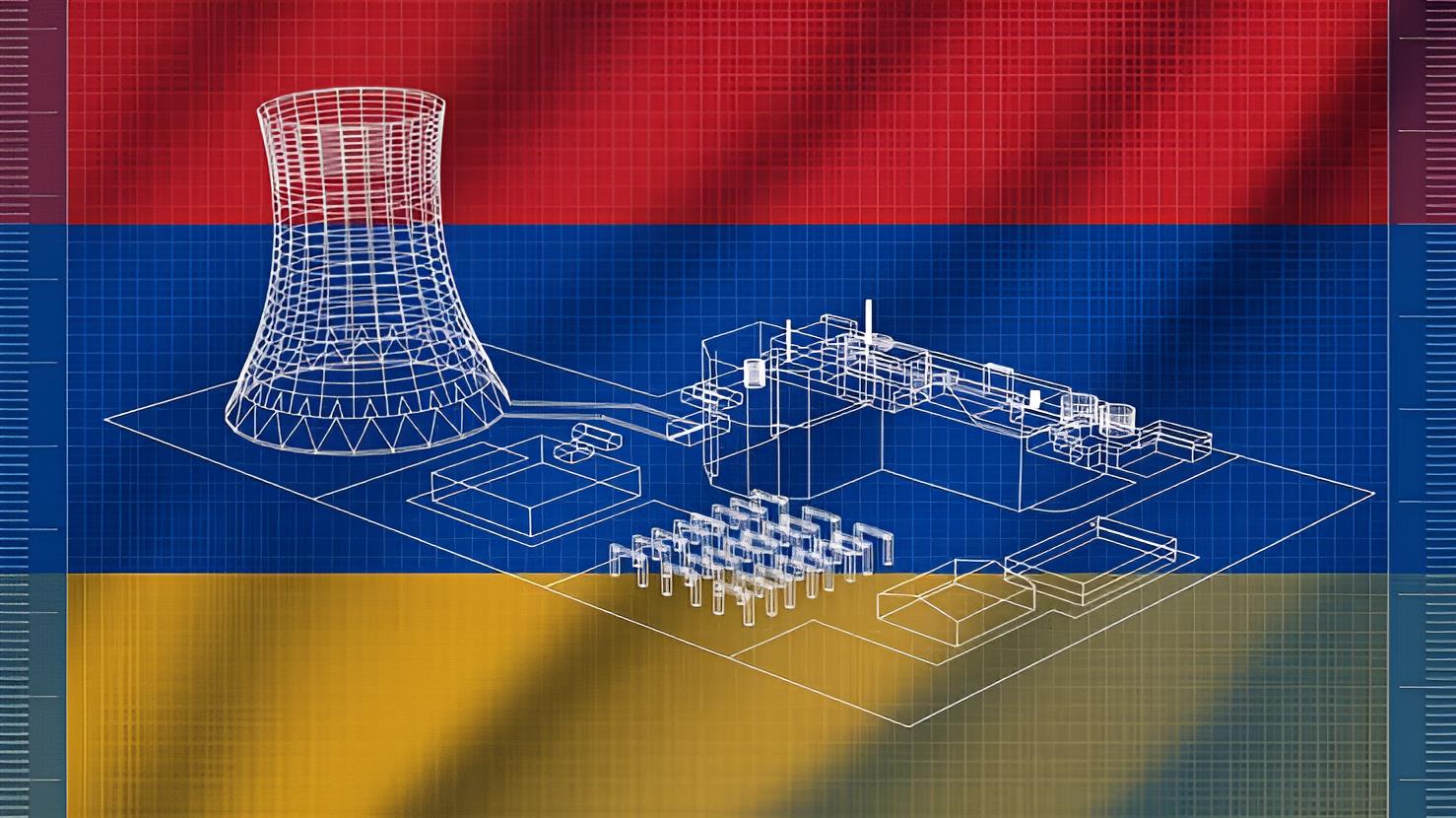
Armenia's Nuclear Dilemma Exposes A Larger Battle For The South Caucasus


It might be said that in Armenia, the conflict between Russia and the West will be played out within the walls of a nuclear reactor. That is because the nuclear power plant Metsamor, which was constructed during the time of Soviet Union, accounts for more than one-quarter of electricity production in the nation. And the decision on whom to choose for the task of replacing the aging plant is essentially a question of who will continue to have a part in Armenia's strategic apparatus.
While visiting Armenia in February, Vice President JD Vance and the US declared that negotiations between the two countries were completed regarding a civil-nuclear cooperation deal. However, in early September, Russia, through its nuclear corporation Rosatom, made an offer to build a 1,000-megawatt VVER reactor in Armenia. This came just two days after Prime Minister Nikol Pashinyan said his previous position on using modular technology may no longer suit Armenia.
Well, a reactor is never just a reactor
The reasons for Pashinyan's proposal were purely economic. Investment projects, and especially energy-intensive projects such as artificial intelligence infrastructure, allegedly turned the existing excess in the energy production sector into an energy deficit. He has suggested that Amazon could invest in case of guaranteed power supply around the clock. However, the statement of interest is not a commitment to purchase electricity. It does not mean any need for a gigawatt-scale reactor either. Energy consumption projections and grid evaluations matter more than announcements of investment intentions in a data centre.
In fact, there is an engineering decision to be made. Small modular reactors may provide some advantages regarding their flexibility, but questions regarding costs and practical implementation remain open. A large reactor will produce a constant amount of energy. At the same time, it requires initial investments and a grid ready to consume it. Rosatom is currently servicing the Metsamor extension program, which should keep the operational reactor running till 2036. The construction of another reactor by Russia will continue the reliance on Moscow's equipment, servicing, and fuel supplies. In reality, this dependency extends beyond just nuclear energy. In an IMF evaluation, roughly 83 percent of the natural gas that Armenia imports originates from Russia. Through the use of gas, railways and access to Russian markets, Russia maintains its leverage, even though the government in Armenia claims to have a European future ahead. Not every commercial disagreement is necessarily a case of coercion.
But the political contradiction came to a head on November 11 when the Collective Security Treaty Organization under Russian leadership stripped Armenia of its voting and nomination rights to specific posts due to failure to make required payments. Yerevan stopped participating in the organization and blamed the organization for its inability to resolve Armenia's security issues, but it did not withdraw from it officially.
Even more importantly, Pashinyan announced plans to visit Russia three times in December, namely on December 3, 11, and 22. A prime minister seeking alternative options in Washington and Brussels is still preparing visits to Moscow three times a month. 'Our goal is not to undermine our relations', said Pashinyan in an affirmative tone. Armenia is attempting to find maneuvering space in a system that is largely built upon Russia. And the nuclear tender is the test for this balance of power after a decision that has a lifetime of many generations.
Baku's different calculations and geopolitics of water
Just across the border, Azerbaijan is pursuing a different version of strategic autonomy. Its hydrocarbons remain an important source of income, but pipelines, ports and railways also make it useful to Europe and Asia. In 2025 the European Union imported 11.3 billion cubic metres of Azerbaijani gas, about 3.9 per cent of its gas imports. It cannot replace Russia alone, but strengthens Baku's position in Europe's diversification strategy.
The current week provided a contrasting picture for Armenia's nuclear power discussion. German Foreign Minister Johann David Wadephul was in Baku on November 17, and both parties emphasized the launch of Azerbaijani natural gas supplies to Germany this year. They also mentioned a bilateral economic committee, investments, and the Middle Corridor. In addition to its Azerbaijani orientation, German diplomacy made other stops: Wadephul toured Armenia, and Germany supported rapprochement between the two neighbors.
Deputy Prime Minister of Georgia Mariam Kvrivishvili was visiting Baku too, and she was talking about transport and energy cooperation. Georgia connects Azerbaijan to the Black Sea and Türkiye. According to the World Bank estimates, the right investments and reforms can increase trade volumes along the whole Trans-Caspian corridor by three times until 2040. However, Azerbaijan suffers from the problems of commodity dependency and infrastructure bottlenecks. The point is that Azerbaijan already has functional trade routes that others are trying to widen.
Yet another, less prominent [in a way of out of sight], event could have equally significant implications. On November 12 in Dublin, Pashinyan and Azerbaijan's President Ilham Aliyev agreed on establishing joint working groups on cross-border rivers. For Azerbaijan, whose territory receives roughly 70% of its surface water resources from beyond its borders, this is no peripheral matter. The history of the Sarsang reservoir, where disputed seasonal releases affected downstream agricultural communities during the years of Armenian control, illustrates the strategic importance of water management. So, too, do Azerbaijan's longstanding concerns over industrial contamination of the Okhchuchay and Araz river systems. Baku's restoration of control over Karabakh's hydraulic infrastructure has changed the balance, but shared rivers still require shared responsibilities.
More intriguing, however, is that the Dublin discussions also addressed the forthcoming interconnection of the two countries' electricity grids. Aliyev had already raised the prospect of Azerbaijan providing Armenia with an additional source of electricity, particularly as the ageing Metsamor nuclear plant approaches the limits of its operating life. Baku has outlined plans for power transmission lines running through Armenia towards Nakhchivan, while technical representatives from both countries have discussed potential electricity imports and exports. This presents Yerevan with an interesting alternative to viewing its energy future exclusively through the prism of Russian or Western nuclear technology. Azerbaijan could potentially help cover part of Armenia's electricity demand, particularly during periods of shortage or growing industrial consumption. Such an arrangement would not eliminate the need for reliable domestic generation, nor has a binding supply agreement been announced. But it could provide greater flexibility while Armenia weighs the costs and political consequences of building a new reactor.
The future of the South Caucasus could well be determined more by electricity power lines, river arrangements and economic interdependence than rival promises made in Moscow and Washington. Where the history of a region has been dominated by what divided its states, the next indicator of sovereignty could well be what they share.
Real test of sovereignty in the midst of tug-of-war
In this sense, then, what is happening in the South Caucasus goes beyond a battle of Russian versus Western flags. Instead, it is about who will construct its nuclear facilities, finance its transportation corridors, purchase its energy resources and share its water supply. The United States provides alternatives in technology and diplomacy; Russia provides structures and infrastructure; while Europe needs reliable supply sources and dependable connections. None can simply redraw the map of this region at will.
For Armenia, a reactor built without clear economics would only change one kind of dependency for another. For Azerbaijan, pipelines and reclaimed territory will need to be complemented with sustainable business connections and sound border regulations. Any lasting peace will be judged more on the basis of whether electricity is flowing and trains are crossing borders than on any declarations made. In this struggle of the region, sovereignty will not lie with he or she who chooses the patron, but with whoever constructs the greatest freedom of choice.

Legal Disclaimer:
MENAFN provides the
information “as is” without warranty of any kind. We do not accept any
responsibility or liability for the accuracy, content, images, videos,
licenses, completeness, legality, or reliability of the information
contained in this article. If you have any complaints or copyright issues
related to this article, kindly contact the provider above.


Comments
No comment