


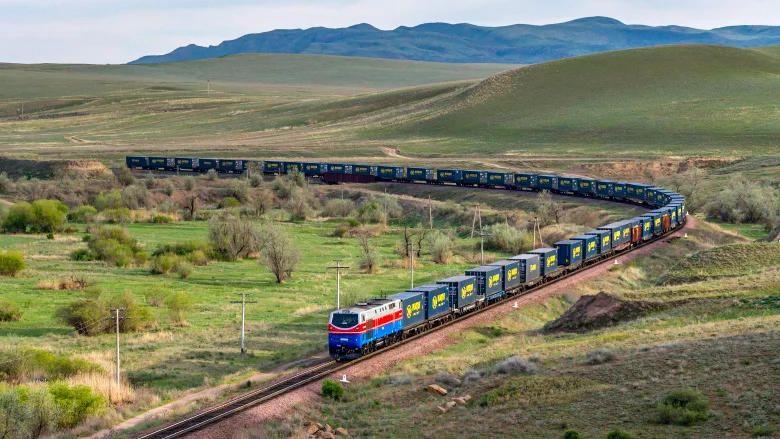
Middle Corridor Requires €18.5 Billion Investment As EU Seeks Alternative Trade Routes To Central Asia


The full development of the Middle Corridor, a transport route linking Central Asia with Europe through the Caspian Sea, Azerbaijan, Georgia and Türkiye, will require an estimated €18.5 billion ($21.8 billion) in capital investment as the European Union seeks to diversify its supply chains.
According to materials published by analytical agency UkrAgroConsult following the 4S Business Summit Rotterdam, European demand for alternative logistics routes and raw-material processing capacity is increasing amid concerns over the concentration of critical mineral processing in China.
Speaking at the summit, Arno Berjessin, a representative of Dutch consultancy Panteia, said the EU's efforts to diversify mineral and agricultural supply chains were partly driven by China's dominant position in critical raw-material processing.
Citing International Energy Agency estimates, Panteia reported that China accounts for approximately 92% of global rare-earth processing capacity and a similar share of battery-grade graphite production.
Against this backdrop, the EU is placing greater emphasis on the Trans-Caspian International Transport Route, commonly known as the Middle Corridor, which connects Asian and European markets through Kazakhstan, the Caspian Sea, Azerbaijan, Georgia and Türkiye.
Infrastructure investment remains a major challenge
According to the summit materials, the route includes approximately 4,256 kilometres of railway infrastructure and a 508-kilometre maritime section across the Caspian Sea. Cargo transportation involves at least seven transshipment operations, creating logistical challenges for operators.
Panteia estimates the corridor's current annual capacity at approximately 3.3 million tonnes, with the potential to reach 11 million tonnes by 2030.
However, achieving this target will require substantial investment in railway infrastructure, port facilities, border crossings and transport coordination.
The European Bank for Reconstruction and Development estimates that €18.5 billion in investment will be needed to address infrastructure requirements, while approximately €10 billion could potentially be mobilized through the EU's Global Gateway initiative.
Experts emphasized that the competitiveness of alternative transport corridors depends not only on delivery speed but also on the reliability and predictability of transit schedules.
As an example, Panteia highlighted operational difficulties along Europe's Rhine–Danube railway corridor.
In 2025, only 31% of monitored trains arrived within 30 minutes of their scheduled arrival time, compared with 42% in 2024. Furthermore, just 29% of the corridor's length met the infrastructure standard required to accommodate 740-metre freight trains.
Panteia therefore recommended that logistics operators assess delivery schedules using broader transit-time ranges, particularly the P90 indicator, which reflects the time within which 90% of shipments are expected to arrive.
Black Sea and Danube bottlenecks complicate European connections
Infrastructure limitations also remain a concern in the Danube-Balkan region, where railway maintenance and capacity restrictions could disrupt freight transportation in 2027.
At a railway corridor meeting in Budapest on October 13, 2026, participants warned of potential disruptions caused by planned maintenance in Serbia and along routes connecting Romania and Bulgaria.
Alternative border crossings, including Giurgiu–Ruse, Calafat–Vidin and Negru Vodă–Kardam, may require diesel locomotives, additional rolling stock or reduced train loads.
Meanwhile, Akdogan Train Cargo plans to introduce an intermodal connection between Türkiye and Europe in January 2028.
Further challenges have been identified at Romania's Port of Constanța, where seasonal grain shipments, insufficient railway access and heavy reliance on road transportation contribute to congestion during harvest periods.
Danube shipping operators have also highlighted fluctuating water levels as a risk to the reliability of inland waterway transportation.
To improve coordination between European logistics hubs, Panteia has proposed closer cooperation between the ports of Constanța and Rotterdam.
Under the conceptual proposal, Constanța could serve as an entry point for cargo arriving from the Black Sea region, while Rotterdam could provide additional processing capacity and logistics services.
Azerbaijan's transit role expands as cargo volumes increase
The Middle Corridor has recorded substantial growth in freight transportation over recent years, strengthening its importance for Azerbaijan's transit sector.
According to Kazakhstan's Ministry of Transport, cargo volumes increased from 759,000 tonnes in 2019 to 4.484 million tonnes in 2024.
According to the Organization of Turkic States, freight transportation reached approximately 4.7 million tonnes in 2025, with a further 10% increase anticipated by 2027.
Longer-term projections envisage further expansion. The corridor's annual throughput capacity could reach 10 million tonnes by 2027, while the freight transportation target for 2030 has been set at 11.4 million tonnes.
World Bank projections cited in the report suggest that cargo volumes could reach 32.1 million tonnes by 2040.
For Azerbaijan, these developments could create additional opportunities to expand transit services, attract infrastructure investment and strengthen its position in trade flows between Central Asia and Europe.
However, UkrAgroConsult analysts emphasized that the successful development of alternative corridors will depend on more than investment in individual railway or port projects.
Modernizing border crossings, expanding terminal capacity and improving coordination between transport operators will be essential to establishing reliable connections across the Caspian, Black Sea and European logistics networks.

Legal Disclaimer:
MENAFN provides the
information “as is” without warranty of any kind. We do not accept any
responsibility or liability for the accuracy, content, images, videos,
licenses, completeness, legality, or reliability of the information
contained in this article. If you have any complaints or copyright issues
related to this article, kindly contact the provider above.


Comments
No comment