


Hamdan Bin Mohammed Smart University Examines Harvard, MIT And Boston University's Approaches To University Endowments And Financial Sustainability


(MENAFN- Mid-East Info) Delegation led by Dr. Mansoor Al Awar meets with university endowment and investment officials and conducts comparative assessments ahead of presenting findings to the Board of Trustees
Borderless Finance. AI-Native.
Your digital companion for smarter everyday choices. Built for how you live, earn, and grow. Move money at your pace with AI-powered finance, all in one tap.
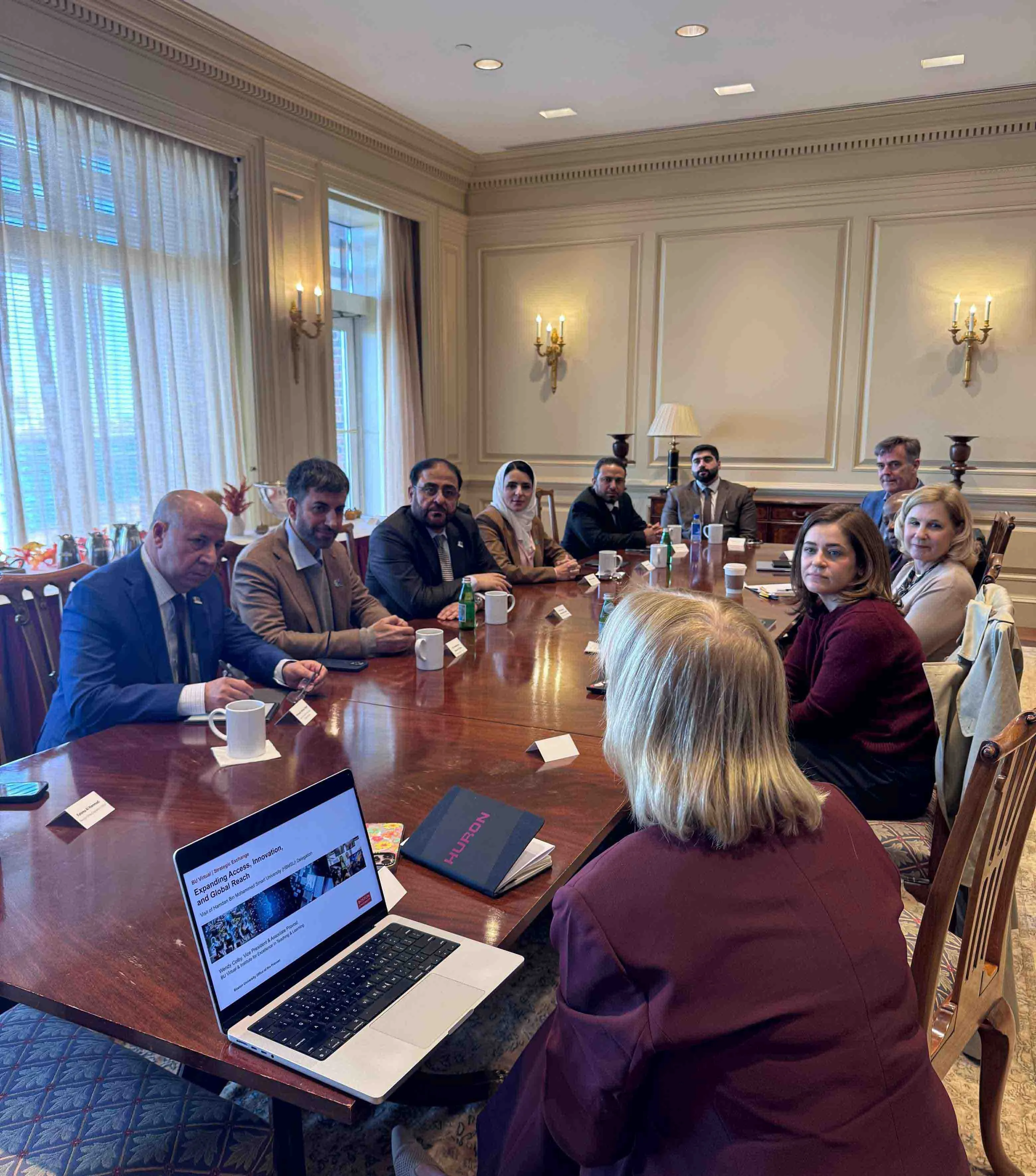
Join the waiting list. Earn A delegation from Hamdan Bin Mohammed Smart University (HBMSU), led by H.E. Dr. Mansoor Al Awar, Chancellor of the University, concluded a strategic visit to Boston, United States, visiting Harvard University, the Massachusetts Institute of Technology (MIT), and Boston University. The visit aimed to draw on the experiences of these globally renowned academic institutions in diversifying revenue streams, managing university endowments and investments, and strengthening governance frameworks and financial sustainability. The visit formed part of HBMSU's efforts to enhance its long-term financial and institutional resilience by studying established international models for managing and growing resources and developing sustainable funding streams that support education, scientific research, and innovation. During the visit, the delegation held direct meetings with officials responsible for university endowments and investments at the three institutions. Discussions explored different approaches to resource management, governance and oversight mechanisms, risk management practices, and the relationship between investment policies and academic and research priorities. The HBMSU delegation also conducted a comparative assessment of the three institutions' experiences to develop findings and recommendations to be submitted to the University's Board of Trustees for consideration in developing an institutional model aligned with HBMSU's unique characteristics and future aspirations. Al Awar: We Went to Boston to Learn from the Experiences of Established Academic Institutions Dr. Mansoor Al Awar emphasized that the visit was driven by a firm belief that institutional learning is just as important as academic learning, and that universities, regardless of their expertise in particular fields, must remain open to learning from the experiences of others. Al Awar stated:“We went to Boston to learn from the experiences of three distinguished academic institutions with extensive expertise in building sustainable educational, research, and institutional ecosystems. Our objective was not to identify a ready-made model to replicate at our university, but rather to understand the principles underpinning these experiences, how their financial and governance systems have evolved over time, and what lessons we can draw from them in ways that align with our circumstances and ambitions.” He added:“We focused particularly on university endowments, investments, and revenue diversification because we recognize that a university's future depends not only on the quality of its academic programs, but also on its ability to secure the resources needed to sustain development and innovation and respond to economic changes with confidence and flexibility.” Al Awar explained that the three universities offer distinct institutional experiences worthy of examination, not merely in terms of the scale of their resources, but also in how those resources are managed, the governance structures guiding investment and expenditure decisions, and the mechanisms used to ensure financial sustainability across generations. He said:“One of the most important lessons we seek to draw from these experiences is that financial sustainability cannot be achieved simply by securing additional resources. It requires building an integrated system that combines revenue diversification, financial discipline, sound governance, risk management, and long-term planning capabilities.” He added:“A university endowment is not merely an additional source of funding; it represents a long-term institutional commitment that requires clearly defined objectives and responsibilities, transparent management, and a balance between preserving and growing assets while directing their returns toward supporting the University's mission.” Three Universities, Three Institutional Models Worth Examining: The visit included a series of meetings with academic and administrative leaders and officials at the three institutions to gain insights into their experiences and different approaches to achieving institutional sustainability. At Harvard University, the delegation held meetings at the Harvard Kennedy School, focusing on institutional governance, leadership development, and the management of research centers. Discussions also addressed university endowment and investment management, highlighting the importance of clearly aligning financial decisions with academic priorities. At the Massachusetts Institute of Technology (MIT), the delegation explored the Institute's experience in innovation, scientific research, and entrepreneurship. Discussions with relevant officials addressed investments, financial sustainability, and the role of diversified activities and partnerships in supporting the academic and research ecosystem. The visit also included a tour of the MIT Media Lab, an interdisciplinary research environment that brings together technology, design, and science to explore innovative solutions to future challenges. At Boston University, meetings included discussions with officials responsible for university endowments and investments. The delegation also explored the University's approach to advancing virtual education through its BU Virtual initiative and visited the Center for Computing & Data Sciences and the virtual learning studio. These engagements provided the delegation with an opportunity to compare different institutional approaches to financial resource management, revenue diversification, and investment governance, while assessing the relevance of these practices to HBMSU's strategic direction. From Institutional Benchmarking to Recommendations for the Board of Trustees: Al Awar explained that HBMSU will draw on the findings of the meetings and comparative assessments conducted during the visit to formulate strategic directions and recommendations for presentation to the Board of Trustees, to inform the development of a more diversified and sustainable funding framework. He stated:“We are not seeking to replicate the models of Harvard, MIT, or Boston University. Each institution has its own history, characteristics, and legislative and economic environment. What we want is to understand why these models have succeeded, how they are managed, and which principles can be adapted to meet our university's needs.” He added:“For us, revenue diversification is not a financial objective separate from the University's mission. Rather, it is a means of safeguarding that mission, strengthening our ability to invest in the advancement of education, scientific research, and innovation, and reducing dependence on a limited number of funding sources.” He noted that the institutional benchmarking exercise will support the assessment of various options, including developing non-traditional revenue streams, leveraging endowments and long-term investments, and strengthening partnerships, with particular emphasis on governance, accountability, and risk management. Al Awar stressed that any future direction in this area must be based on a thorough assessment of feasibility and institutional suitability, comply with applicable legislative and regulatory frameworks, and maintain an appropriate balance between financial sustainability and the University's academic mission. Exchange of Expertise in Smart Learning and Artificial Intelligence: Alongside the visit's primary focus, the meetings provided opportunities to exchange knowledge and perspectives on the future of higher education, artificial intelligence, digital learning, and innovation in teaching and assessment methodologies. The HBMSU delegation presented the University's experience in smart and flexible learning, as well as its strategic direction toward advancing adaptive learning and leveraging artificial intelligence to enhance the educational experience. Al Awar noted that these discussions demonstrated the importance of knowledge exchange among academic institutions, regardless of differences in their history, scale, or educational models. He stated:“We were pleased by the interest shown in our smart learning experience by those we met, but we were equally committed to listening and learning. Progress in one field does not eliminate the need to learn in others. Openness to the experiences of established institutions is one of the most important drivers of institutional development.” He added:“Genuine knowledge exchange is not about demonstrating the superiority of one institution over another. It is about recognizing that every institution possesses knowledge and experience from which others can benefit.” Financial Sustainability Is Essential to Sustaining Innovation: At the conclusion of the visit, Dr. Mansoor Al Awar emphasized that the rapid transformations taking place in higher education require universities to reconsider not only their educational models, but also their financial, administrative, and governance frameworks. He stated:“Our experience in smart learning has taught us that innovation is not achieved simply by introducing technology, but by fundamentally rethinking the model itself. Today, we need to apply the same philosophy to resource management and financial sustainability.” He added:“Building a university capable of keeping pace with the future requires more than an ambitious academic vision. It requires an institutional and financial model that can translate this vision into a sustainable reality and preserve the University's capacity for development across generations.” Al Awar concluded:“We return from Boston with a deeper appreciation of the wealth of expertise accumulated by these distinguished academic institutions, and with an even stronger conviction that learning from their experiences can help us make more informed and mature decisions about our university's future. We will work to translate what we have learned into studies and recommendations that can be reviewed and evaluated by the Board of Trustees.” He reaffirmed:“A university that believes in lifelong learning must itself be an institution that never stops learning.”
Legal Disclaimer:
MENAFN provides the
information “as is” without warranty of any kind. We do not accept any
responsibility or liability for the accuracy, content, images, videos,
licenses, completeness, legality, or reliability of the information
contained in this article. If you have any complaints or copyright issues
related to this article, kindly contact the provider above.


Comments
No comment