


Pierangelo Tieri: Between Urban Silence, Memory, And The Poetry Of Nature


Having studied at the Academies of Fine Arts in Frosinone and Naples, Tieri developed a distinctive artistic practice centered on woodcut printmaking. Combining traditional techniques with large-scale compositions and thoughtful explorations of color, texture, and space, he creates works that invite viewers to slow down and look beyond the familiar. In this conversation, we explore his artistic journey, his approach to printmaking, the themes of isolation and memory that shape his work, and the evolving relationship between his urban and natural landscapes.
The Artistic JourneyYou have explored different forms of visual expression before making woodcut printmaking a central part of your practice. How did your artistic journey begin, and what drew you to this technique?
I studied at the Academies of Fine Arts in Frosinone and Naples. Initially, I found myself divided between sculpture and drawing, until I discovered woodcut printmaking as an ideal synthesis of both: the material presence of wood in sculpture and the expressive tension of the graphic line.
Later, photography and my experience with painterly drawing helped develop and refine my interest in wood engraving. For me, this practice represents both a destination and a journey, while simultaneously opening the beginning of a new vision.
My artistic research is rooted in the anti-naturalistic and anti-academic traditions of the twentieth-century avant-garde, from Post-Impressionism to Expressionism, reinterpreting their languages in an original and independent way, as several art critics have noted.
The Language of Woodcut PrintmakingYour large-scale woodcuts combine intricate carving, layered textures, and carefully balanced compositions. What interests you most about working with wood, and how do the inking and printing processes influence the final image?
I work with large formats in woodcut printmaking because they give me greater freedom and room to develop my graphic language.
I am particularly interested in the dialogue between the decisive gesture of carving and the response of the woodblock itself. Every grain of the wood and even the smallest incision contribute to the printed image.
Inking brings out the textures and tonal contrasts, while the pressure and printing method, whether using a baren or a press, influence the quality and distribution of marks on the paper.
It is through this process that the composition fully takes shape. When the sheet is lifted from the block, the final print reveals itself, sometimes even surprising the artist.
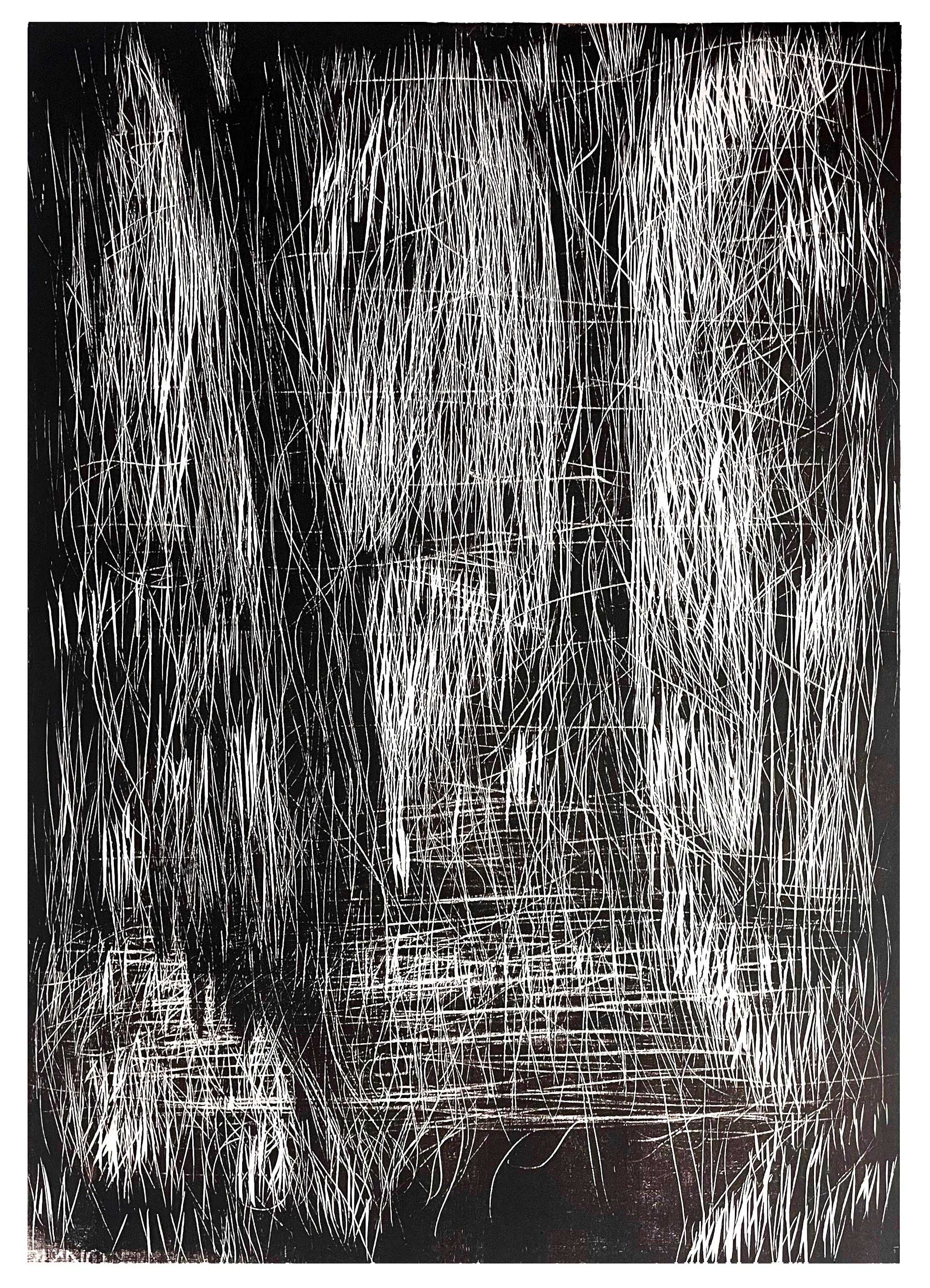
“Reflected Trees”, 2026, woodcut, 70×50 cm
Railway stations, trains, urban landscapes, and solitary figures frequently appear in your work. What draws you to these subjects, and what do they reveal about contemporary life?
I seek to transform familiar places and scenes of urban life into images that encourage broader reflection, because I see them as mirrors of our liquid modernity.
In railway stations and trains, individuals seem to shed their personal roles and become anonymous presences, shaped by loneliness, transience, and utilitarian relationships.
I want to capture movement within a silent moment, such as a platform illuminated by artificial light, creating a space of suspension and reflection.
Viewers may recognize their own vulnerability in these scenes and question how modernity shapes and empties us at an ever-increasing pace. Otherwise, under the weight of homogenization, we risk remaining dramatically alone, without memory or soul.
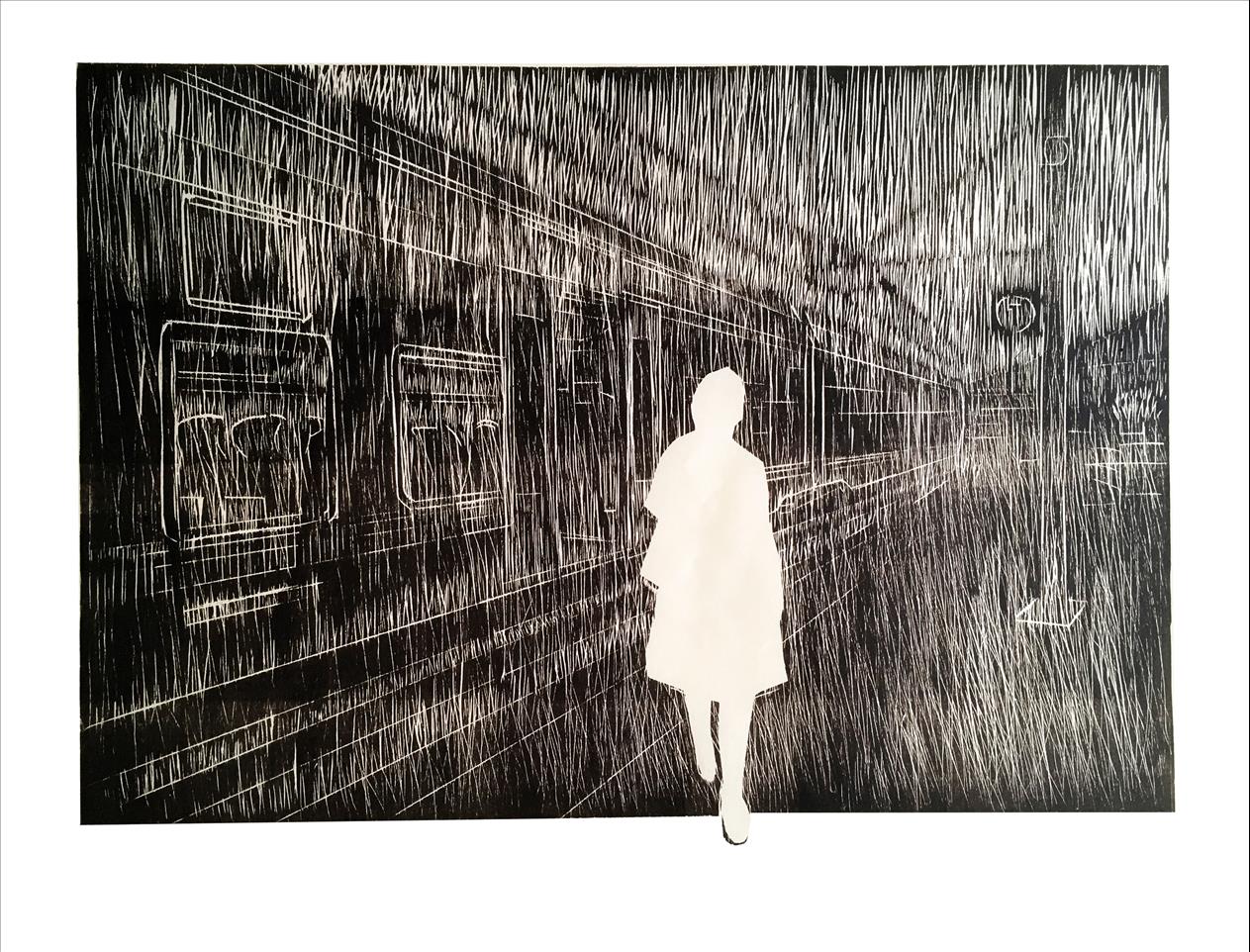
“Through”, 2020, woodcut, 50×70 cm
Many of your works convey a sense of stillness, distance, or solitude, even when depicting places associated with movement. What interests you about this contrast, and how do you use space and light to express it?
In metropolitan environments, I am interested in the contrast between the frenzy of physical movement and the emotional immobility that results from it.
Although these spaces are designed to connect routes and functions, they often create a relationship between individuals and places rather than between the people passing through them.
For this reason, my works do not simply depict transit locations. I transform them into impersonal spaces without a clearly defined identity.
Through the stillness of these scenes, I create a suspended and unsettling atmosphere that invites viewers to slow down their gaze and experience the artwork through the lens of their own memories.
Your approach combines the traditional art of woodcut printmaking with experimentation in scale, color, and composition. How do you balance respect for this historical technique with the desire to explore new artistic possibilities?
My practice originates in the tradition of woodcut printmaking, which I consider a starting point for exploring new forms of expression.
I work with large formats and modular compositions, often arranged as diptychs and polyptychs, while experimenting with unusual color fields.
This balance operates on two levels. On one hand, I maintain a rigorous respect for traditional techniques: preparing the woodblock, carving the relief, and applying ink with great care. On the other, I use this discipline as expressive material to reinvent, exploring contemporary themes such as alienation and the transformation of human relationships brought about by technology.
Ultimately, I do not see tradition as a boundary, but as a laboratory. Woodcut printmaking thus becomes a space for generating new images and creating a dialogue between the past and the present, one that can speak directly to our time.
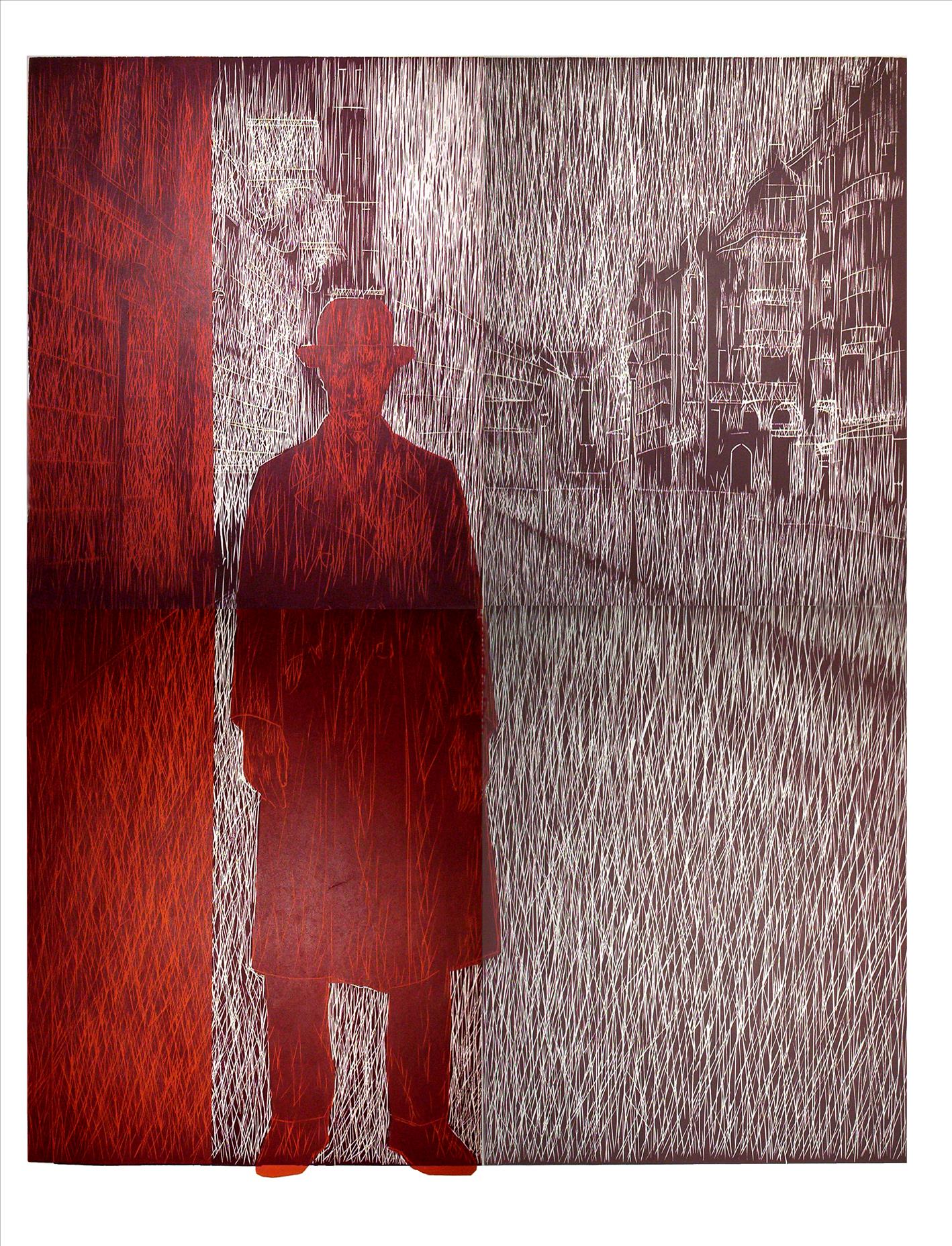
“The Solitary Man”, 2005, colour woodcut, 200×140 cm (polittico)
You often explore the emotional distance between people in contemporary society. What role do you believe art can play in encouraging empathy, solidarity, and meaningful human connections?
It is always difficult, if not impossible, to identify the original source of a guiding principle in one's creative practice. However, I can trace mine to both my inner experiences and my daily observations of social phenomena.
The contemporary world is filled with countless messages, yet it often seems to lack genuine communication. We are increasingly connected through technology, but frequently more distant from one another emotionally.
It is as though human beings, having lost touch with their inner selves, are searching for increasingly immediate and superficial emotions.
In this sense, the idea of the“loss of the soul” is one of the central themes of my artistic research.
I believe that the emptiness present in my works is not merely an aesthetic choice, but also a diagnosis. It represents a psychological void, reflecting the loss of inner life and the difficulty of building deep relationships. It also represents a social void, revealing the erosion of community bonds and the growing fragmentation of individual lives.
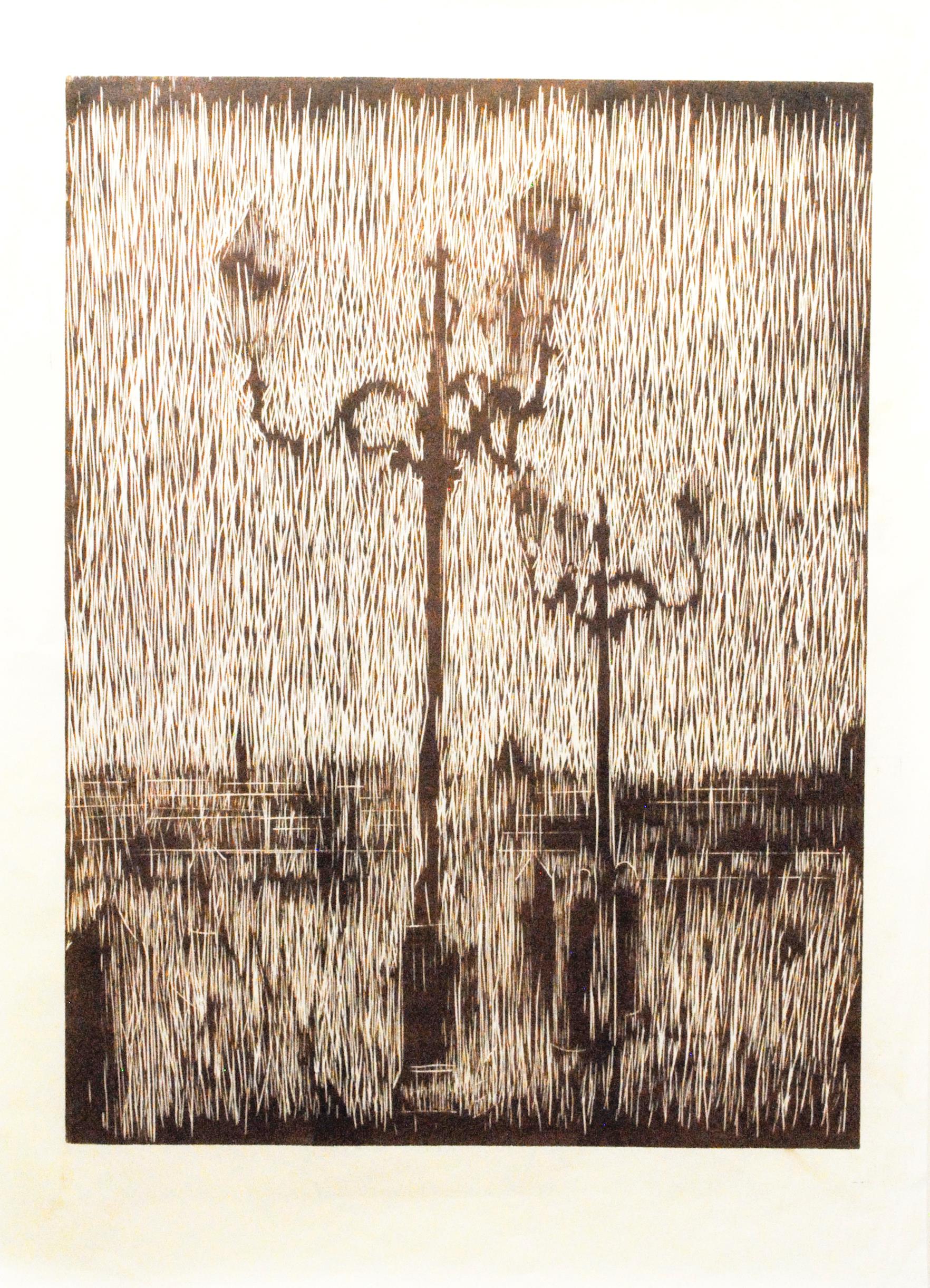
“Street Lamps”, 2016, woodcut, 100×70 cm
Your work has been exhibited in Italy and abroad, reaching audiences from different cultural backgrounds. What does it mean to see your art interpreted by people whose experiences may differ greatly from your own?
Seeing my works exhibited in different places and received by audiences from diverse backgrounds confirms my belief that art is a journey capable of crossing the borders of its country of origin.
Just as artistic prints once circulated between Europe and Japan, anticipating an early form of globalization, my images also become objects of exchange and comparison.
Every exhibition is an opportunity for enrichment through encounters with different sensibilities and cultures. In this way, a dialogue emerges that continues the history of original printmaking and artistic cross-pollination, a tradition in which I feel deeply involved.
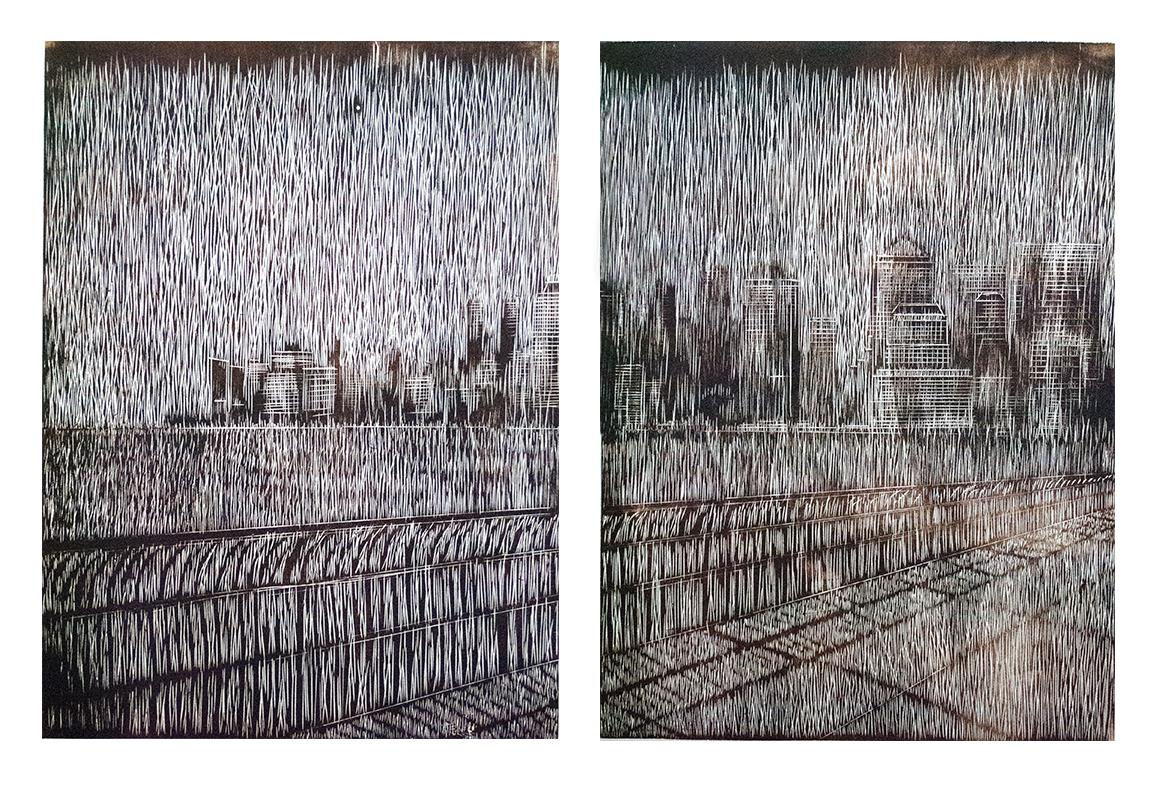
“Manhattan”, 2015, woodcut, 100×140 cm (dittico)
Your more recent works explore trees, forests, and the subtle interplay of light and shadow. What continues to evolve in your artistic practice, and what would you like to explore further?
In my recent works featuring natural subjects, characterized by a transformed and poetic form of realism, I explore the expressive power of nature and the dialogue between light, forms, and landscape.
This research does not represent a departure from my earlier urban works, but rather their continuation, opening up new technical possibilities through subtle interplay of light and shadow.
I continue to question the relationship between human beings and the places they inhabit, as well as their connection with both natural and built environments, using images as a means of reflection.
“Rome”, 2017, woodcut, 100×70 cm
Pierangelo Tieri's work invites us to reconsider the spaces we move through every day and the emotions we often leave unexamined. Through the tactile language of woodcut printmaking, he transforms familiar environments into contemplative images, exploring the tension between movement and stillness, connection and isolation, memory and change.
Whether depicting an illuminated railway platform or the delicate forms of trees and forests, Tieri remains interested in the relationship between people and the world around them. His evolving practice demonstrates how a traditional artistic technique can continue to open new perspectives on contemporary life.
Discover more of Pierangelo Tieri's artworks and artistic practice on website:

Legal Disclaimer:
MENAFN provides the
information “as is” without warranty of any kind. We do not accept any
responsibility or liability for the accuracy, content, images, videos,
licenses, completeness, legality, or reliability of the information
contained in this article. If you have any complaints or copyright issues
related to this article, kindly contact the provider above.


Comments
No comment