


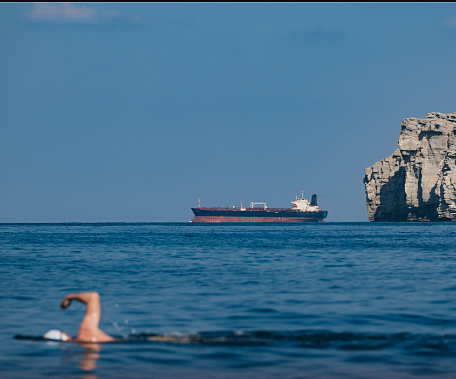
Watch: UK Man Completes 3-Day Swim In Hormuz To Highlight War's Environmental Toll


Beyond the human suffering and material destruction caused by the US-Iran war, another casualty often goes overlooked: the environment. In an effort to draw global attention to the impact of the conflict on nature, British endurance swimmer Lewis Pugh has completed a gruelling three-day swim across the Strait of Hormuz.
Recommended For YouHormuz is a vital waterway which falls within the territorial waters of both Iran and Oman, connecting the Arabian Gulf to the Gulf of Oman. The narrow channel is about 21 nautical miles (39km) wide at the narrowest point, between the Omani Musandam Peninsula and Iran. Since US-Israeli strikes on Iran in February launched the Middle East war, Tehran has sought to restrict passage through the strategic waterway, and regularly targets ships that transit without its authorisation.
To raise awareness on the importance of preserving nature in the area, Pugh, who is the first UN patron of the oceans, started his journey from the Musandam peninsula, on the southern tip of the strait, and ended by rounding the Cape of Hormuz, completing about 15 kilometers (9.3 miles) in total, according to media reports. Wearing swimming trunks, goggles and a cap bearing the UN logo, the 56-year-old completed the challenging swim in sections, despite the dangers posed by the ongoing conflict.
Stay up to date with the latest news. Follow KT on WhatsApp Channels.
"I have just completed a three-day swim through the Strait of Hormuz to draw attention to the devastating environmental consequences of war," the British swimmer said in a post on his Instagram account.
Recounting the dangers he faced along the way, Pugh said: "Just 30 minutes after I began swimming, an oil tanker was struck a few kilometres away. The explosions rocked the sea around me. Over the following days, I witnessed further attacks on commercial shipping and saw vessels engulfed in flames." He also shared a video of his swim, where he can be seen swimming as plumes of smoke rise from ships not so far from him. Watch this video:
Marine life at Hormuz
Beyond its importance as a global shipping route, the Strait of Hormuz is also home to a rich marine ecosystem. Its waters connect the deeper, cooler Gulf of Oman with the shallower, warmer Arabian Gulf, supporting a variety of marine species and habitats.
Nutrient‐rich currents passing through the strait sustain plankton blooms, coral reefs, and seagrass beds that underpin the region's marine life. Whale sharks migrate through these waters seasonally, the International Fund for Animal Welfare (Ifaw) said in a May report. Indo‐Pacific dolphins are resident year-round.
And there is the Arabian Sea Humpback whale. This critically endangered population is unique-non‐migratory and almost entirely confined to the Arabian Sea and Gulf region. Scientists estimate that around 100 individuals remain.
Alongside them live roughly 7,000 dugongs, animals that depend entirely on healthy seagrass beds for survival. "For both species, the Strait of Hormuz is not just a transit zone, it is essential habitat. They have nowhere else to go," Ifaw said.
'Open the Strait'
Acknowledging the immense human suffering caused by the war, Pugh said there was another casualty that received far too little attention: nature itself.
"The Strait of Hormuz is one of the most beautiful places I have ever visited. Towering mountains rise above spectacular fjords. There are coral reefs and mangrove forests, and waters home to dolphins, sea turtles and dugongs. It is one of the great natural wonders of the world.
Yet this extraordinary place is now caught in the middle of a war. Oil tankers, gas carriers and other merchant ships are being attacked. The environmental consequences will last for decades."
British endurance swimmer Lewis Pugh
Pugh's previous feats
In 2023, Pugh completed a 315-mile (500-kilometer) journey down New York's Hudson River, highlighting its successful decades-long cleanup as a beacon for other waterways.
"Fifty years ago, this was one of the most polluted rivers in the whole world," said Pugh. "We need to have clean, healthy rivers," he told reporters after completing the unassisted trip from the Hudson's mountain source all the way down to New York City.
He said that in New York's industrial past, the river would sometimes change colour from day to day, depending on what dyes and other pollutants were dumped or ran off.
But after decades of action to clean up pollution, Pugh was able to safely swim down the river, a month-long feat he said will hopefully inspire others.
"They're going to be inspired by what happened here and say to themselves: 'If they can do that in the Hudson, surely we can do it in our river and our river can also be saved,'" he said.
Pugh has previously undertaken high-profile swims in Antarctica, the North Pole and the Red Sea to advocate for rivers clean enough to swim and fish in safely.
(With inputs from AFP)
ALSO READ- Commentary: Fixing Hormuz will take more than conventional maritime security Oman rescues 25 from burning ship; Iran halts tankers Oman reviews progress on dealing with grounding of oil tanker, handling cargo 'All hands on deck': UAE firms race to help contain coastal oil spill

Legal Disclaimer:
MENAFN provides the
information “as is” without warranty of any kind. We do not accept any
responsibility or liability for the accuracy, content, images, videos,
licenses, completeness, legality, or reliability of the information
contained in this article. If you have any complaints or copyright issues
related to this article, kindly contact the provider above.


Comments
No comment