


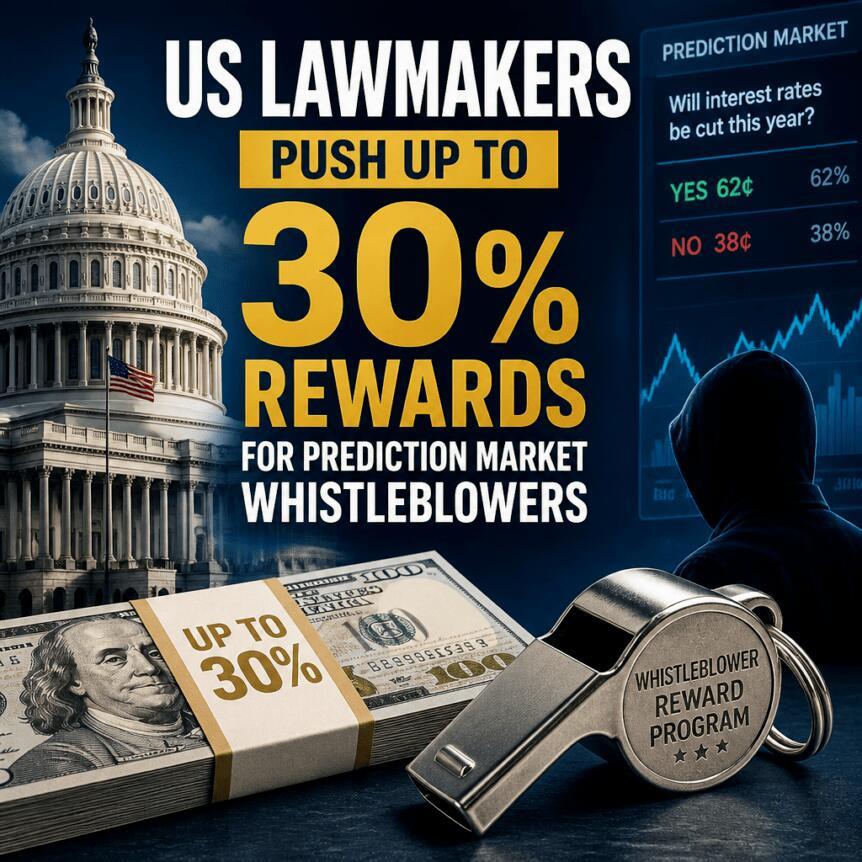
US Lawmakers Push Up To 30% Rewards For Prediction Market Whistleblowers


On Friday, Democratic Representatives Sean Casten and Ted Lieu announced the Policing Insider Trading in Prediction Markets Act of 2026. If enacted, the measure would create a DOJ program that pays rewards from the DOJ's Assets Forfeiture Fund when enforcement actions involve qualifying fraud connected to prediction market platforms and the resulting sanctions exceed $1 million.
Key takeaways- The bill would allow whistleblower rewards of 10% to 30% of monetary sanctions in covered federal prediction market fraud cases. Payouts would be funded through the DOJ's Assets Forfeiture Fund and capped at a percentage tier set by the Attorney General. Rewards would only apply when sanctions exceed $1 million, aiming to focus incentives on major enforcement outcomes. The proposal would permit anonymous submissions via attorneys and would bar employer retaliation against whistleblowers. The effort aligns with broader congressional moves to restrict certain types of prediction market contracts tied to sensitive real-world events.
Under the Casten–Lieu proposal, whistleblowers would be eligible for awards in cases involving“covered federal fraud” tied to prediction market platforms. The legislation sets a threshold for the size of sanctions: only cases where monetary sanctions exceed $1 million would qualify for rewards.
Rather than guaranteeing a fixed payout, the bill would leave key details to the Attorney General. The Attorney General would determine reward amounts based on the significance of the whistleblower's information and the degree to which the assistance helped resolve enforcement actions. The legislation also proposes anonymous tips, provided they are submitted through legal representatives.
To reduce disincentives for potential informants, the bill would also include anti-retaliation protections, preventing employers from taking adverse action against whistleblowers who participate under the program.
Why Congress is focusing on prediction market insider tradingCasten and Lieu framed the bill around concerns that government insiders could benefit from nonpublic information-particularly when markets speculate on events that directly implicate national security and public policy. The lawmakers pointed to the risk of officials profiting from bets related to matters such as military operations and presidential speeches.
The announcement specifically references the broader ecosystem of prediction platforms where such bets may be traded, including platforms named in ongoing political and enforcement debates such as Kalshi and Polymarket. While the bill is structured around enforcement actions and fraud cases, its stated purpose reflects a wider push to ensure that participants in prediction markets do not gain an unfair advantage from access to confidential government information.
Legislative momentum: from Senate restrictions to new anti-insider-trading toolsThe whistleblower bill arrives as prediction markets face increasing scrutiny in Congress. According to the announcement, the proposal follows Senate passage of the DEATH BETS Act on Thursday. That Senate measure would prohibit federally regulated prediction markets from offering contracts tied to war, assassination, terrorism, and death.
In other words, the Casten–Lieu bill addresses a different-but related-problem. Where the DEATH BETS Act is designed to limit certain categories of contracts, the new whistleblower proposal aims to strengthen enforcement against trading conduct that may rely on improper access to information. Together, the legislative direction suggests lawmakers are trying to reduce both the range of allowable prediction bets and the incentives for insider-driven misconduct.
There has also been prior congressional activity aimed at insider trading concerns. In March, lawmakers introduced separate legislation intended to prevent officials from using nonpublic information to trade prediction market contracts, as coverage from Cointelegraph noted in a prior report. In May, House lawmakers sought records from Kalshi and Polymarket over suspected insider trading tied to military actions, which Cointelegraph previously covered.
What to watch next for investors and market participantsIf the Policing Insider Trading in Prediction Markets Act of 2026 advances, it could change how participants assess legal risk around prediction market trading-especially for anyone who may interact with sensitive information through their role. The bill's reward structure is designed to increase the flow of reporting to prosecutors, potentially making enforcement more aggressive and more frequent where monetary sanctions are substantial.
Still, important details remain tied to future implementation. The Attorney General would decide payout amounts based on“significance” and assistance, which means outcomes could vary case by case. Market participants and platform operators should also monitor how anonymity through attorneys is handled and how anti-retaliation protections are interpreted in practice.
For now, the most immediate signal is congressional intent: lawmakers appear determined to pair contract restrictions in sensitive domains with tougher mechanisms to detect and deter insider-linked conduct. Readers should watch whether the bill gains support in the House and Senate, and whether related oversight and investigations around prediction platforms lead to enforcement actions that could meet the proposed $1 million sanctions threshold.
Risk & affiliate notice: Crypto assets are volatile and capital is at risk. This article may contain affiliate links.
Legal Disclaimer:
MENAFN provides the
information “as is” without warranty of any kind. We do not accept any
responsibility or liability for the accuracy, content, images, videos,
licenses, completeness, legality, or reliability of the information
contained in this article. If you have any complaints or copyright issues
related to this article, kindly contact the provider above.


Comments
No comment