


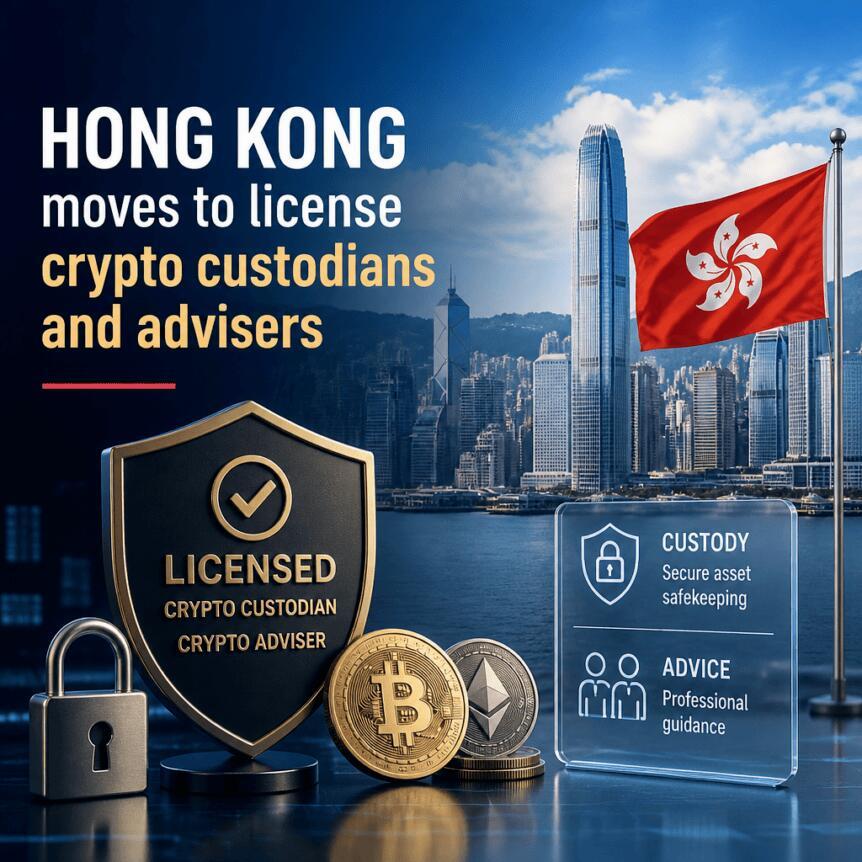
Hong Kong Moves To License Crypto Custodians And Advisers


According to Hong Kong's government, the bill-published on Friday -aims to strengthen investor protection while giving clearer boundaries for how businesses can offer services in the city's crypto ecosystem.
Key takeaways- New bill expands regulation to four virtual asset activities: dealing, advisory, management, and custody. Licensing or registration with the SFC would be required for firms providing these services. AML/CFT upgrades are proposed through amendments to Hong Kong's Anti-Money Laundering and Counter-Terrorist Financing Ordinance. Bank and stored-value providers supervised by the Hong Kong Monetary Authority would also need SFC registration to offer virtual asset services. Industry concerns remain about how the transition would work for existing businesses without adequate grace periods.
In the published legislation, the government outlines an expanded regulatory framework for virtual asset service providers. The proposal would cover firms carrying out four specific activities: virtual asset dealing, advisory, management, and custody.
Under the approach described in the bill, companies that perform these activities would either need to obtain a license or register with the SFC, depending on the activity and regulatory requirements set out in the amended framework.
Crucially, the planned scope is broader than oversight focused only on market-facing or trading-related functions. By explicitly including custody and advisory, the government is targeting areas where regulators typically worry about operational risk, client safeguards, and governance-issues that can be less visible than trading controls.
AML/CFT requirements and“fit-and-proper” checksThe bill also proposes changes to Hong Kong's AML/CFT legal framework, specifically via amendments to the Anti-Money Laundering and Counter-Terrorist Financing Ordinance. The stated intent is to apply additional compliance obligations to the newly covered service providers.
As reported in the government's published summary, providers would be subject to fit-and-proper checks and other regulatory requirements. While the details of these checks are not specified in the text provided here, the direction is clear: Hong Kong is aligning the virtual asset service regime with expectations seen in other regulated sectors, where senior management suitability and compliance controls are central to authorization.
Another important element is how regulated financial institutions would fit into the framework. Banks and stored-value facility licensees supervised by the Hong Kong Monetary Authority (HKMA) would also be required to register with the SFC in order to offer virtual asset services.
This matters for industry participants because it implies that even entities already operating under HKMA oversight would not be automatically covered for crypto service offerings. Instead, the SFC registration would act as an additional gatekeeper for virtual asset activity.
SFC oversight and investor protection goalsSFC chief executive Julia Leung described the proposal as a way to strengthen investor protections and create clearer routes for responsible innovation. The emphasis on investor safety suggests that the expanded licensing framework is designed not only to standardize compliance, but also to make it easier for clients to identify which firms are authorized to serve them.
In practice, this kind of licensing/registration structure can help reduce friction for legitimate providers while increasing accountability. It also creates a clearer compliance baseline for due diligence teams-particularly for custodians and advisory providers, where counterparty risk can be difficult for customers to assess without regulatory signals.
According to the published bill, it is scheduled for its first reading in the Legislative Council on Dec. 2. That procedural milestone will determine whether the legislation advances to detailed consideration and amendments in the Hong Kong parliamentary process.
Timeline targets-and questions about the transitionThe current publication builds on earlier signals from Hong Kong's authorities. In October, Hong Kong said it would introduce legislation covering the four activities before the end of 2026, following consultations on the proposed regulatory framework. The government's latest move indicates that the city is working toward that end goal by formalizing the bill.
However, the expanded regime has also raised implementation concerns from industry. In January, the Hong Kong Securities & Futures Professionals Association warned that implementing licensing without transitional arrangements could lead existing businesses to suspend operations while their applications are reviewed.
The association argued that companies need a six- to 12-month grace period to avoid a scenario where the new regime takes effect faster than firms can complete licensing processes. Such a gap could be disruptive, particularly for providers already operating in custody or advisory roles that require operational adjustments to meet regulatory expectations.
That debate-between the urgency of bringing activity under a tighter regulatory umbrella and the practical need for a workable transition window-may become a key focus as the bill progresses through the legislative process. Investors and users should watch for whether policymakers build in clarity on timelines, application handling, and what happens to existing providers as licensing deadlines approach.
What to watch nextWith the bill heading to its first Legislative Council reading on Dec. 2, the immediate question for market participants is whether Hong Kong will pair the expanded SFC licensing/registration requirement with a sufficient transition framework. How regulators manage existing providers' applications-and what compliance expectations look like in practice for custody and advisory-will likely shape how quickly the industry can adapt without service interruptions.
Risk & affiliate notice: Crypto assets are volatile and capital is at risk. This article may contain affiliate links.
Legal Disclaimer:
MENAFN provides the
information “as is” without warranty of any kind. We do not accept any
responsibility or liability for the accuracy, content, images, videos,
licenses, completeness, legality, or reliability of the information
contained in this article. If you have any complaints or copyright issues
related to this article, kindly contact the provider above.


Comments
No comment