


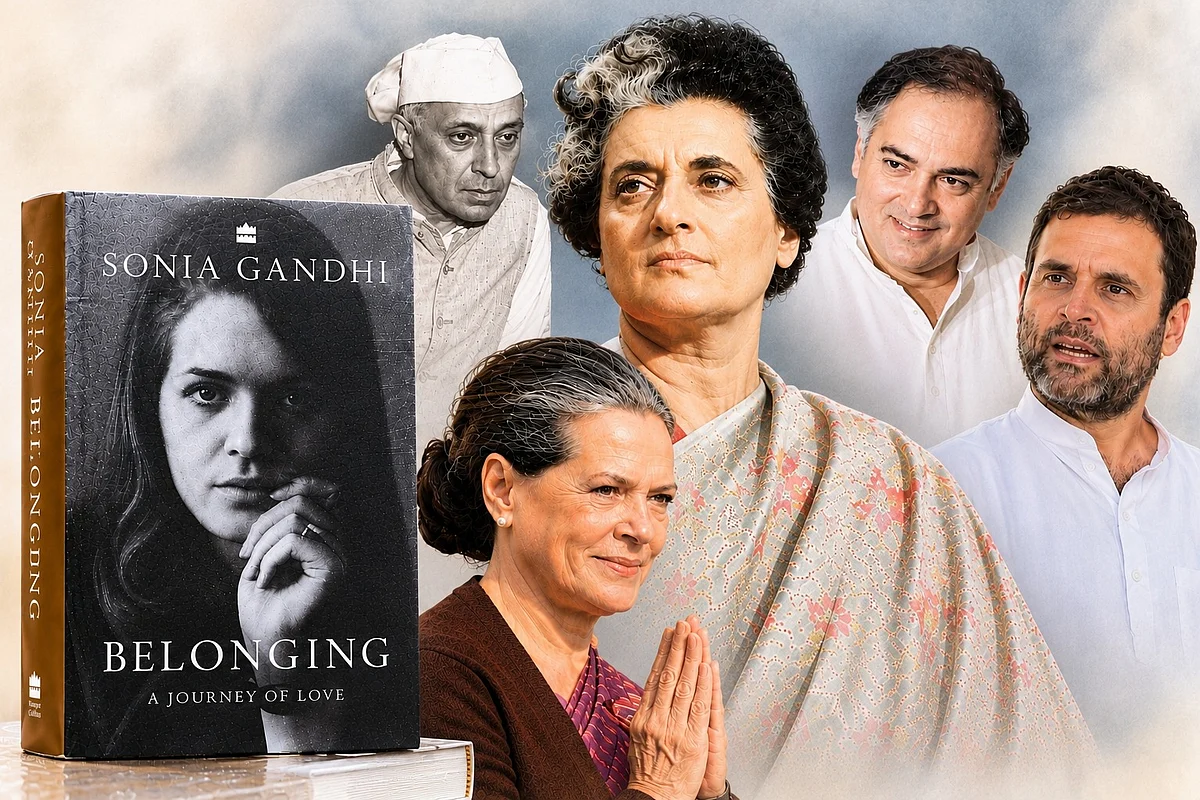
'Belonging' Review: Beyond Journey Of Love, Sonia Gandhi Reflects On Loss, Duty, Survival


But after nearly three decades in politics, Sonia, 79, born in Italy, has offered a rare glimpse into her life in her recently launched book, Belonging: A Journey of Love .
Recommended For You“So much had been written about me, they insisted, but the real person they knew was nowhere in any of those writings,” Gandhi says in the prologue.
Stay up to date with the latest news. Follow KT on WhatsApp Channels.
In the 544-page memoir, she has written about her childhood under a strict Italian father; her carefree youth, her fondness for foreign languages-she can speak French, Russian, English and Hindi; her romance with Rajiv Gandhi, the former Indian Prime Minister, while studying in Cambridge; her arrival in Delhi on a long-haul flight in 1968, the shock of being in a new country; and her eventual marriage to Rajiv.
Sonia has described her mother-in-law, the former Indian Prime Minister Indira Gandhi, and how she was initially scared of her outbursts.
She has also painstakingly described the moments when the formidable Gandhi was assassinated by her two bodyguards and how she had rushed her to a hospital covered in blood.
The chapters describing the moments when Sonia learnt about her husband being killed by a bomb are particularly moving.
The memoir revisits her reluctance to enter politics, the Congress party's electoral victories and defeats, and her continuing fears for her children, Rahul and Priyanka, both parliamentarians.
The book, published by HarperCollins in India, hit the stands on November 10 and has already become the publisher's fastest-selling book, with more than 200,000 copies sold in less than a week.
It has largely been received well by critics and book lovers for its moving prose, simple yet captivating writing, humour and, most importantly, Gandhi's frankness.
But there has also been criticism of her omissions on several politically sensitive issues.“I chose to write a personal memoir, one for which politics is the background, a kind of framework,” Sonia writes.
Childhood, romance and marriageThe book begins with a description of her husband, Rajiv, whom she met at a Greek restaurant while studying English in Cambridge in the mid-1960s. Sonia was then 19.
She has repeatedly said that she had instantly fallen in love with the“tall and handsome [man] with deep black eyes”.
The chapters then dwell on their love story, how the two youngsters met and went on dates, attended a ball, and were eventually separated during vacations when Rajiv returned to Delhi and she to her hometown of Orbassano, now a city in Italy's Turin region.
She paints a vivid picture of the place, her devoted mother, her strict father, who served in the Second World War as a sergeant major in Mussolini's army, and her two sisters, who were given foreign-sounding names by her very non-religious father.
She talks about her extended family, the nonnas and ninnas, the zias and zios, the cousins, the vacations at the beach and ski resort, and the breads, pastries and her favourite ice cream.
The details are particularly interesting because very little has been known about Gandhi, who has lived a very reserved life even after she took a plunge into politics in the 1990s.
It becomes even more gripping when she describes the time she secretly arrived in Delhi on a connecting flight from Beirut to be with Rajiv after“coming of age”, that is, when she turned 21.
After college, when the two decided to get married, it was Sonia's rational father who gave her a return ticket to India to allow her to first get accustomed to the foreign place before taking the relationship further, a radical thing to do in those times, she says, noting:“...a friendship outside family circles and with an outsider would have been frowned upon, let alone a romantic one, before marriage."
The chapters cover her excitement, anxiety and even sadness as she lands in Delhi and stays with Amit's parents-Amit later became superstar Amitabh Bachchan-although she does not disclose how the relationship later went sour.
She talks about the glares she received as a“foreigner”; the smell of spices; the hot food; and the tinned olive oil, an essential ingredient in Italian cooking, that was sold for massage in India!
Meeting Indira GandhiThe fascinating part is when she talks about her first meeting with Indira, a commanding political figure, in London in the mid-1960s. Indira spoke to Sonia in French-both were fluent in the language-and calmed her when she broke into sobs due to nervousness.
“Her big, deep eyes and long eyelashes were her most striking features, and her prominent nose,” she writes.
“Seized by nervousness and a deep emotion, I broke into tears that turned into sobs...In a gentle, comforting manner she drew me closer to her and said, 'Don't be afraid, Sonia, I'm human, I too was once young and in love-I understand you perfectly.'”
Sonia's book explores her relationship with Indira, who was known for her outbursts that often reminded her of her own father, but was also an affectionate maternal figure who helped her adapt to Indian life.
She revisits the turbulent period of 1975, when Indira imposed the Emergency-regarded as one of the darkest chapters in independent India's history-after winning the 1971 election, thanks to her pro-poor policies and military intervention to create Bangladesh. But a court had set aside the victory, finding her guilty of electoral malpractice.
More than 100,000 political opponents, trade union members, activists, dissenters, and journalists were imprisoned.
Sonia says Indira was not likely to have been in favour of the Emergency, but the decision was taken to stop the right-wing opposition from coming to power, which would have meant a threat to democracy.
“To resign at this juncture would go against her fiercely held conviction that the country had to be protected at all costs against communal and right-wing forces.”
She has recounted the harrowing moments of Indira's assassination in 1984, when she was shot dead by two of her Sikh bodyguards.
Sonia recalls hearing what sounded like“firecrackers” while preparing to take a bath, before seeing Indira being carried into a car, lying motionless, with her sari and chest covered in“blood, her eyes wide open and her face frozen”.
Rajiv Gandhi, who was until then working as a commercial pilot, was sworn in as Prime Minister the same evening, much to the objections and disappointment of Sonia, who never wanted him to join politics.
“His mother lay there, her body pierced with more than thirty bullet holes. I knew, I knew it then in my heart: Rajiv's path would lead to the same end,” she writes.
She has shed light on the controversies surrounding Rajiv's handling of the Shah Bano case, involving maintenance for a divorced Muslim woman following protests from conservative Muslim groups, and the Bofors scandal in 1987 over allegations that Rajiv's government received kickbacks to secure a 14-billion-rupee deal with Swedish arms manufacturer Bofors for the supply of howitzer guns to the Indian Army.
Rajiv was never put on trial. In February 2004, a court found no evidence that he had received bribes, effectively clearing him of criminal culpability.
Rajiv's AssassinationThe most poignant part of the book is the passage in which Sonia describes the moment her 19-year-old daughter Priyanka broke the news of her husband's death.
Rajiv was assassinated on May 21, 1991, by a suicide bomber linked to the LTTE (Liberation Tigers of Tamil Eelam) while addressing an election rally in Sriperumbudur, Tamil Nadu.
Sonia was not told that Rajiv had been blown into pieces. She could not see her husband's body, and when she demanded to donate his eyes, as he had wished, a doctor said,“Eyes? What are you talking about? There's nothing left, nothing!”
She says the doctor's bitter words had dealt her a blow that made her“sick to the stomach and want to throw up”.
“I couldn't breathe. I wanted to die. I should have gone with him.”
Political plunge and refusal of the PM postAfter the assassinations of her mother-in-law and her husband within a span of seven years, Sonia was pressured by party members to join Congress. She ignored the pleas but eventually gave in.
“Each time I walked past Rajiv's picture and my mother-in-law's, a mixture of pain and guilt would seize me; How could I...let their work and their sacrifices go in vain?”
She assumed the party's presidency in 1998. She delivered speeches in her heavily accented Hindi during election campaigning, steering the party's resounding victory against the right-wing BJP in 2004.
She has disclosed in her memoir that she never chose to become Prime Minister because neither Rahul nor Priyanka wanted her to accept the position, having witnessed two assassinations at home.
But she deliberately concealed her intentions from Congress leaders, fearing that an early announcement could trigger an internal contest for the leadership. She ultimately chose Manmohan Singh for the post.
She also rejects the longstanding claim that President APJ Abdul Kalam had prevented her from becoming prime minister because of her Italian birth.
Modi, the RSS and Congress's declineTurning to contemporary politics, Sonia offers a critical assessment of Prime Minister Narendra Modi 's rise, describing the 2014 general election as a watershed in Indian campaigning.
She acknowledges that voters were ready for change after a decade of Congress-led rule, but argues that the BJP's sophisticated publicity machinery, substantial financial resources and attacks on her party helped propel Modi to power.
Sonia reveals that despite more than a decade of Modi's premiership, the two have had virtually no meaningful personal interaction and that their interactions have largely been confined to formal greetings.
In one of the sharpest political assessments in her memoir, she has drawn an ideological distinction between her vision of India and that of Modi.
She argues that Modi's idea of the country was shaped by the ideology of the Rashtriya Swayamsevak Sangh, the ideological fountainhead of the BJP, which places its faith and culture above others and prioritises hierarchy, order and control.
She says that while Modi was fighting for his idea of India, she was fighting for an India“against hegemony” and one that stands for“inclusiveness, secularism, and social justice.”
Rahul, Priyanka and India's youthThe book also provides a mother's perspective on Rahul Gandhi's political career. Sonia recalls opposing Rajiv's entry into politics but accepting Rahul's decision to contest the 2004 election, while also expressing her fears for his and Priyanka's safety.
She describes the personal attacks directed at her son and his decision to resign as Congress president following the party's second consecutive election debacle in 2019.
Sonia attributes that defeat partly to the national security sentiment generated after the Pulwama attack, in which 40 CRPF personnel were killed in Kashmir, and India's subsequent airstrikes in Pakistan.
She takes a more hopeful view of the 2024 election, when Congress improved its parliamentary tally and the BJP lost its single-party majority, although Modi remains in power through an alliance.
She ends the memoir with a note of hope in India's younger generation, expressing confidence that they will defend the country's constitutional freedoms, resist attempts to impose uniformity and reclaim its pluralistic identity.
ALSO READ- Sonia Gandhi launches memoir, reveals why she turned down India PM post in 2004 Sonia Gandhi's autobiography to be adapted into Telugu film Sonia Gandhi recalls first meeting with Rajiv Gandhi, 1991 assassination in new memoir

Legal Disclaimer:
MENAFN provides the
information “as is” without warranty of any kind. We do not accept any
responsibility or liability for the accuracy, content, images, videos,
licenses, completeness, legality, or reliability of the information
contained in this article. If you have any complaints or copyright issues
related to this article, kindly contact the provider above.


Comments
No comment